
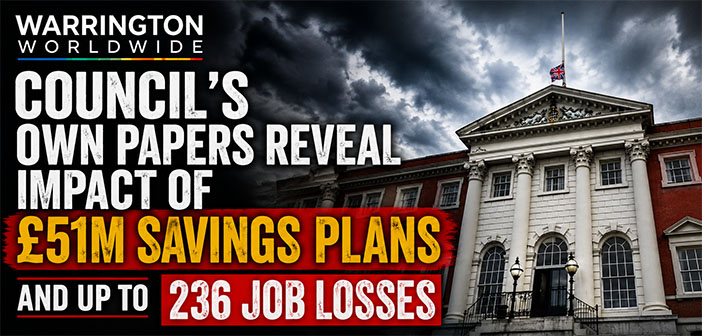
FULL details of Warrington Borough Council’s £51.2 million savings programme reveal proposed reductions to highways maintenance, environmental services, customer contact and staffing, alongside increased parking charges, changes to community facilities and up to 236 job losses.
Following on from Warrington Worldwide’s revelations last week following member briefings, the proposals are outlined in papers published ahead of the council’s Scrutiny Committee meeting on September 7, where members will examine the plans before they go to Cabinet on September 9 and Full Council on September 21.
The detail follows comments from Labour Cabinet member for finance Cllr Denis Matthews to Warrington Worldwide that the figures would have “no impact on the majority of Warrington residents” and that there would be “no change to the everyday services that most people use all the time”.
Independent Group Leader Cllr Stuart Mann, who sits on the Scrutiny Committee, had previously said he would wait for the full papers before reaching conclusions.
He says their publication now raises serious questions over those reassurances.
The council’s own assessment says proposed highways changes could result in reduced inspections and maintenance, less carriageway sweeping and weed treatment and fewer maintenance schemes.
It warns of “worsening road conditions”, an increased risk of third-party claims and a risk of injury or damage.
Environmental proposals could save £1.15m and remove around 22 FTE posts. The report warns of a “considerable impact on the ‘look of the borough’”, alongside fewer ranger-led activities, reduced support for volunteers and Friends groups, a review of Public Rights of Way inspections and “prioritised” fly-tipping removal.
Cllr Mann said: “These are the council’s own words, not mine.
“If roads are inspected and maintained less often, there is less sweeping and weed treatment and fewer people are available to deal with residents, it is difficult to see how that amounts to no change to everyday services.”
Other proposals include fewer staff working for Contact Warrington, with the report acknowledging there would initially be fewer staff available for face-to-face appointments at 1 Time Square and to answer telephone calls.
Council-owned car park charges could also rise by 10 per cent in April 2027, another 10 per cent in April 2028 and a further 10 per cent in April 2029.
Libraries, leisure services and community buildings face further review. A £2.728m proposal seeks to achieve a net-neutral cost for leisure and reduce the running costs of libraries and community centres through alternative operating models. The council acknowledges this could mean fewer community buildings being directly managed by the authority.
The scale of the potential workforce reduction has also become clearer.
The papers estimate reductions of 70 to 100 FTE posts in Adult Social Care, 76.5 in Corporate Services, 55 across Place and five in Children’s Services.
That amounts to around 206 to 236 FTE posts, before the outcome of reviews in some areas where the eventual staffing impact has not yet been determined.
Some comparatively small savings also come with significant risks identified in the council’s own assessment.
A proposal to save £30,000 by ending out-of-hours call-outs for Urban Traffic Management and Control faults warns of an increased risk of road traffic collisions because faults occurring outside office hours would not be attended to until the following day.
A proposed £1.6m reduction in the IT budget could mean an increased chance of disruption to digital services, more system and network downtime and reduced backup arrangements in the event of a cyberattack.
The proposals come at the same time as greater use of technology and digital self-service is expected to help deliver savings elsewhere across the council.
Cllr Mann said: “The question isn’t whether Warrington needs to save money. It clearly does.
“The question is whether each saving is properly evidenced and deliverable, whether the financial benefit is proportionate to the risk and whether we are being completely honest with residents about what will change.”
The papers also reveal the scale of the financial challenge that will remain even if the latest proposals are delivered.
Phase 1 savings of around £39m were approved in March, with the latest Phase 2 proposals adding £51.243m.
Despite that, the report says another £88.39m remains to be addressed over the Medium Term Financial Plan period. A further Phase 3 savings programme is due to come forward in March 2027.
There are also immediate pressures.
At Quarter 1, the council is forecasting a £20.603m adverse variance. This includes £8.661m of projected departmental overspends, £8.732m relating to transformation savings for the current year that had not been identified at budget setting and £3.210m of undelivered savings.
That is likely to form part of the challenge at Scrutiny over how much confidence can be placed in delivering another £51.243m of savings.
Cllr Mann also wants greater clarity over the distinction between genuine efficiencies and savings achieved by reducing services, increasing income or moving costs and responsibilities elsewhere.
Several proposals involve reallocating staff costs to grants or other funding, while the community buildings review could ultimately lead to alternative organisations taking on responsibilities currently held by WBC.
He said: “A cost doesn’t disappear simply because Warrington Borough Council stops paying it.
“If another organisation, parish council or community group is expected to take something on, we need to know whether they have agreed, whether they can afford it and what happens if they say no.”
The council is also proposing to add up to £5m to its Transformation Fund from service earmarked reserves to help meet the costs of delivering the savings programme, including redundancy costs and investment in digital and IT systems.
That would reduce service earmarked reserves from £12.746m to £7.746m.
Cllr Mann said the Independent Group would not oppose savings simply because they involved difficult decisions, but would expect evidence that proposals were achievable and did not create greater risks or costs elsewhere.
“Warrington has to restore financial sustainability and difficult decisions are unavoidable,” he said.
“But residents deserve to know which proposals are genuine efficiencies, which mean reduced services, which involve higher charges and which simply move a cost or responsibility somewhere else.
“When the council’s own papers talk about worsening road conditions, less maintenance, fewer people answering calls, changes to community facilities and more than 200 FTE posts potentially disappearing, it is very difficult to reconcile that with a claim that everyday services won’t change.
“That is what Scrutiny now needs to get to the bottom of.”
When approached with the findings last week, Cllr Denis Matthews said: “The figures quoted will have no impact on the majority of Warrington residents. There will be no change to the everyday services that most people use all the time. In fact, this year, the council has added a successful food waste collection service, we’re filling more potholes than ever before and we’re improving our parks and public spaces. Like all councils, most of our budget is spent on adult social care, so it’s great that our new Prime Minister has a plan to help this.”
The Scrutiny Committee will consider the Medium Term Financial Plan update on September 7 before the proposals are considered by Cabinet on September 9 and Full Council on September 21.
Details of the scrutiny papers can be found at the following link.



1 Comment
Do Cllr Matthews and the rest of them at the town hall think every day services are working and will stay the same. He needs to open his eyes and WALK round the streets around Warrington. The streets are overgrown with weeds and full of rubbish. Who is going to clean it up. Private property owners are the worst near me, very few keep their gardens done and they don’t believe in pulling weeds that grow near the doors and under windows. I can’t see the councillors being interested at all just like all labour they get paid for nothing. Sit back, have a meeting then sit down again and do nothing. Warrington is a sh…..le and All councillors should be ashamed. Matthews doesn’t care he has a job at the environment agency so he’s on a good wage anyway.