
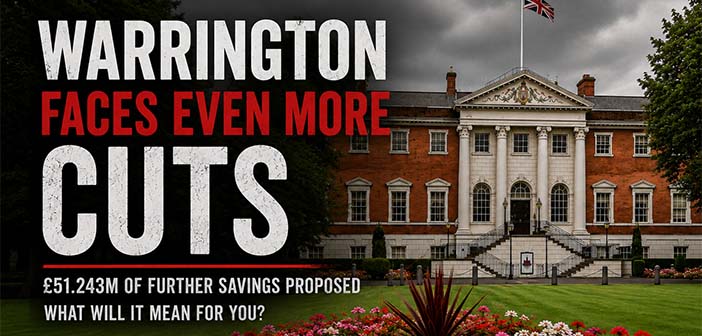
WHILE Warrington Borough Council is proposing a further £51.2m in savings which officers openly acknowledge will fundamentally change the services residents receive – the council’s finance chief says the majority of residents will not be impacted.
This is despite potentially hundreds of jobs being affected and major reductions in council activity stretching through to 2029/30.
The scale of the financial crisis facing Warrington is laid bare in the council’s latest Phase 2 Savings and Future Council Programme with social care taking the biggest hit – although the council’s Cabinet member for Finance, Cllr Denis Matthews, says new Prime Minister Andy Burnham has a plan to fix this.
The £51.243m savings package comes on top of around £39.274m of Phase 1 savings, while the council says its overall financial requirement to 2029/30 is approximately £178.9m.
In other words, even after Phase 1 and Phase 2, the authority still faces a massive financial challenge.
The council’s own report makes the stark admission that Warrington is moving towards “a smaller council with a fundamentally different operating model.”
That means fewer staff, greater use of digital services and automation, reduced subsidies, higher income generation, rationalisation of council property and assets – and greater reliance on communities and other organisations.
And perhaps most significantly, officers have acknowledged that some service standards will reduce. They have not attempted to suggest that £51m can be removed without residents noticing.
Adult social care takes the biggest hit
By far the largest element of the package falls on Adult Services, with £34m of savings – around two-thirds of the entire Phase 2 programme.
The proposals include reviewing high-cost care packages, reducing reliance on residential and nursing care, increasing auditing and supporting more people to remain at home. But the scale of the proposed workforce reduction is particularly striking.
Warrington’s Adult Social Care workforce is understood to number around 500 people, with the briefing indicating that approximately 70–100 posts could be lost.
The council says it will simplify processes, use more technology, reduce management layers and reduce staffing. That comes against a background in which the council’s own 2025/26 outturn recorded a £26.364m overspend in the People Directorate, with the authority citing demand, inflation and historic underfunding in Adult Social Care.
The question facing councillors is therefore whether the £34m represents genuine efficiency – or whether a significant proportion ultimately depends upon people receiving less intensive support or fewer people entering care.
Services residents can see will also be hit
The Place Directorate faces £9.51m of savings, representing more than 30 per cent of its net budget.
This is where residents could see some of the most obvious changes.
Proposals include:
1. Longer intervals between some highway inspections
2. Reduced highway maintenance
3. Reduced carriageway sweeping
4. Reduced weed treatment
5. Staffing reductions in environmental services
6. Changes affecting parks, open spaces, rangers, trees and nature reserves
7. Reduced public protection and enforcement capacity
8. Further parking charge increases
The council has specifically discussed reducing weed treatment from around three treatments a year to two.
These are not theoretical efficiencies. They are visible reductions in services.
Parking charges could rise by around 10 per cent a year as motorists aface further increases.
The council has already announced a parking increase of around six per cent, but officers confirmed that the Phase 2 proposal is additional.
The emerging assumption discussed at the briefing was approximately 10 per cent per year for three years, although officers clarified that residents would not face the recent increase and another full increase in the same financial year.
The direction of travel, however, is unmistakable: parking is expected to generate more money for the council.
Libraries, leisure and community facilities under pressure
Leisure, libraries, community centres and culture are expected to deliver £3.131m in savings.
The council wants leisure and community provision to move towards a zero-subsidy or financially sustainable model, while also reducing expenditure on libraries and cultural provision.
But there is a major unanswered question.
The council’s proposed “neighbourhood model” – under which residents, councillors, voluntary organisations, community groups and partner agencies could take a greater role – has not yet been finalised.
That means some of the savings being presented to councillors depend upon a model that is still being designed.
The report says councillors still need to be told what the £3.131m saving means building by building – including which facilities could close, reduce hours, transfer to community operation or require financial support from communities.
Enforcement could be scaled back
One of the most worrying areas raised during the member briefing was enforcement.
Concerns were raised about the increasing use of the phrase “not expedient to pursue” in enforcement cases. Officers did not guarantee that existing enforcement levels could be maintained.
Instead, a smaller council would have to prioritise statutory responsibilities and the highest-risk cases.
The report warns that reduced enforcement could mean fewer prosecutions and enforcement actions, while residents could question the value of a system which identifies breaches but lacks the resources to act upon them.
The Public Protection and Community Safety budget faces a £859,000 saving, around 25 per cent of its net budget, with staff reductions the principal mechanism.
Council’s front door could become more digital
Contact Warrington is also facing change. The workforce will be reduced and the council is considering changes to the front-door service at 1 Time Square, including greater use of appointments, reduced unrestricted drop-in provision and greater digital self-service.
Officers acknowledged that waiting times for less urgent enquiries may increase.
While they say remaining resources will prioritise people unable to use digital services, the move raises obvious concerns about elderly and digitally excluded residents.
Waste collections are not being cut – yet
There is some good news for householders. Officers confirmed that the £882,000 waste saving does not currently involve reducing the frequency of household bin collections.
Instead, the council wants to create a single depot and waste transfer station in Warrington, reducing the need for waste vehicles to travel to Widnes to discharge waste.
However, that proposal itself requires substantial capital investment and the identification and construction of a suitable site.
Perhaps one of the most significant findings in the report is that Warrington has previously struggled to deliver the savings it has promised.
For 2025/26, the council had a savings target of £30.481m.
It actually delivered £19.479m – just 63.9 per cent of the target – leaving £11.001m unachieved.
The council’s own financial risk register reportedly describes previous savings plans as “over-ambitious and under-delivered”, with savings and transformation delivery remaining at the highest risk level shown.
The risk register also warns that failure to deliver the required savings could ultimately result in a Section 114 notice.
That makes the £51m headline figure far from guaranteed. Only £1.4m arrives in the first year.
The majority of the £51.243m saving is also some way into the future.
The programme is currently phased as:
2026/27 – £1.426m
2027/28 – £13.972m
2028/29 – £16.104m
2029/30 – £19.741m
That means the overwhelming majority of the savings – and therefore the disruption associated with delivering them – lies ahead.
Council still needs to find tens of millions more
The £51.243m programme is only one part of the solution.
The overall financial requirement identified to 2029/30 is approximately £178.899m.
Phase 1 accounts for £39.274m and Phase 2 for £51.243m, leaving approximately £88.382m identified as the Phase 3 or remaining requirement.
The council is also examining its investment and debt strategy.
A major review is expected later this year, with officers suggesting that this could potentially generate £40m–£60m in savings.
But that figure is currently only an indicative expectation – not an agreed saving.
The real question: what kind of council will remain?
The council’s financial problems did not begin with this £51m package.
The report shows that the authority had already identified £15.9m of savings in its 2024/25 budget. It then set a £30.481m savings target for 2025/26 but delivered only £19.479m.
The 2026/27 budget subsequently included a further £17.092m of specific service-delivery savings plus an £8.732m transformation target.
The new £51.243m Phase 2 programme therefore comes on top of years of cuts and savings activity.
That makes the council’s assertion that Warrington is simply moving back towards the service levels of comparable authorities particularly contentious.
Initial benchmarking contained within the report presents a mixed picture.
While some areas appear to have higher spending than peer authorities, others are already below the comparator median – including libraries, highways maintenance and road safety.
The report therefore concludes that the argument that Warrington is simply eliminating historically “generous” provision cannot be applied across the board without detailed service-by-service evidence.
September will be the next big test
The formal timetable will see the Phase 2 proposals go before scrutiny on September 7, Cabinet on September 9, Full Council papers published on September 11, and Full Council meeting on September 21.
Importantly, approval of the savings programme does not necessarily constitute final approval of every individual service change. Some measures will require further consultation and separate decisions.
Councillors are being urged to demand detailed information before signing off the package – including exactly how many posts will disappear, which services will be reduced, what happens to individual facilities, the impact on statutory duties and whether savings genuinely remove costs or simply transfer them to schools, communities, families or other organisations.
The stark reality is already acknowledged by the council itself – Warrington is becoming a smaller council.
But the biggest question for residents is not how much smaller it becomes?
It is what will be left when the cuts are complete – and whether the services remaining will still be enough for the people of Warrington.
When invited to respond to the proposed cuts Cabinet member for Finance, Cllr Denis Matthews, said: “The figures quoted will have no impact on the majority of Warrington residents. There will be no change to the everyday services that most people use all the time. In fact, this year, the council has added a successful food waste collection service, we’re filling more potholes than ever before and we’re improving our parks and public spaces. Like all councils, most of our budget is spent on adult social care, so it’s great that our new Prime Minister has a plan to help this.”




4 Comments
When will the idiots that created this mess be punished. They sit there in there ivory tower making people redundant and this after they gave themselves a pat on the back and then giving themselves a wage increase
The few are paying through the nose for the people that are living here that don’t contribute a penny and never have! It’s extortion
So basically our council tax is higher than it’s ever been and because the council has played fast and loose with OUR money, we will get even less services?!! The less spraying of weeds actually made me laugh, they’re hardly doing it now, and as for cutting the grass verges etc, half the time the way they cut it looks worse than not bothering ! Why should we suffer for the mistakes and stupidity of those making “ investments” that are foolish ? This is paying through the nose for something we won’t receive, so how about emptying HMO’s and putting people in that will pay council tax like we have to?
Won’t notice any changes – well we already noticing many changes now and the future ones are outlined in this article and feeling the impact of decisions of the past.