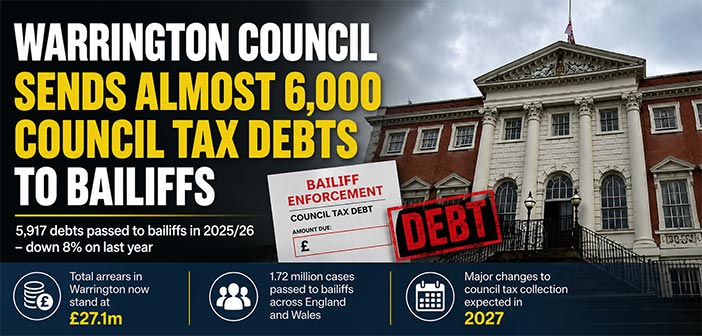
ALMOST 6,000 council tax debts were passed to bailiffs by Warrington Borough Council during the last financial year, according to new figures obtained under Freedom of Information legislation.
The data, compiled by National Debtline as part of its annual Stop the Knock campaign, shows that 5,917 Warrington council tax debts were referred for bailiff enforcement during 2025/26.
However, the figure represents an 8 per cent reduction compared with 2024/25.
The figures come as separate government data reveals that the total amount of council tax arrears owed in Warrington has risen to £27.1 million.
Nationally, council tax arrears have reached £7.4 billion, up from £6.6 billion in 2024/25.
Across England and Wales, National Debtline says 1.72 million council tax arrears cases were passed to bailiffs during 2025/26, broadly unchanged from 1.74 million the previous year.
The charity says 153 local authorities – around 48 per cent of those providing data – increased their use of bailiffs for council tax debts.
National Debtline is particularly concerned about the treatment of residents receiving Council Tax Support.
Its research found that just 26 of 317 local authorities were exempting residents receiving Council Tax Support from bailiff action last year – down from 35 the previous year.
Warrington Borough Council is not currently among those councils offering such an exemption.
National Debtline argues that people receiving Council Tax Support are likely to be among the most financially vulnerable households and may struggle to repay council tax arrears quickly or in full.
Edward Ware, spokesperson for National Debtline, said councils were facing significant financial pressures but should ensure debt collection did not disproportionately affect vulnerable residents.
“We understand that councils are under increasing financial budget constraints, and council tax is vital to funding the local services we all rely on, but collecting this money cannot come at the expense of its most financially vulnerable residents.”
He added that Warrington Borough Council should review whether more could be done to support residents struggling with payments.
“With council tax now one of the most common debts we see we need councils to adopt fairer approaches to collection, not harsher enforcement,” he said.
“Exempting residents who receive Council Tax Support from bailiff action is a key way in which councils can help – and we would urge Warrington Borough Council to put this in place urgently.”
Council says support is available
Warrington Borough Council said council tax was vital in funding the services residents depend upon and that it was important to collect money that was due.
A council spokesperson said: “Council Tax plays a vital role in funding the day-to-day services that residents rely on across the borough.
“It is therefore important that we collect Council Tax that is due, ensuring that funding is available to support essential local services for all residents.”
The council said it recognised that residents could experience financial difficulties for a range of reasons, including low income, illness, disability, unemployment, caring responsibilities or unexpected changes in personal circumstances.
It pointed to its Council Tax Support Scheme, discretionary assistance and flexible payment arrangements, as well as signposting residents to independent debt and welfare advice services.
“Our approach is to work with residents in a fair, compassionate and supportive way, helping them to understand their obligations, maximise their income and maintain sustainable repayment arrangements wherever possible,” the spokesperson added.
Anyone struggling to pay their council tax is being urged by the council to seek help as early as possible CLICK HERE
There could be significant changes to the way council tax arrears are dealt with following a Government consultation on council tax administration.
Several reforms are expected to come into effect in 2027, including giving residents 63 days, rather than around two weeks, before a council can demand the full year’s council tax following a missed instalment.
The changes are also expected to include more affordable repayment arrangements, a £100 cap on court-related fees, stronger protections for vulnerable households and greater emphasis on reducing aggressive enforcement.
The Government is also proposing that 12 monthly council tax payments become the default, rather than the current 10 monthly instalments.
National Debtline has welcomed the proposed reforms but says further action is needed.
It wants councils to be required to take a series of steps before referring debts to bailiffs, including working with residents and debt advisers to establish affordable repayment arrangements.
The charity is also calling for further regulation of the bailiff industry and for the Enforcement Conduct Board to be given statutory powers to oversee the sector.
Mr Ware said: “The proposed changes to council tax collection practices should make a meaningful difference to financially vulnerable households, but we need to see more progress when it comes to regulation of the bailiff industry.
“We need to stop people falling behind with council tax in the first place. The Government should also invest more funding in local Council Tax Support schemes, so that all councils can offer 100% Council Tax Support for its most financially vulnerable residents.”
Residents urged to seek advice
National Debtline says council tax is now one of the three most common types of debt raised by people contacting its advisers, alongside credit cards and energy bills.
It says 31 per cent of people contacting the service currently have council tax debt.
Mr Ware urged anyone worried about their council tax bill or facing bailiff action to seek independent advice as soon as possible.
The Warrington figures therefore present a mixed picture: the number of council tax debts referred to bailiffs has fallen by 8 per cent in a year, but the overall level of council tax arrears in the borough has reached £27.1 million.
The council maintains that it has support available for residents experiencing financial hardship, while National Debtline is calling for changes to ensure vulnerable households are protected from enforcement action.