Warrington-based Dolce Schools Catering, one of the UK’s leading education caterers, is pioneering more sustainable school meals with the launch of the UK’s first-ever ‘zero food waste’ school lunch initiative.
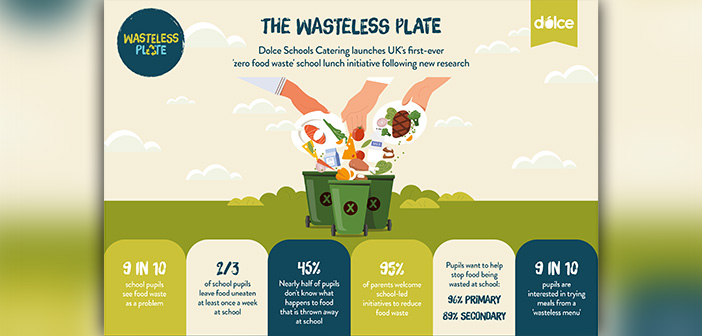
It follows research commissioned by the company that shows 9 in 10 pupils see food waste as a problem.
The initiative is being piloted as part of Dolce’s nationwide Wasteless Plate campaign, which launched in June 2026. The campaign has been designed to shine a light on the 80,000 tonnes of food waste produced annually by schools, and explore solutions to this industry-wide issue.
The initiative sees the launch of the Wasteless Plate menu which has been designed by Dolce’s team of chefs to utilise as much of every ingredient as possible, reducing waste in school kitchens by turning typically discarded parts into new menu elements. Any inedible and unavoidable by-products – which would typically go to landfill – are instead converted into green energy, while any good-to-eat surplus meals are donated to local communities, through Dolce’s new partnerships with ReFood and Olio.
To better understand the wider food waste problem in UK schools, Dolce conducted research* on primary and secondary school pupils, as well as parents, to learn more about pupil food waste behaviours, knowledge and potential solutions.
Dolce’s research shows that 94% of secondary pupils and 92% of primary pupils agree that throwing food away is a problem, and a further 92% of parents are concerned by the amount of food waste produced in UK schools every year.
However, despite this worry, pupils are still throwing a significant amount of food in the bin. Two-thirds of primary and secondary pupils leave food uneaten at least once a week at school, and for 32% of secondary pupils and 24% of primary, this happens at least three days a week.
Ben Sheppard, Operations Director at Dolce, explained: “It’s interesting that despite the clear concern around food waste, many pupils are still putting food in the bin at school. We wanted to hear directly from pupils and their parents about what’s really happening at lunchtime.
“Time pressures, taste, how the food looks and simply getting distracted were all factors that pupils told us can lead to school meals not being finished. However, our research also showed that almost half of pupils don’t know what actually happens to food once it’s thrown away at school. If we can close that knowledge gap and help pupils understand the impact of food waste – with initiatives like our Wasteless Plate campaign – we believe it can play a role in changing behaviours.”
Support for initiatives to reduce food waste is strong: 95% of parents welcome school-led initiatives, while 96% of primary and 89% of secondary pupils are keen to help stop food being wasted at school. In addition, nine out of ten primary (90%) and secondary (88%) pupils are interested in trying meals from the ‘wasteless menu’, and 90% of parents will encourage their children to do so.
Ben Sheppard continues: “As a caterer, the part of the food waste cycle that we have control over is what happens in the kitchen – from the menus and meal options, to the ingredients and how they are used. Given the overwhelming support from parents and pupils, we’re proud to launch our Wasteless Plate school lunch menu, designed to minimise food waste, and also introduce our partnerships with ReFood and Olio. They ensure any unavoidable waste is handled responsibly – whether that’s being turned into renewable energy or shared with members of the local community.
“We’ve also launched a free online hub for schools which helps pupils understand more about what happens to food waste in schools. There are research findings, free downloadable worksheets, tips from our chefs on how to use leftovers at home and lots more. We serve thousands of meals daily, so this campaign allows us to make a meaningful difference in raising awareness amongst vast numbers of pupils as well as tackling food waste nationwide.”
Neil Price, Head of Food Services at Dolce, who led the creation of the Wasteless Plate menu, said: “Reducing food waste has been at the heart of designing our Wasteless Plate menu – but tackling waste isn’t just about using every ingredient. It’s about creating meals that pupils genuinely enjoy eating, look appetising and are served in the right portions so pupils actually eat them.
“Our chefs have taken a creative approach to making ingredients go further. Pizza dough trimmings are baked and served on our bread counter, flavoured with surplus tomato sauce and spare pizza toppings. Overripe bananas are frozen and transformed into our Chocolate Banana Slice, while chickpeas from our sweet potato curry and mushrooms from our brunch find a second life in our Roasted Vegetable Loaf.
“We’ve also looked at every part of the vegetables we use. Broccoli stalks are finely chopped and added to our Hearty Puff Pie, while surplus carrots, courgettes and peppers are blended into the tomato sauce used across our pasta bar and pizzas. Even our salad bar showcases how ingredients can be reinvented, with roasted cauliflower trimmings and florets featuring in a Cauliflower, Spinach and Red Onion Salad, and spare beetroot from our brownies and oranges transformed into a vibrant Spinach, Beetroot and Orange Salad.
“The result is a menu that reduces waste, celebrates great ingredients and shows pupils that sustainability and delicious food can go hand-in-hand.”
Dolce’s research revealed that pupils are most likely to try a new meal if it’s healthy, presented well, and looks familiar. Peer approval is also hugely influential. In fact, primary school pupils said their friends trying a new meal is the number one factor that would encourage them to try it too – also the top reason cited by half of parents (51%) – and over a third of secondary school pupils (36%) said if a friend recommended a new meal they would also order it.
Neil Price continues: “That’s why the dishes work so well – they’re exciting for pupils, but built around familiar flavours. Grab-and-go options are also on the menu, including different flavoured pizzas, paninis, and pasta and curry pots. These always prove popular with secondary pupils, who like the flexibility of choosing where they eat. We also adapt the pizza and curry flavours to complement what else we’re preparing that day, helping us make the most of our ingredients.”
One of the schools to benefit from Dolce’s campaign is Hawarden High School in Flintshire, Wales. The Wasteless Plate menu is being served, ReFood now collects the school’s food waste bins on a weekly basis and any surplus meals that are still perfectly good-to-eat are made available for collection and redistribution through Olio whenever the school has spare food.
Simon Budgen, Headteacher at Hawarden High School, said: “The Wasteless Plate campaign is a huge step forward for our school’s sustainability efforts. Since partnering with Dolce, our catering has come on leaps and bounds – meals are more appealing to pupils and we’ve seen an uplift in the number of school meals purchased. This initiative not only helps us tackle food waste, but also raises awareness amongst our students, which is a fantastic lesson in responsibility and care for the environment.”
With more than 130,000 meals prepared daily across its network of 650 schools, the Wasteless Plate campaign reflects Dolce’s ongoing commitment to sustainability, responsible catering, and engaging pupils and parents in creating a culture of mindful eating in schools.
To find out more about Dolce’s Wasteless Plate campaign please visit https://www.dolce.co.uk/the-wasteless-plate/