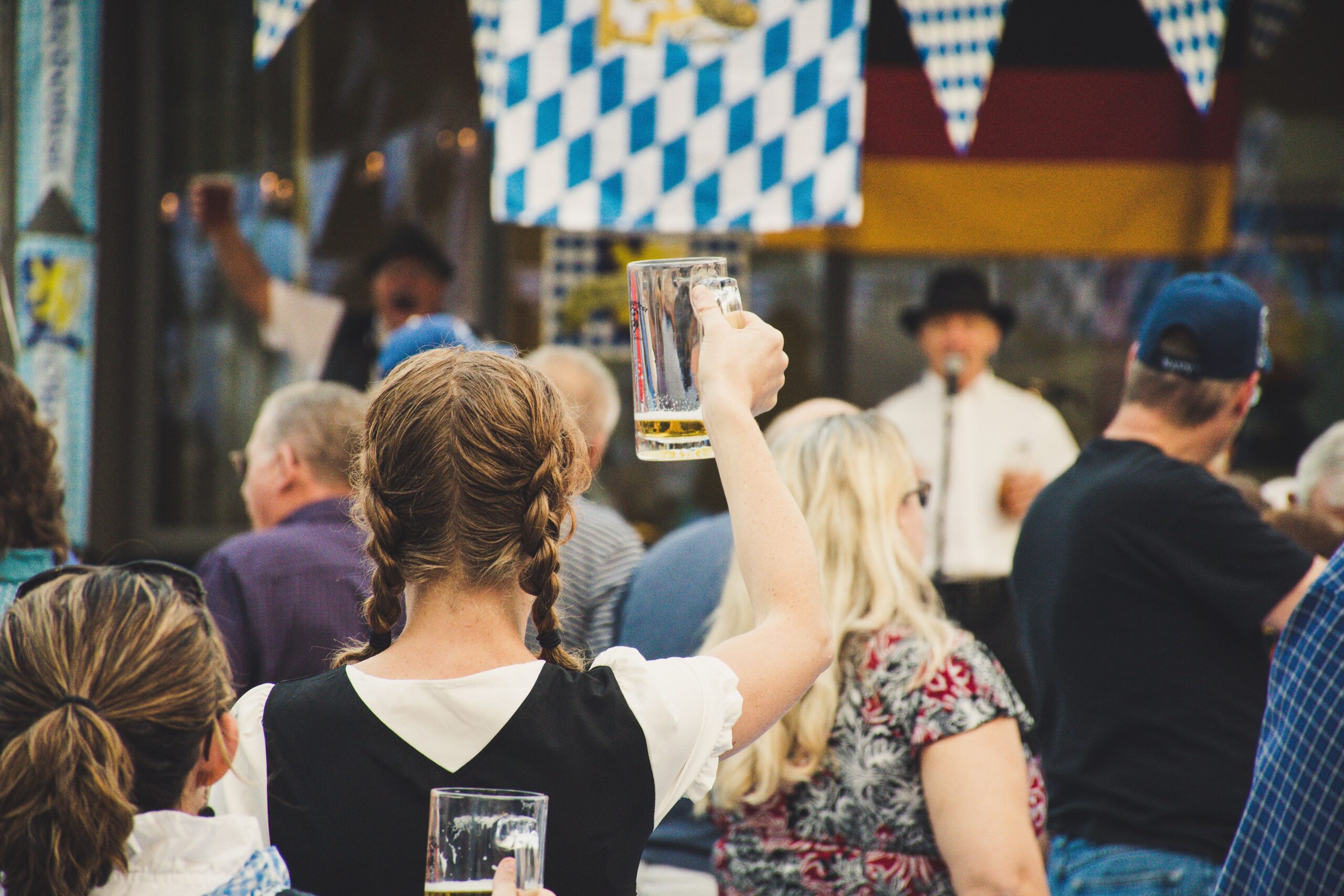
From a purely economic standpoint, the economy of Oktoberfest is an interesting phenomenon. Every year, six million people travel to Munich and spend more money per day than they would at almost any other festival on earth.
For decades, beer prices at Oktoberfest have risen faster than German inflation, and accommodation costs have doubled. Still, the attendance hasn’t decreased; it keeps growing.
Standard demand theory says that higher prices reduce consumption, but at Oktoberfest, the opposite holds. Standard investment theory says cheap alternatives outperform expensive ones over time, but the Tracht market remains stable despite dozens of cheap alternative sellers. Understanding Oktoberfest through economic reasoning does not diminish its cultural significance. It reveals why the event has sustained and expanded for over 200 years and why attending makes rational sense beyond the obvious reasons.
The Macroeconomics of Oktoberfest
To understand the economics of oktoberfest, we need to analyze large-scale economic trends and the growth of the beer festival.
A €1.57 Billion Event That Runs on 16 Days
Oktoberfest generates €1.25-€1.57 billion for Munich over a 16-day period. That contribution represents approximately 2 percent of Munich’s entire annual GDP compressed into only two and a half weeks. No other cultural event on earth produces economic concentration at this density.
This 1.5 billion euro revenue includes visitors from outside Munich who spent €505 million on accommodation alone in 2024, with daily rates exceeding €400, more than double normal levels. On the festival grounds, each attendee spent an average of €70.22. The broader hospitality, transport, retail, and service sectors all participate in the multiplier effect, and that initial spending spreads through Munich’s economy.
The Employment Footprint at Oktoberfest
The festival creates 12,000 to 13,000 seasonal jobs across 16 days. This is multiple, high-earning employment generated by a single annual event. The economic case of Oktoberfest is not simply that people spend money. It is that one festival that generates livelihoods for thousands and economic activity comparable to mid-sized industries within its operating window.
These employment figures confirm that Oktoberfest is not a single-product economic event.
Why Do Rising Prices Not Deter Oktoberfest Visitors?
Beer Consumption as an Economic Indicator
Standard economic theory predicts that demand falls as prices rise. At Oktoberfest, it does not. Oktoberfest beer prices have risen faster than German consumer prices for decades. In 2016, UniCredit economists Tobias Ruehl and Thomas Strobel observed that a liter of festival beer cost 3 percent more than the previous year, far above Germany’s overall inflation rate. Ruehl and Strobel applied the concept of a Giffen good to explain this economic paradox of Oktoberfest: people consume more of a product as its price increases.
Within the beer tents, substitutes are structurally limited. Visitors have traveled to Munich specifically to experience the beer tents. The sunk costs of flights and accommodation entirely change the demand. When the experience is the point, the price of individual components becomes secondary to the total value of participation.
Hotel prices at Oktoberfest Rise due to Demand
Oktoberfest hotel rates of €400 per night during the festival are not a market distortion; they are accurate price signals reflecting the genuine scarcity of accommodation in accordance with global demand.
At Oktoberfest, the prices reflect real demand meeting real supply constraints. The market is functioning correctly. When premium prices across accommodation, beer, food, and transport fail to deter millions of visitors annually, the rational response is to treat it as market confirmation that the event delivers commensurate value.
The Rational Consumer Case for Attending Oktoberfest
The festival grounds at Theresienwiese have no entry fee. The oktoberfest experience is free to access. In economics, this creates what is called consumer surplus: the gap between what you would be willing to pay for something and what you actually pay. When the base entry price is zero, that gap is very large. Beer, food, rides, and traditional dress carry premium prices, but the base experience is free.
Compare oktoberfest to concerts, sporting events, or theme parks where you pay a significant entry fee before spending a single cent inside. Oktoberfest’s pricing model is more favorable to visitors than that of most comparable entertainment options of similar scale and quality.
Network Economics and Oktoberfest’s Compounding Value
Some experiences get better as more people participate. Think of a language: the more people speak it, the more useful it becomes. Oktoberfest works the same way. The communal tables, the collective singing, the shared toasts, the crowd energy, none of these exist if only a few people show up. Six million participants create the experience. You cannot replicate it at home with expensive beer.
Compounding value is why Oktoberfest has grown rather than declined over 200 years. Each festival year builds on the last. The international Oktoberfest visitors who make up 14 percent of attendance each year represent a global word-of-mouth network of people who experienced the value and either returned or sent others.
Global Oktoberfest Replication as Economic Proof
The strongest evidence that Oktoberfest’s economic model works is that the world keeps copying it. More than 3,000 Oktoberfest events now operate worldwide. Oktoberfest Cincinnati attracts 500,000 visitors annually and creates 3,000 jobs locally. Kitchener-Waterloo’s Oktoberfest generates $1.9 million in annual tax revenue. When a model replicates at this scale globally, economists treat it as proof that the original works. Replicas confirm the original’s value rather than undermining it.
Tourism as an Invisible Export
When an international visitor spends money at Oktoberfest, that money flows directly into the German economy. Germany receives payment just as effectively as if it had exported something. Economists call this invisible trade. Tourism is simply an export where the customer comes to collect rather than waiting for delivery.
The 14 percent of Oktoberfest visitors from France, USA, Canada, Spain, Brazil, Ireland, and the Netherlands represent significant invisible export revenue for Bavaria. They pay for hotels, food, clothing, and services, all of which go to German businesses. Oktoberfest does this without any advertising spent by the city. The event markets itself.
The Oktoberfest Outfit Market as an Economic Ecosystem
The traditional clothing market attached to Oktoberfest grew faster than most technology sectors over the same period. Small German Tracht brands that sold around 20 outfits per year between 2000 and 2010 now sell 2,000 to 2,500 outfits annually.
Lederhosen demand increased 500 percent over 5 to 8 years. Same growth is seen in dirndl fashion. This was entirely driven by Oktoberfest’s expanding international reach and a growing preference among visitors for authentic participation rather than costume tourism.
The Investment Case for Authentic Traditional Dress
Most visitors make the clothing decision emotionally. Economists make it on numbers, and the numbers favor authentic Tracht.
An authentic lederhosen costs $180 to $800 and lasts over 10 years. Worn across 10 festival occasions, that comes to a per-wear cost of $15 to $25. A costume lederhosen costs $35 to $60 but lasts one to two wears. In financial terms, the authentic lederhosen is a capital asset. The same logic applies to dirndls, which at $400 to $900 incorporate 12 to 20 hours of hand embroidery and 3 to 6 months of traditional leather preparation.
Authentic Dress is Worth More Socially
At Oktoberfest, standing out as a serious cultural participant rather than a tourist passing through is genuinely difficult. Authentic traditional dress is one of the few signals that does this immediately and credibly.
Bavarians can identify authentic leather construction and hand-stitched embroidery from polyester and machine printing within seconds. Visitors in authentic Tracht get invited to join established tables more readily, start conversations more easily, and access a qualitatively different social experience within the same physical event. Economists call these returns social capital. The returns are real even if they do not appear on a balance sheet.
The Economic Cost of Not Attending the Oktoberfest
Every economic decision has an opportunity cost: what you forgo by choosing not to do something.
What You Give Up by Staying Home
Not attending Oktoberfest carries a cost that most people do not count.
Oktoberfest runs 16 days, once a year, in one place. You cannot time-shift the festival, and you cannot buy the experience later. The network that creates its value exists for only 16 days. If you miss this year’s Oktoberfest, you have permanently foregone this year’s version of the event.
The Psychological cost of not attending the Beer Festival
The consistent return behavior of Oktoberfest visitors strongly suggests that regret about not attending plays a meaningful role in why visitors keep coming back. This is the part explained by behavioral economists that there is anticipated regret in knowing that you could have done something and chose not to do it. The regret of not attending brings plays role in decision making and multiplies the oktoberfest visitors each year
Planning Oktoberfest Attendance as an Economic Agent
Attending Oktoberfest is a great decision, and to fully cherish this event, you need to make financially friendly choices.
Saving Big at Oktoberfest
The biggest cost lever for oktoberfest attendance is accommodation. Booking accommodation 6 to 9 months in advance locks in rates before the premium surge that can double or triple prices closer to the event. The difference between booking in January and booking in August can easily be €100 to €200 per night.
Weekday oktoberfest attendance, Tuesday through Thursday, delivers an identical cultural experience to weekend attendance at lower crowd density. The beer costs the same. The experience is broadly equivalent; only the streets are less crowded.
Tent selection matters financially. Some tents require a minimum prepaid voucher of 300 to 400 euros per person before you sit down. Others operate on standard pay-as-you-go. For first-time visitors, open-seating tents remove mandatory spend requirements while delivering the same festival atmosphere.
Conclusion
The economic case for attending Oktoberfest does not require ignoring the costs. It requires accounting for all the returns: the free entry, the network effects, the non-depreciating experience value, the social capital generated by authentic participation, and the contribution to a cultural economy that has sustained and grown for over 200 years. All these factors return much more than you actually spent at the festival.
The festival creates 12,000 to 13,000 jobs. It sustains a craft industry in traditional clothing. It funds brewing operations that employ workers year-round. Your attendance not only benefits you but also contributes to the economic system that makes the event worth attending in the first place.
Attend Oktoberfest, invest in authentic traditional attire, book early, arrive before noon, eat with your first beer, and treat the cultural experience as the primary asset. You will be coming back with an experience that is valuable not only in numbers but also priceless in terms of memories, and the Oktoberfest market has been confirming it for two centuries.