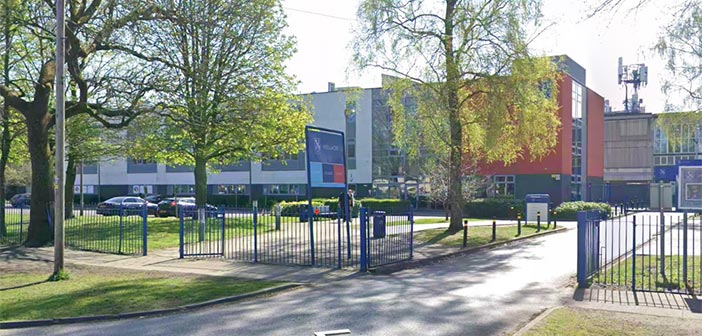
A school teacher from Lymm has been banned from teaching indefinitely for failing to maintain professional boundaries, after sending thousands of messages and meeting up with a teenage pupil.
Three years on from being cleared of all charges of a sexual relations with the 15-year-old pupil, Rebecca Whitehurst has been banned from returning to the profession for ‘serious misconduct.’
The teenager had sent her an explicit image of himself as well as a message containing pornography.
Ms Whitehurst, aged 49, a former languages teacher at Wellacre Academy in Urmston, was cleared of all charges in July 2022 after a jury at Manchester Minshull Street Crown Court found the teenage accuser had faked incriminating WhatsApp messages and lied about sexual encounters.
A panel assembled by the government’s Teaching Regulation Agency ruled recently that while innocent and initially well-intentioned, the parts of the relationship between Mrs Whitehurst and the pupil that were agreed to be true, amounted to serious professional misconduct.
The panel considered the allegations set out in the notice of referral dated 29 August 2025.
It was alleged that Ms Whitehurst was guilty of unacceptable professional conduct and/or conduct that may bring the profession into disrepute, in that whilst employed as a teacher at Wellacre Academy between 2016 and 2019:
1. She failed to maintain appropriate professional boundaries with Pupil A, including by:
a. sharing her personal phone number and/or social media details with Pupil
A;
b. communicating via phone and/or text and/or social media with Pupil A;
c. received one or more indecent images of Pupil A;
d. received pornographic imagery from Pupil A;
e. meeting with Pupil A on one or more occasions outside of School;
f. received gifts on one or more occasions from Pupil A.
2. She failed to take appropriate action and/or ensure appropriate action was taken
to safeguard Pupil A in or around August 2019, despite receiving on one or more
occasion messages from Pupil A in which they wanted to end their life
Ms Whitehurst admitted the facts alleged and admits that they amount to unacceptable professional conduct and/or conduct that may bring the profession into disrepute.
Ms Whitehurst was employed as a teacher of modern and foreign languages at Wellacre Academyfrom 1 September 2016 until 18 November 2019. During her employment at the School, she undertook all required annual safeguarding training.
During the academic year of 2018/19, Pupil A was in Year [REDACTED]. On 17 September 2019, after Pupil A had entered Year [REDACTED], Ms Whitehurst notified the School that she had been communicating with Pupil A via their personal mobile phones and over social media. She explained that she had obtained his phone number on a school trip when he was in Year [REDACTED] and [REDACTED] years’ old. She disclosed that he had sent her inappropriate/indecent images of himself. She said she had met him a couple of times outside School and then confirmed this had happened on eight occasions. On three consecutive days in August 2019, Ms Whitehurst and Pupil A had exchanged a number of messages on social media, including messages in which he expressed
suicidal thoughts. She did not report those messages to the School or any external safeguarding authority.
The panel was satisfied that Ms Whitehurst had not deliberately set out to exploit or harm Pupil A. It was satisfied that her breach of professional boundaries started from a desire
to help him. However, this created a set of circumstances in which she made poor choices, and to that extent, her conduct was deliberate.
Similarly, the panel was satisfied that she was not acting under extreme duress. The panel accepts that Ms Whitehurst may have felt somewhat trapped in the situation that her initial actions had created, but the safeguarding framework around her was absolutely clear about what she needed to do, and she chose not to follow it.
The panel concluded that Ms Whitehurst did have a previously good history, and that there had been no previous issues of this sort.
The decision maker on behalf of the Secretary of State Sarah Buxcey said:” I have given very careful consideration to this case and to the recommendation of the panel in respect of both sanction and review period.
“In considering this case, I have also given very careful attention to the Advice that the Secretary of State has published concerning the prohibition of teachers.
In this case, the panel has found all of the allegations proven and found that those proven facts amount to unacceptable professional conduct and conduct that may bring the profession into disrepute.
“The panel has made a recommendation to the Secretary of State that Ms Rebecca Whitehurst should be the subject of a prohibition order, with a review period of five years.
In particular, the panel has found that Ms Whitehurst is in breach of the following standards:
Teachers uphold public trust in the profession and maintain high standards of ethics and behaviour, within and outside school, by
treating pupils with dignity, building relationships rooted in mutual respect, and at all times observing proper boundaries appropriate to a teacher’s professional position
having regard for the need to safeguard pupils’ well-being, in accordance with statutory provisions
Teachers must have proper and professional regard for the ethos, policies and practices of the school in which they teach…
Teachers must have an understanding of, and always act within, the statutory frameworks which set out their professional duties and responsibilities. The panel finds that the conduct of Ms Whitehurst fell significantly short of the standards expected of the profession.
“The findings of misconduct are particularly serious as they include findings of a breach of professional boundaries and failures to safeguard, involving a vulnerable pupil.
“I have to determine whether the imposition of a prohibition order is proportionate and in the public interest. In considering that for this case, I have considered the overall aim of a prohibition order which is to protect pupils and to maintain public confidence in the
profession. I have considered the extent to which a prohibition order in this case would achieve that aim taking into account the impact that it will have on the individual teacher.
“I have also asked myself, whether a less intrusive measure, such as the published finding of unacceptable professional conduct and conduct likely to bring the profession into disrepute, would itself be sufficient to achieve the overall aim. I have to consider whether the consequences of such a publication are themselves sufficient. I have considered therefore whether or not prohibiting Ms Whitehurst, and the impact that will have on the teacher, is proportionate and in the public interest.
In this case, I have considered the extent to which a prohibition order would protect children/safeguard pupils. The panel has observed, “There was a strong public interest consideration in respect of the safeguarding and wellbeing of pupils, given the serious findings of a breach of professional boundaries and failures to safeguard.” A prohibition order would therefore prevent such a risk from being present in the future.
“I have also taken into account the panel’s comments on insight and remorse, which the panel sets out as follows, “The panel recognised that Ms Whitehurst had shown some insight, as demonstrated by her admissions of the facts and that her conduct amounted to unacceptable professional conduct and conduct that may bring the profession into disrepute. She had also provided a written statement for the panel to consider, but did not attend the hearing or give evidence in person. She is entitled not to do so, but this meant that the panel did not have an opportunity to explore her insight through questioning.”
The panel has also commented “that It was therefore left with the contents of her written statement. In the panel’s view, that statement did not demonstrate that she had full insight into the likely impact of her serious misconduct on Pupil A, nor did it clearly demonstrate empathy towards him. Further, the panel had no evidence of any work done by Ms Whitehurst since the events of 2019 to understand and address the risks of her actions.” In my judgement, the lack of full insight or remorse means that there is some risk of the repetition of this behaviour and this puts at risk the future wellbeing of pupils. I have therefore given this element considerable weight in reaching my decision.
“I have gone on to consider the extent to which a prohibition order would maintain public confidence in the profession. The panel observe, “the panel considered that public confidence in the profession could be seriously weakened if conduct such as that found against Ms Whitehurst were not treated with the utmost seriousness when regulating the conduct of the profession.” I am particularly mindful of the finding of failures to safeguard a pupil in this case and the impact that such a finding has on the reputation of the profession.
“I have had to consider that the public has a high expectation of professional standards of all teachers and that the public might regard a failure to impose a prohibition order as a failure to uphold those high standards. In weighing these considerations, I have had to consider the matter from the point of view of an “ordinary intelligent and well-informed citizen.”
“I have considered whether the publication of a finding of unacceptable professional conduct and conduct likely to bring the profession into disrepute. in the absence of a prohibition order, can itself be regarded by such a person as being a proportionate response to the misconduct that has been found proven in this case.
“I have also considered the impact of a prohibition order on Ms Whitehurst herself and the panel comment “The panel concluded that Ms Whitehurst did have a previously good history, and that there had been no previous issues of this sort.”
“A prohibition order would prevent Ms Whitehurst from teaching. A prohibition order would also clearly deprive the public of her contribution to the profession for the period that it is in force.
“In this case, I have placed considerable weight on the panel’s comments “The panel was satisfied that Ms Whitehurst had not deliberately set out to exploit or harm Pupil A. It was satisfied that her breach of professional boundaries started from a desire to help him. However, this created a set of circumstances in which she made poor choices, and to that extent, her conduct was deliberate.”
“I have also placed considerable weight on the findings of the panel regarding insight and remorse “The panel recognised that in the last six years, Ms Whitehurst had been through a lot, and that her experience would impact on her behaviour now. It recognised that the delay in the resolution of the regulatory proceedings was likely to be exhausting for her, and that this might have adversely impacted on her ability to show insight and remediate her misconduct. But the fact remains that, in the panel’s view, she has not shown sufficient insight or remediation to establish that she would not present a risk to pupils if she were to return to teaching. In these circumstances, the panel needs to recommend restrictive action in order to prevent a risk to pupils and to maintain confidence in the profession.”
“I have given less weight in my consideration of sanction therefore, to the contribution that Ms Whitehurst has made to the profession. In my view, it is necessary to impose a prohibition order in order to maintain public confidence in the profession. A published decision, in light of the circumstances in this case, that is not backed up by full insight or remorse, does not in my view satisfy the public interest requirement concerning public confidence in the profession.
“For these reasons, I have concluded that a prohibition order is proportionate and in the public interest in order to achieve the intended aims of a prohibition order.
“I have gone on to consider the matter of a review period. In this case, the panel has recommended a 5 year review period.
“I have considered the panel’s comments “The panel concluded that it would be appropriate to recommend a review period, and that this should be five years. For Ms Whitehurst, the last six years must have been dominated by the proceedings she has faced as a result of her actions. Now that they are concluded, she will need a considerable amount of time to fully work through the issues and be able to demonstrate full insight and remediation. Further, the seriousness of her conduct is such that public confidence demands a significant period of reflection and remediation.”
“In this case, factors mean that allowing a lesser review period is not sufficient to achieve the aim of maintaining public confidence in the profession. These elements are the seriousness of the findings, involving a vulnerable pupil and the lack of evidence that Ms Whitehurst has demonstrated full insight or remorse.
“I consider therefore that a five year review period is required to satisfy the maintenance of public confidence in the profession.
“This means that Ms Rebecca Whitehurst is prohibited from teaching indefinitely and cannot teach in any school, sixth form college, relevant youth accommodation or children’s home in England. “She may apply for the prohibition order to be set aside, but not until 02 October 2030, 5 years from the date of this order at the earliest. This is not an automatic right to have the prohibition order removed. If she does apply, a panel will meet to consider whether the prohibition order should be set aside. Without a successful application, Ms Whitehurst remains prohibited from teaching indefinitely.
“This order takes effect from the date on which it is served on the teacher.”
Ms Whitehurst has a right of appeal to the High Court within 28 days from the date she is given notice of this order.
The full findings of the report can be read by CLICKING HERE