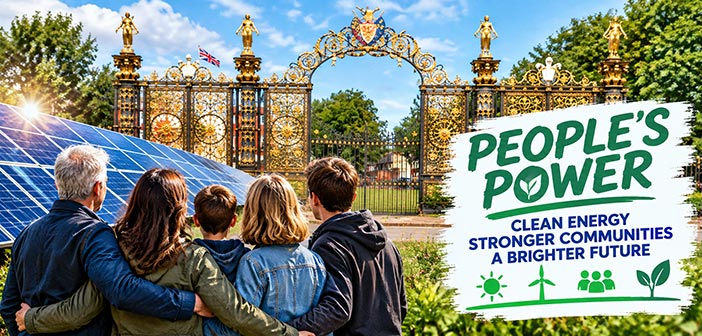
WARRINGTON could be well placed to benefit from a new Government-backed “People’s Power” scheme aimed at putting communities in control of their own clean energy.
Great British Energy has launched the first £30m tranche of what could eventually become up to £1bn of investment in community energy projects across the UK.
The scheme will allow local authorities and community energy organisations to develop projects including solar panels on community buildings, wind farms, battery storage and hydro schemes.
And Warrington already has considerable experience in the renewable energy sector – with Warrington Borough Council having invested in solar generation for more than a decade, although this has not been without its own troubles.
The council says it has invested in solar schemes ranging from commercial buildings and social housing to installations on its own buildings.
One of its largest local installations is a 3,000-panel array at the Plastic Omnium building at Omega, which generates around 735,000kWh of electricity a year and saves an estimated 208 tonnes of CO2 annually.
The council has also invested in large-scale solar farms outside Warrington, with the revenues generated helping to support council services.
It says a proportion of the earnings from those investments is also channelled into local energy initiatives through Warrington Community Energy.
Now the new Great British Energy funding could provide another opportunity – potentially allowing Warrington communities to move beyond simply benefiting from renewable energy and towards actually owning and controlling their own projects.
The Great British Energy Community Fund is offering grants of up to £40,000 for feasibility work, £100,000 for project development and up to £3m towards construction-ready projects.
Projects must be designed to be at least 50 per cent community-owned once operational.
For Warrington, that could potentially mean community organisations investigating solar installations on suitable buildings, battery storage schemes or other renewable energy projects, with income generated potentially being reinvested locally.
There is also a separate Great British Energy Partnerships Grant offering English local authorities up to £40,000 for partnership formation and feasibility work, rising to £100,000 for development, where they are working with a community energy group.
Prime Minister Andy Burnham said: “I know many people are worried about climate change and feel like they’ve got no control over where their energy comes from, or how they can actually make a difference.
“Today we’re changing that by giving people power. Whether it’s solar panels on a local library or a community-owned wind farm, we’re letting people decide what clean energy projects they want and making sure they feel the benefits of the clean energy transition in their pockets too.”
Energy Secretary Miatta Fahnbulleh said: “All of us felt deep concern for our climate during the record-breaking temperatures we experienced this summer.
“Ahead of New York Climate week, we are putting power in the hands of people and places, so more communities can take action.
“Everyone deserves a stake in our energy future and through these local power projects, communities can reap the full benefits of clean energy – reducing emissions, cutting bills and reinvesting profits to benefit local areas, instead of big energy companies.”
CEO of Great British Energy Dan McGrail said: “Great British Energy is continuing to put communities at the heart of the clean energy transition with the GBE Community Fund and Partnerships Grant. Our vision is that every community should have the chance to build and own its own renewable energy. These grants will give community organisations and local authorities the practical support they need to get clean energy projects off the ground – lowering bills, supporting jobs and putting the benefits from energy into local hands.”
Warrington is no stranger to using renewable energy as a way of generating income.
The council says its solar investments have generated revenue to help deliver essential services, while its solar farm projects have collectively delivered substantial carbon savings.
It has also previously used a Community Municipal Investment bond, raising £1m from the public towards the cost of its 23MW solar farm at Cirencester.
The council says most of the revenues from its solar farms are returned to support council services, while a proportion is invested in local energy projects.
Warrington Borough Council has already described itself as a pioneer in renewable energy investment, and its own climate programme highlights the role of renewable generation in helping the borough move towards its carbon-neutral ambitions.
However, Warrington’s experience of renewable energy investment has not been without financial controversy. A report by Government-appointed Ministerial Envoys published earlier this year identified Warrington’s solar farms as one of the areas requiring urgent attention, warning that the council needed to establish whether the assets could continue to meet their debt repayments. The report specifically stated that the Cirencester solar farm was unable to make its expected payment to the council for 2025/26, while calling for a review of the performance of the three solar farms and the contractual arrangements with their operator.
The concerns come against the wider backdrop of Warrington Borough Council’s troubled commercial investment programme. The council itself acknowledged in February that, while its commercial portfolio had generated around £166m since 2009, the value of the portfolio had fallen by an estimated £275m, contributing to significant financial pressures. The Envoys described the position of the solar farms as one of the areas where early decisions were required, including whether the council should continue its involvement and whether the assets could deliver the returns originally anticipated.
That experience provides an important backdrop to the Government’s new People’s Power initiative. Community ownership could allow local people and organisations to share directly in the benefits of renewable generation, but Warrington’s experience also demonstrates that clean-energy projects involve financial, operational and contractual risks as well as environmental benefits. Any move towards community-owned energy in the borough is therefore likely to raise questions about who carries the financial risk, who owns the assets, how returns are guaranteed and what happens if a project fails to deliver the expected income.
The latest funding could now provide an opportunity to take that approach a step further – from council-owned renewable energy to genuinely community-owned power.
The challenge will be turning the Government’s headline promise of “People’s Power” into projects that deliver tangible financial benefits for residents, community organisations and local services.