Workplace injuries happen without warning. A slip on a wet floor, a colleague collapsing at their desk, or a burn in the staff kitchen can turn an ordinary workday into an emergency. The difference between a good outcome and a devastating one often depends on whether someone nearby knows what to do.
UK law requires employers to provide adequate first aid provision, and accredited training courses meet this obligation. Delegates who complete first aid training with this provider gain the skills to respond confidently to workplace emergencies, meeting the standards set by the HSE and giving staff the protection they deserve. For more on local health initiatives, see coverage of the new community Live Well website, which sits alongside first aid training as part of Warrington’s wider wellbeing push.
What Are Employers’ Legal Obligations for First Aid?
The Health and Safety (First Aid) Regulations 1981 place a clear duty on every UK employer to make adequate first aid arrangements. This includes providing trained personnel, suitable equipment, and facilities appropriate to the size and nature of the workplace.
The definition of “adequate” varies by business. A low-risk office with ten staff has different requirements from a manufacturing facility with 200 workers. According to the Health and Safety Executive, employers must conduct a first aid needs assessment that considers the nature of the work, the number of employees, shift patterns, and the distance from emergency medical services.
Failure to maintain adequate provision can result in enforcement action from the HSE, including improvement notices and, in serious cases, prosecution. Insurance implications add further risk, as claims related to workplace injuries may be challenged if the employer cannot demonstrate compliant first aid arrangements.
What Skills Do Delegates Learn on a First Aid Course?
Accredited first aid training covers the practical skills needed to manage the emergencies most likely to occur in a workplace setting:
- Scene assessment and personal safety: ensuring the environment is safe before approaching a casualty and calling for appropriate help.
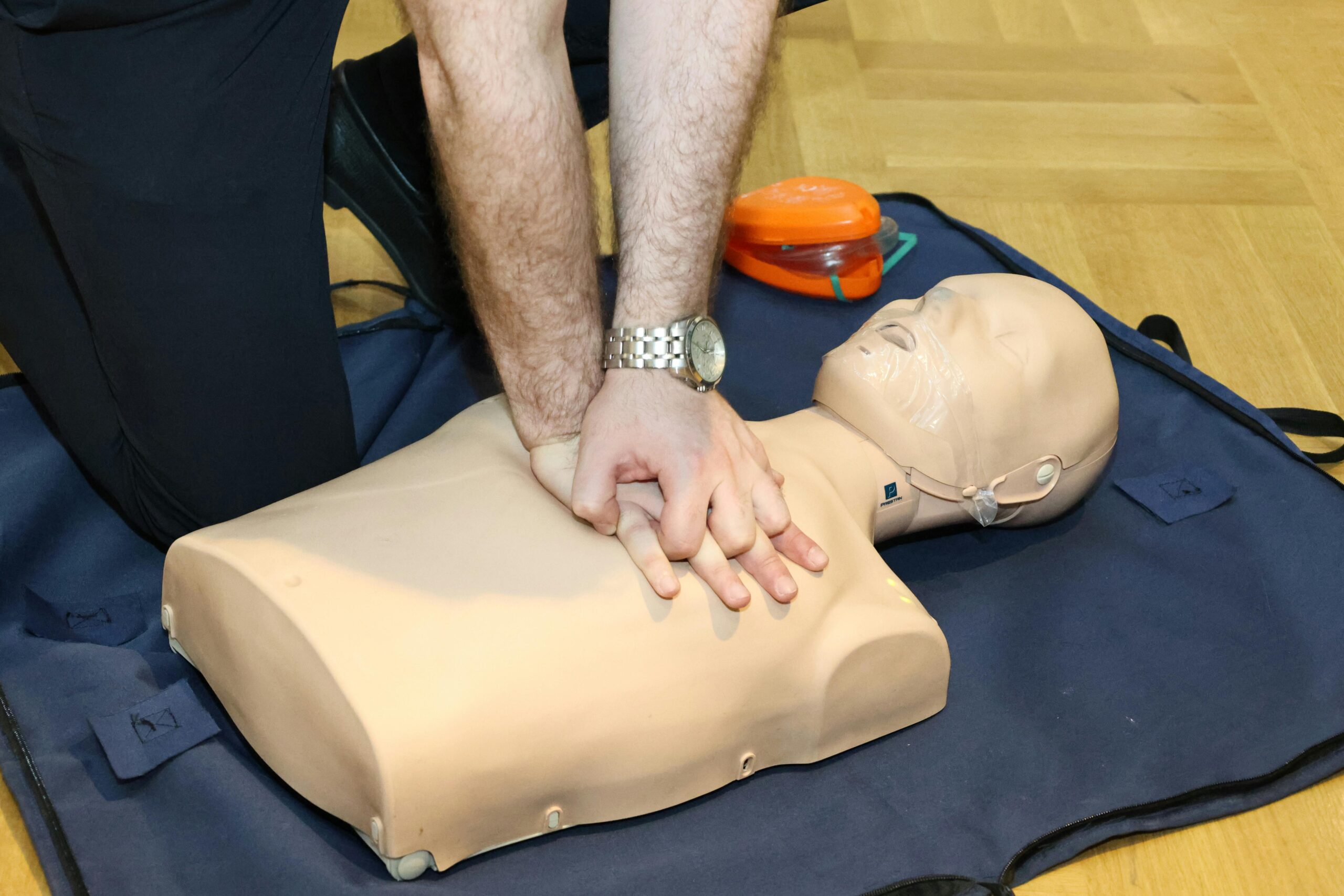
- CPR and AED use: performing cardiopulmonary resuscitation and operating an automated external defibrillator for adult casualties.
- Choking management: recognising and treating airway obstructions in conscious and unconscious casualties.
- Bleeding control: applying direct pressure, using wound dressings, and recognising the signs of shock.
- Burns and scalds: cooling, covering, and managing thermal, chemical, and electrical burns.
- Fractures, sprains, and musculoskeletal injuries: immobilising injured limbs and managing pain while awaiting paramedics.
According to the Resuscitation Council UK, bystander CPR doubles the chances of survival following cardiac arrest. In a workplace context, a trained first aider is often the only person available to provide this life-saving intervention during the critical minutes before an ambulance arrives.
How Should Warrington Employers Structure Their First Aid Provision?
The appropriate level of provision depends on your workforce size, risk profile, and working patterns. Here is what the HSE guidance recommends:
- Fewer than 25 employees (low risk): At least one appointed person plus a first aid kit. A trained first aider is strongly recommended even at this size.
- 25 to 50 employees (low risk): At minimum one Emergency First Aid at Work (EFAW) qualified delegate.
- More than 50 employees (low risk): At least one First Aid at Work (FAW) qualified delegate per 100 workers, plus additional EFAW holders.
- Higher-risk workplaces: One FAW delegate per 50 employees, with additional provision for remote working areas and shift patterns.
- Multiple sites: Each site or location requires independent first aid coverage that does not depend on delegates travelling between premises.
Photo by Roger Brown on Pexels
Alt text: A well-stocked first aid kit in a UK office workplace setting
Employers should also consider coverage during annual leave, sickness, and staff turnover. Training multiple delegates ensures continuity of provision throughout the year.
What Is the Difference Between EFAW and FAW Qualifications?
The two main workplace first aid qualifications serve different needs.
Emergency First Aid at Work (EFAW) is a one-day course that covers the essential skills: CPR, choking, bleeding, and basic emergency response. It satisfies the minimum requirement for low-risk workplaces with smaller teams.
First Aid at Work (FAW) is a three-day course that covers everything in EFAW plus a wider range of injuries and medical conditions including fractures, burns, eye injuries, poisoning, and medical emergencies such as heart attack, stroke, and anaphylaxis.
According to the Institution of Occupational Safety and Health, the choice between EFAW and FAW should be determined by the first aid needs assessment. Higher-risk environments, larger workforces, and remote locations typically require the more comprehensive FAW qualification. Industrial employers across Warrington already apply similar risk-adjusted frameworks in their operational processes, as covered in this practical guide to best practices in sheet metal fabrication.
What to Remember
- UK employers have a legal duty to provide adequate first aid provision under the 1981 Regulations.
- A first aid needs assessment determines the number and qualification level of delegates required.
- EFAW (one day) covers essential emergencies; FAW (three days) covers a broader range of scenarios.
- Bystander CPR doubles survival rates for cardiac arrest, making trained workplace delegates critical.
- Multiple trained delegates provide coverage during leave, shift changes, and staff turnover.
- Certificates are valid for three years and require a refresher course before expiry.
Protection That Starts With Training
Workplace first aid is not a box-ticking exercise. It is the difference between a colleague receiving immediate, skilled care and that same colleague waiting helplessly for an ambulance. For Warrington employers, investing in accredited training is one of the most meaningful ways to demonstrate genuine duty of care.
FAQ
How many first aiders does my business need?
This depends on your first aid needs assessment. Low-risk offices need at least one trained delegate per 25 to 50 staff. Higher-risk environments require one per 50 workers. Consider shift patterns and multiple site coverage when calculating.
How long is a first aid certificate valid?
Three years from the date of qualification. Delegates must complete a refresher course before their certificate expires to maintain compliance. Annual CPR refreshers are recommended but not mandatory.
Can first aid training be delivered on-site at my business?
Many accredited training providers offer in-house courses delivered at your premises. This is often more convenient and cost-effective for businesses training multiple delegates simultaneously.
Do volunteers and charity workers need first aid training?
The HSE recommends that voluntary organisations follow the same first aid principles as employers. Charities with employees are legally required to comply. Organisations using volunteers should assess risk and provide appropriate training.