
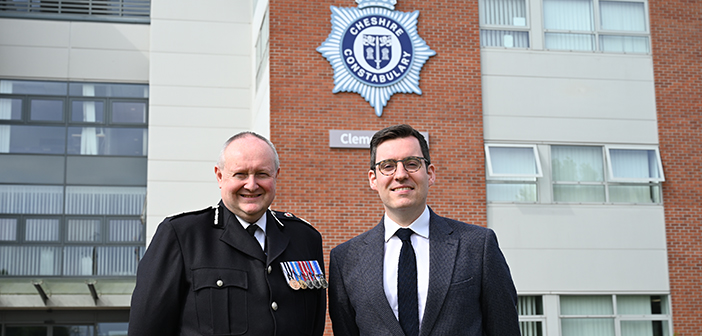
CONCERNS over the future of neighbourhood policing have intensified after a Warrington Worldwide reader challenged what they believe is a significant shortfall in Police Community Support Officer (PCSO) numbers, prompting a renewed public warning from Cheshire Police and Crime Commissioner (PCC) Dan Price.
The debate centres on the Neighbourhood Policing Guarantee, under which residents agreed to a council tax precept increase earlier this year to help fund an increase in PCSO numbers.
In a letter to Warrington Worldwide, local resident Mr Wallace said he was raising “a matter of significant public concern” after claiming his own community had lost its PCSO through redundancy and had not seen a police officer since.
He said residents had backed a council tax increase “with the clear and specific intention” of increasing PCSO numbers from 27 to 57 as part of the Neighbourhood Policing Guarantee.
However, he claimed active PCSO numbers had since fallen well below that level and questioned whether there were plans to recruit more during 2026/27.
“If accurate, this represents a substantial discrepancy between what residents were promised and what has been delivered,” he said.
“It raises serious questions about transparency, financial stewardship and adherence to the commitments made by senior leadership within Cheshire Constabulary and the Office of the Police and Crime Commissioner.”
Mr Wallace also referred to comments made by PCC Dan Price during a recent radio interview in which the Commissioner indicated that if the agreed PCSO numbers could not be maintained while balancing the budget, money raised through the precept could be returned to residents.
While welcoming that acknowledgement, Mr Wallace argued it failed to address the wider issue.
“Communities are paying more for neighbourhood policing while receiving less,” he said.
He called for public clarification on the current number of PCSOs, recruitment plans for 2026/27, how the additional precept funding had been allocated, how the Neighbourhood Policing Guarantee was being upheld, and what action would be taken to restore visible policing in affected communities.
The concerns have also been echoed by Cheshire Police and Crime Commissioner Dan Price after Mr Wallace’s concerns were raised directly with him by Warrington Worldwide.
Mr Price said he continued to challenge Cheshire Constabulary over its commitment to maintain the agreed number of PCSOs.
“I continue to challenge Cheshire Constabulary about their commitment to keep 57 PCSO roles as part of its revised Neighbourhood Policing plan. This is about making sure public trust is not broken.
“We agreed 57 and that this wouldn’t drop below 53. Now, around six months later, I’ve been told it’s 49.
“The previous PCC allowed PCSO numbers to drop dramatically and that will not be happening on my watch.”
Mr Price said he had repeatedly questioned the Chief Constable, both publicly and privately, about plans to restore PCSO numbers.
He added: “The Constabulary is aware that if PCSO numbers do not return to agreed levels, next year’s council tax bill will reflect me giving the public their money back.”
The issue is expected to be examined further at the Cheshire PCC’s Public Scrutiny Meeting on Tuesday, July 21, where Mr Price said he would seek “clarity on the next steps and ask the questions that matter to residents.”
Chief Constable defends strategy
Responding to the criticism, Cheshire Chief Constable Mark Roberts QPM acknowledged PCSO numbers had reduced but insisted neighbourhood policing across the county had actually become stronger through increased police officer numbers.
He said Cheshire Police now had a total of 309 officers and PCSOs dedicated to neighbourhood policing, representing an increase of 46 since the Neighbourhood Policing Guarantee was introduced.
Chief Constable Roberts said PCSOs continued to play “an important role”, but stressed their powers were different from those of warranted police officers.
“PCSOs in our community play an important role and do so alongside increased officer numbers. However, they cannot respond to emergency calls, arrest offenders, work throughout the night or provide mutual aid to other forces.
“In short we have a bigger neighbourhood team better able to meet the needs of the public.”
He said the force now had 89 more neighbourhood police officers than previously, reflecting the increasing operational demands facing modern policing.
The Chief Constable also pointed to Cheshire Constabulary’s national performance, saying it had been ranked among the UK’s top-performing police forces, leading the country in bringing offenders to justice for overall crime and achieving some of the highest charge rates for offences including violence, burglary, stalking, harassment, vehicle crime and shoplifting.
He also highlighted the force’s most recent HMICFRS inspection, which graded Cheshire as “Outstanding” for managing offenders and suspects and one of only two forces nationally to receive an “Outstanding” rating for protecting vulnerable people.
While confirming there are currently 50 PCSOs in post, he said workforce numbers are continually reviewed using evidence to ensure resources are deployed where they are most needed.
“We continually monitor the workforce mix on an evidence basis to ensure it best protects the people of Cheshire from the threats we face, and the national independent crime statistics and HMIC suggest we are doing that very successfully,” he said.
Chief Constable Roberts added that Cheshire Police regularly updated the PCC on staffing levels and the financial pressures facing policing.
He also warned that any reduction in the policing precept would have wider consequences.
“If the precept is reduced this will not only mean a reduction in the number of PCSOs, but it will also mean fewer officers which in turn risks more victims of crime and fewer offenders brought to justice.”
He added that recruitment decisions for PCSOs are kept under constant review to determine when it is cost-effective to recruit and train additional staff.
Public scrutiny ahead
The differing positions leave an increasingly public disagreement over how neighbourhood policing should be delivered.
While the PCC and residents argue that commitments made to taxpayers on PCSO numbers must be honoured to maintain public confidence, Cheshire Constabulary maintains that neighbourhood policing has been strengthened overall through a larger combined workforce with more warranted police officers able to tackle today’s policing demands.
The issue is expected to come under further scrutiny when the PCC’s Public Scrutiny Panel meets next week, with questions likely to focus on whether the original Neighbourhood Policing Guarantee has been fulfilled and what assurances can now be given to communities concerned about the visibility of local policing.





1 Comment
Cheshire isn’t upholding the Neighbourhood Policing Guarantee — it’s relabeling staff to simulate compliance. Roles are being shifted, rebadged, and reclassified to inflate neighbourhood numbers while real PCSO capacity has fallen off a cliff. That’s not neighbourhood policing; it’s cosmetic accounting.
The public were promised 57 PCSOs. Instead, departments are being moved under the neighbourhood banner to disguise frontline losses. This tactic manufactures a compliant headcount on paper while communities are left with less visibility, less presence, and fewer PCSOs than they were guaranteed.
This isn’t meeting the Guarantee.
It’s constructing it through creative bookkeeping.