
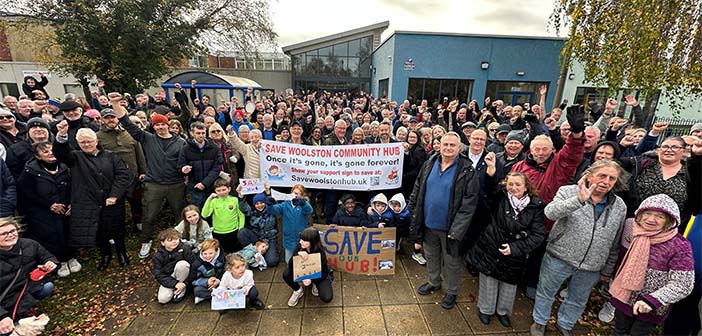
MEMBERS of the Save Woolston Hub campaign recently met with Council officers, the Cabinet Member for Leisure, and the local MP behind closed doors to discuss the continued closure of Woolston Neighbourhood Hub.
While Warrington Borough Council continues to state Legionella bacteria remains present within elements of the water system, so it would not be safe or responsible to reopen any part of the building, campaigners are challenging the science behind the decision.
Decsribing the recent meeting as “constructive and positive”, the campaign group continues to have “deep concerns” about the council’s decision-making, the rationale for full and continued closure, and the lack of proactivity to execute on its own Full Council motion, as well as lack of transparency in openly sharing the evidence which informed key decisions leading to consultation, and the ability to reflect on those decisions and reconsider its path when questions are raised.
The council’s narrative around the Hub’s closure has been widely reported, with safety issues and high costs being the dominant prohibitive factors in the hub’s short and long-term future. However, it now emerges that key assumptions—particularly around cost, safety, and feasibility—were made without robust evidence, surveys, or detailed technical analysis.
Key Clarifications from the Meeting
The £3 Million Figure
The Council has admitted that the widely cited £3 million repair figure is a high-level estimate only. No detailed scope of work or bill of quantities exists.
Long-Term costs or safe re-opening costs?
Officers confirmed that the majority of high-cost projections relate to medium- to long-term investment (5–10 years), not the immediate safety measures required to reopen the building today.
No Surveys Undertaken
No intrusive physical surveys have been carried out to ascertain the true extent of the technical issues. For example, no inspection has been conducted inside the roof void; assumptions about corrosion are based on the age of the building rather than evidence.
Maintenance Admissions
Officers admitted that no planned preventative maintenance (PPM), such as gutter clearing, is currently undertaken on the roof. This suggests leaks are likely linked to standing water and maintenance failures rather than sudden structural failure.
The “Scientifically Impossible” Claim – Library & Legionella
The Council continues to refuse re-opening the Library and Dry Side facilities, citing a “risk of death” from Legionella bacteria allegedly present within the ventilation system.
Scientific Challenge
Senior officers claimed that Legionella is “airborne” within dry ventilation ducts. This directly contradicts established Health & Safety guidance. Legionella is an aquatic bacterium; it requires water droplets (aerosols) to transmit. It cannot survive, multiply, or travel through dry ventilation systems.
Contradictory Evidence
The Council’s own water sampling data from September 2025 shows that outlets within the Dry Side (including GP Surgery and offices) tested negative for Legionella.
Conclusion
There is no scientific basis for keeping the Library closed. Unless the ventilation system is actively transmitting pool or shower water into the library—an extreme and serious biohazard in itself—the Dry Side is safe to occupy. The campaign is demanding that the Council immediately publish the Competent Person’s Risk Assessment that allegedly validates this “airborne” theory.
Ongoing Concerns
Missing Mitigations: After seven months without the pool and five months of full closure, there remain no meaningful mitigations for vulnerable users, including older residents, disabled people, families, and schools.
Operational Failures: Admissions regarding the failure to remove sludge from tanks and the cessation of mandatory weekly flushing suggest the Legionella outbreak may have been exacerbated by operational decisions rather than inherent building defects.
Political Will: There remains a distinct lack of proactivity from the Council in acting on the unanimous Full Council motion to explore all reopening options until the analysis of the consultation. This should be part of the consultation and has the mandate of Full Council following the motion.
The campaign does not expect a rushed decision on the long-term future of Woolston Hub. However, urgency is required in delivering short-term mitigations and the safe reopening of dry-side facilities.
Next Steps for the Campaign
Request Immediate publication of the Library Health & Safety Risk Assessment and the Competent Person’s report relating to alleged airborne risks.
Partial Reopening: A fair, evidence-based assessment of reopening dry-side facilities immediately, given they tested negative for Legionella.
Technical Scrutiny: Continued challenge of cost estimates that present assumptions and guesswork as fixed facts.
“The meeting gave us an opportunity to raise key concerns directly,” said a spokesperson for Save Woolston Hub. “We fully support caution regarding safety, but months on, the decision to keep the Library and GP surgery closed does not stack up. The Council claims a ‘risk of death’ from Legionella in dry areas, yet their own data shows those areas tested negative. Scientifically, Legionella cannot travel through dry air ducts. We are insisting the Council publish the technical risk assessment that justifies this closure. Furthermore, admitting that the £3 million figure is a long-term estimate—and that basic maintenance like gutter clearing had stopped—raises serious questions about whether this public asset is being managed in the community’s best interests.”
In response to the concerns, a Warrington Borough Council spokesperson said: “We welcomed the opportunity to meet with members of the Save Woolston Hub campaign committee, and we recognise the strength of local feeling about the hub and its importance to the community. Public safety, however, must remain our priority.
“Legionella bacteria remain present within elements of the water system, so it would not be safe or responsible to reopen any part of the building.
“We continue with the extensive process of reviewing and analysing all representations from the consultation process. This will help inform the development of several options, which include a full or partial re-opening of the facility or permanent closure. A formal decision is currently expected in early Spring.



5 Comments
The solution here is actually relatively simple. The HSE provides a specific Code of Practice (ACOP L8) for controlling Legionella. This isn’t a document based on opinion or guesswork; it is a factual, step-by-step legal requirement.
The evidence shows the Council simply hasn’t followed it. If they had followed the basic measures set out in L8—like flushing the pipes and cleaning the tanks—we wouldn’t be in this position. The building isn’t broken; the management process is.
Labour have too much control of our council s in this country
if you close WOOLSTON BATHS ! LABOUR will be finished in this town forever ! “WE WILL VOTE YOU OUT” !!
The sooner you vote them out the better !
Hotels and other structures have had this disease for years. They treat them and reopen.