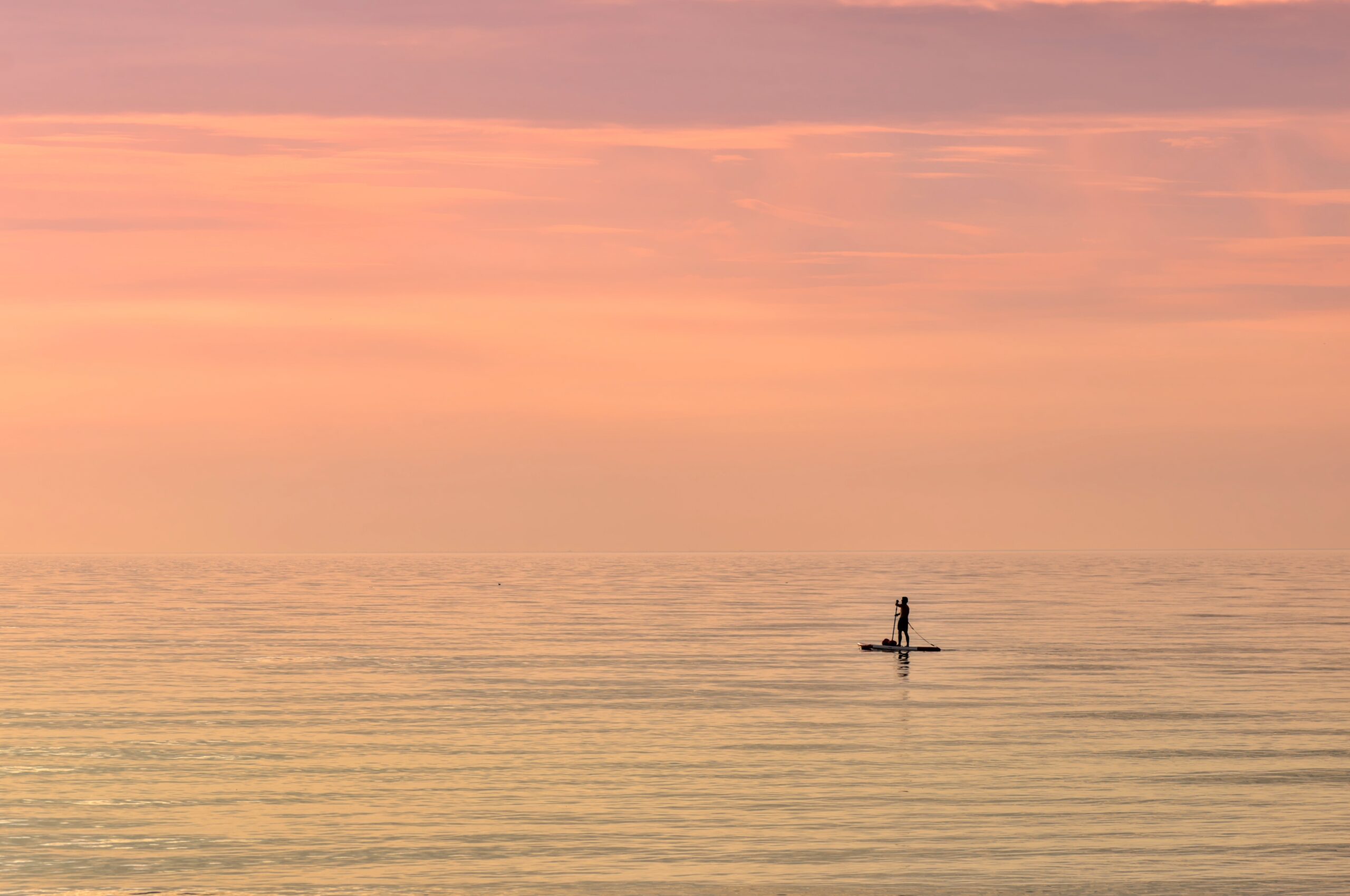
The mist hasn’t burned off yet when I push away from the towpath, and for a second the only sound is water dripping off the blade of my paddle. A stone bridge arches ahead, low enough that I have to duck.
On the other side, a narrowboat called Kingfisher’s Rest sits moored against the bank, curtains still drawn, a thin curl of smoke rising from its chimney. A heron watches from the reeds, unbothered, like it’s seen a hundred paddle boarders before me and has already decided I’m not interesting enough to fly away from.
This is not what people picture when they think of paddle boarding in Britain. They picture Cornwall. Sea cliffs, wetsuits, a bit of a swell to fight against. What they don’t picture is the quieter, stranger, arguably better version of the sport that’s been sitting under their noses the whole time: over 2,000 miles of canal, most of it dug by hand in the 1700s and 1800s to move coal and cotton, now doing nothing more strenuous than reflecting the sky.
Why Canals Beat Rivers and Lakes for This
Rivers have currents. Lakes have wind fetch that can turn a calm morning into a slog by lunchtime. The sea has, well, the sea, tides, swell, the occasional jet ski driver with main character energy.
Canals have none of that. They were engineered to be flat, because flat water is what you need to float a barge full of iron ore without losing half of it over the side. That same engineering makes them almost absurdly forgiving for anyone who’s never stood on a board before.
There’s also no current to fight, which means you can paddle out for an hour and know, with total confidence, that the trip back will feel exactly the same. No panicked recalculating about whether the tide’s turned.
And because canals were built to move goods, not just water, they run straight through the best bits of the landscape, under Georgian bridges, past Victorian ironworks, through hills via tunnels blasted through solid rock, and out into farmland where the only traffic is a moorhen dragging a family of chicks across your bow.
Five Canals Worth Packing a Board For
Regent’s Canal, London.
Start in Little Venice and paddle to Camden. You’ll pass the backs of houses worth more than most people’s life savings, glide beneath Regent’s Park where the zoo’s aviary sits practically on the water, and end up dodging tourists at Camden Lock. It’s the canal equivalent of a greatest-hits album.
Kennet and Avon Canal, Wiltshire.
Bath to Devizes, if you’ve got the stamina, or any short stretch in between. Aqueducts, sheep fields, and the Caen Hill flight of locks, 29 of them in a row, a genuinely strange thing to see from water level.
Llangollen Canal, Wales.
This one has a party trick: the Pontcysyllte Aqueduct, a cast-iron trough 126 feet above the River Dee that carries the canal (and you) straight across the valley with nothing but a low rail between you and a very long way down. Not for the faint of heart, but unforgettable.
Leeds and Liverpool Canal.
At 127 miles, it’s the longest single canal in Britain, and it earns every mile, mill towns, moorland, industrial brick giving way to open Pennine country.
Grand Union Canal.
The workhorse. It connects London to Birmingham, so if you’re after distance rather than drama, this is where you rack it up.
The Practical Bits Nobody Tells You
You do need a licence, and this catches a lot of first-timers off guard. Every unpowered craft on Canal & River Trust water, including inflatable boards, needs one, in the same way a rowing boat or kayak would.
Day licences run from around a fiver, or you can get a Paddle UK membership that covers thousands of miles of waterway in one go if you think you’ll be doing this more than once or twice.
Check the Canal & River Trust’s waterway map first; not every stretch is covered, and some reservoirs and private sections have their own rules.
Etiquette matters more on a canal than it does almost anywhere else you’ll paddle, mostly because you’re sharing the water with people’s actual homes. Give narrowboats a wide berth, especially near locks where they’re manoeuvring in a tight space.
Slow down when passing moored boats; your wake, however gentle, still rocks someone’s breakfast table. On the towpath side, dog walkers and cyclists have right of way if you’re carrying your board to the water, so don’t expect the path to part for you.
Early mornings are the move. Before nine, most canals are close to glassy, and you’ll have long stretches entirely to yourself. By midday, narrowboat traffic picks up, especially in summer, and the water gets choppier and more crowded.
On gear: an inflatable board is the obvious choice here, not because rigid boards don’t work, but because you’ll often be walking a fair distance from car park to water, and a roll-up board with an electric paddle board pump that fits in a backpack beats wrestling a nine-foot hardboard down a narrow towpath every time.
Safety Notes Worth Actually Reading
Canal water carries a small risk of leptospirosis, Weil’s disease, spread through animal urine in the water. It’s rare, but the precautions are simple: cover any cuts before you paddle, and shower properly afterward. If you develop flu-like symptoms in the days after a paddle, mention the water exposure to a doctor.
Locks and weirs deserve real respect. Never approach a weir without knowing exactly where it drops and how strong the pull is; the calm surface can be deceptive right up until it isn’t. Around locks, wait for boats to finish their business before crossing, and never try to “beat” a narrowboat through.
And don’t underestimate cold water outside of summer. Canals look tame, but falling in during February is still falling into cold water, and hypothermia doesn’t care how gentle the current was.
A Half-Day Route to Actually Try
If you want a low-stakes first outing, the stretch of the Kennet and Avon Canal from Bathampton to Bradford-on-Avon is close to perfect. Put in at Bathampton Lock, where there’s easy road access and parking. The first mile winds past Georgian terraces and under a handful of low bridges, good practice for ducking.
After that, the canal opens into farmland, with the Avon Valley rolling out on one side and the odd heron doing its best impression of a garden ornament. The Dundas Aqueduct, about three miles in, is worth a stop; you can pull up on the towpath and look down at the River Avon crossing beneath you.
Take out at Bradford-on-Avon, where there’s a café by the water that has clearly seen its share of dripping paddlers and doesn’t mind one bit. All in, it’s a two-to-three-hour paddle, flat the whole way, with an easy exit if the weather turns.
The Slow Travel of It All
Paddle boarding on the coast rewards a kind of adrenaline, reading a swell, timing a wave. Canals reward the opposite instinct: patience, attention, the willingness to go three miles an hour and actually notice things.
You see the country from a height and a pace nobody else gets, half a metre above the waterline, moving slowly enough to watch a kingfisher rather than just glimpse one.
If you’re tempted, don’t overthink the first trip. Check the Canal & River Trust’s route planner for a stretch near you, sort a day licence, and go out early on a still morning. The canals have been waiting patiently for two hundred years. They’re not going anywhere.