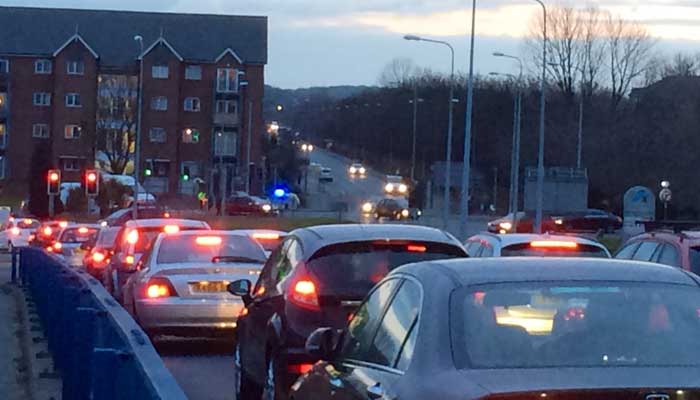
A new national survey has highlighted growing frustration for business drivers – as Warrington motorists face daily battles with queues and delays.
The survey has found that 59 per cent of people who drive for work are travelling more than they were last year, with congestion now their single biggest frustration.
And for Warrington businesses, the figures come against a backdrop of growing concern about the town’s already heavily congested road network.
According to the survey by Venson Automotive Solutions, 28 per cent of business drivers identified traffic congestion as their biggest frustration, compared with just 16 per cent who pointed to travel costs.
More than half – 53 per cent – said they would rather drive to a meeting than take the train or attend virtually, meaning the car remains the default choice for many business journeys.
For Warrington, where the town’s strategic location between the M6, M62 and M56 brings huge volumes of commuter and commercial traffic through the borough, congestion is not simply an inconvenience – it can have a direct impact on businesses, employees and the local economy.
Anyone regularly travelling through the town will be familiar with the problems.
The A49, A50, A56 and A57 can all experience significant delays, while the geographical constraints created by the Manchester Ship Canal, River Mersey and Bridgewater Canal mean there are relatively few routes across some of the town’s key transport corridors.
Warrington Borough Council itself has previously acknowledged that congestion can be particularly severe because traffic patterns can be affected by incidents on the surrounding motorway network and by the operation of the Ship Canal swing bridges.
Today alone there are 98 sets of roadworks within a five mile radius of Warrington!
The council is progressing schemes aimed at improving movement around the borough, including improvements to the A49 designed to tackle congestion at key junctions and improve connections between North Warrington and the town centre.
But the scale of the challenge is becoming increasingly difficult to ignore.
For local businesses operating vans, cars and commercial vehicles, time spent sitting in traffic quickly adds up.
A journey which should take 20 minutes can become 40 minutes or more during peak periods – with knock-on effects for appointments, deliveries, customer service and staff working time.
The Venson survey found that 35 per cent of those driving more for work are travelling slightly more than last year, while almost a quarter – 24 per cent – are travelling much more.
The company is urging fleet operators to look more closely at route planning, real-time traffic information and the amount of productive time being lost in congestion.
Simon Staton, Client Management Director at Venson Automotive Solutions, said:”Our research found that 28% of business drivers rank congestion as their single biggest frustration, nearly twice the 16% who point to cost.”
He said businesses should monitor the amount of time their vehicles spend in traffic alongside measures such as cost, safety and vehicle utilisation.
A growing issue as Warrington expands
The issue is particularly significant for Warrington because the borough is planning for further growth.
The council has now formally begun preparing a new Local Plan which will shape development across Warrington for the coming years, with transport infrastructure one of the key issues it will have to address.
The existing Local Plan already includes major development proposals, while the council’s transport strategy seeks to improve public transport and encourage more walking and cycling as part of its approach to managing congestion.
But with more homes, jobs, commercial development and logistics activity comes the obvious question:
How much more traffic can Warrington’s existing road network take?
That question is particularly pertinent in South Warrington, where existing roads and canal crossings have been the subject of repeated concerns during the Local Plan process.
Council-published representations from residents have highlighted existing congestion around Stockton Heath, Latchford, the Manchester Ship Canal and Bridgewater Canal crossings, while concerns have also been raised about the impact of future housing growth on already busy routes.
The national survey suggests the frustration is no longer simply about the financial cost of driving.
For business drivers, time is becoming the real currency.
Every minute spent stationary in a queue is time which cannot be spent visiting customers, making deliveries, completing jobs or running a business.
And with 59 per cent of business drivers saying they are travelling more for work than they were a year ago, the pressure on road networks is only becoming more significant.
For Warrington, the message is particularly stark.
Congestion isn’t just something motorists complain about on the school run or during the evening rush hour. It is increasingly a business issue – and ultimately an economic issue for the town.
The challenge facing Warrington will be finding ways to keep people and goods moving while the borough continues to grow.