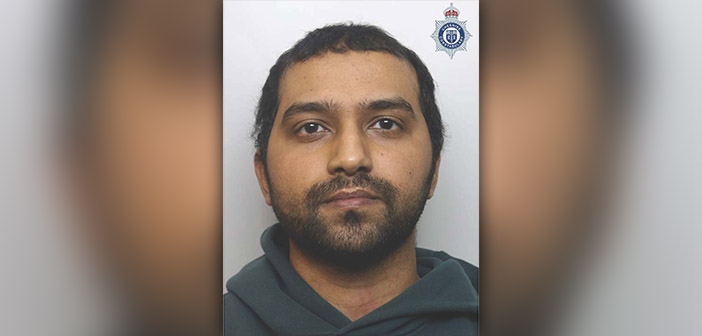
AN Indian man has been jailed for 30 years following Cheshire Police’s largest online child abuse investigation which identified 70 girls across the UK who were targeted and sexually exploited online.
Bilal Kazi, 27, of Hubert Croft, Birmingham, appeared at Chester Crown Court today (Friday, November 13), where he was sentenced to 30 years in prison, followed by a further eight years on extended licence.
He had previously pleaded guilty to 37 charges relating to child sexual offences.
The investigation was taken over by Cheshire Constabulary’s Online Child Abuse Investigation Team (OCAIT) in May 2022, after one of Kazi’s victims reported the abuse she had suffered to Derbyshire Police.
The victim had begun communicating with Kazi on Snapchat when she was 13, believing he was a boy of the same age.
However, conversations quickly became sexual, with Kazi requesting explicit photographs and videos. When the girl eventually told him she wanted to end the exchanges, he became abusive and threatened to distribute the material she had already sent to her friends unless she continued complying with his demands.
Fearing the threats, the victim felt compelled to continue sending images and videos. Her Snapchat account was subsequently hacked and the material was distributed to her friends.
She reported Kazi to police in November 2021.
Following initial enquiries, the investigation was transferred to Cheshire Constabulary after it emerged Kazi’s last known address was in Chester. However, he had left the area and his whereabouts were unknown.
It was later established that he had left the country. He was eventually arrested at Heathrow Airport in July 2023 after returning to the UK.
His mobile phone was seized and examined by Cheshire Constabulary’s Digital Forensics Unit. Investigators uncovered evidence of an extensive network of alleged offending, prompting a major victim identification operation.
Officers identified 180 potential victims, with specialist officers using usernames and other information recovered from his device to trace those targeted.
The investigation ultimately identified 70 girls, aged between 11 and 17 at the time of the offending, across 28 of the UK’s 45 police forces.
Each of the identified victims was visited by police officers and offered the opportunity to disclose their experiences.
Investigators established that Kazi used a consistent method to target young girls through social media platforms including Snapchat, Roblox and Wink.
He posed as a white British teenage boy called ‘Reece’, using photographs of an unidentified boy to convince victims they were communicating with someone of their own age.
After gaining their trust and creating the impression of a genuine romantic relationship, he would begin requesting explicit images and videos.
His demands frequently escalated, with victims being pressured into recording themselves performing sexual acts. When they refused, he threatened to share material they had already sent him.
In some cases, he maintained contact with victims for more than a year, continuing to deceive them about his identity.
Kazi was subsequently charged with 39 offences as part of Cheshire Constabulary’s investigation, relating to offending between August 2021 and August 2025. He admitted 37 charges, while two were left to lie on file.
He also faced eight further charges brought by West Midlands Police relating to offences committed while he was on police bail for the Cheshire investigation. These were taken into consideration as part of his overall sentence.
The offences included causing a child aged 13 to 15 to engage in penetrative sexual activity, blackmail and making indecent images of children.
Following sentencing, Detective Constable Georgia Hughes, of Cheshire Constabulary’s Online Child Abuse Investigation Team, said the scale of the offending had made it a “truly mammoth investigation”, requiring significant resources and collaboration across the force.
She said: “Thanks to the dedication and expertise of our colleagues in the OCAIT, Digital Forensics Unit and Victim Identification Unit, we were able to identify 70 victims across the UK and give them the opportunity to have their voices heard.
“There is a misconception that online offences have less impact on victims than crimes committed in person, but that could not be further from the truth.
“The girls targeted by Kazi were young and vulnerable. For many, their interactions with him were their first experience of what they believed to be a romantic relationship. Exploiting that trust, Kazi manipulated them into believing that his behaviour was normal.”
DC Hughes said the offending had left a profound and lasting impact on victims, many of whom had lived in constant fear of what Kazi might do if they refused his demands.
She added: “I hope today’s result provides the victims with a sense of closure now that Kazi has been held accountable for his actions, and I hope it allows them to move forward with their lives knowing that he can no longer cause harm to anyone else.”
Detective Sergeant Ross Peel urged victims of online abuse not to feel ashamed and encouraged parents to take an active interest in the online platforms their children use.
He said: “Victims should never feel ashamed of what they have experienced. The responsibility for these offences lies solely with the offender, and we want anyone who has been subjected to this kind of abuse to know that they will be listened to, supported and taken seriously.
“Our message to parents is to speak to your children and take an interest in the apps and platforms they are using.
“The potential for online offending is vast, and offenders can target children from anywhere in the world. By educating yourselves and your children about online safety and the risks associated with communicating with people they do not know online, you can help protect them from becoming victims of crime – the impact of which can be profound and long-lasting.”
He added that the case should serve as a warning to anyone who believes they can hide behind a screen and avoid detection.
“No matter where you are or how you choose to offend, those who target children and vulnerable people will be identified and brought to justice,” he said.