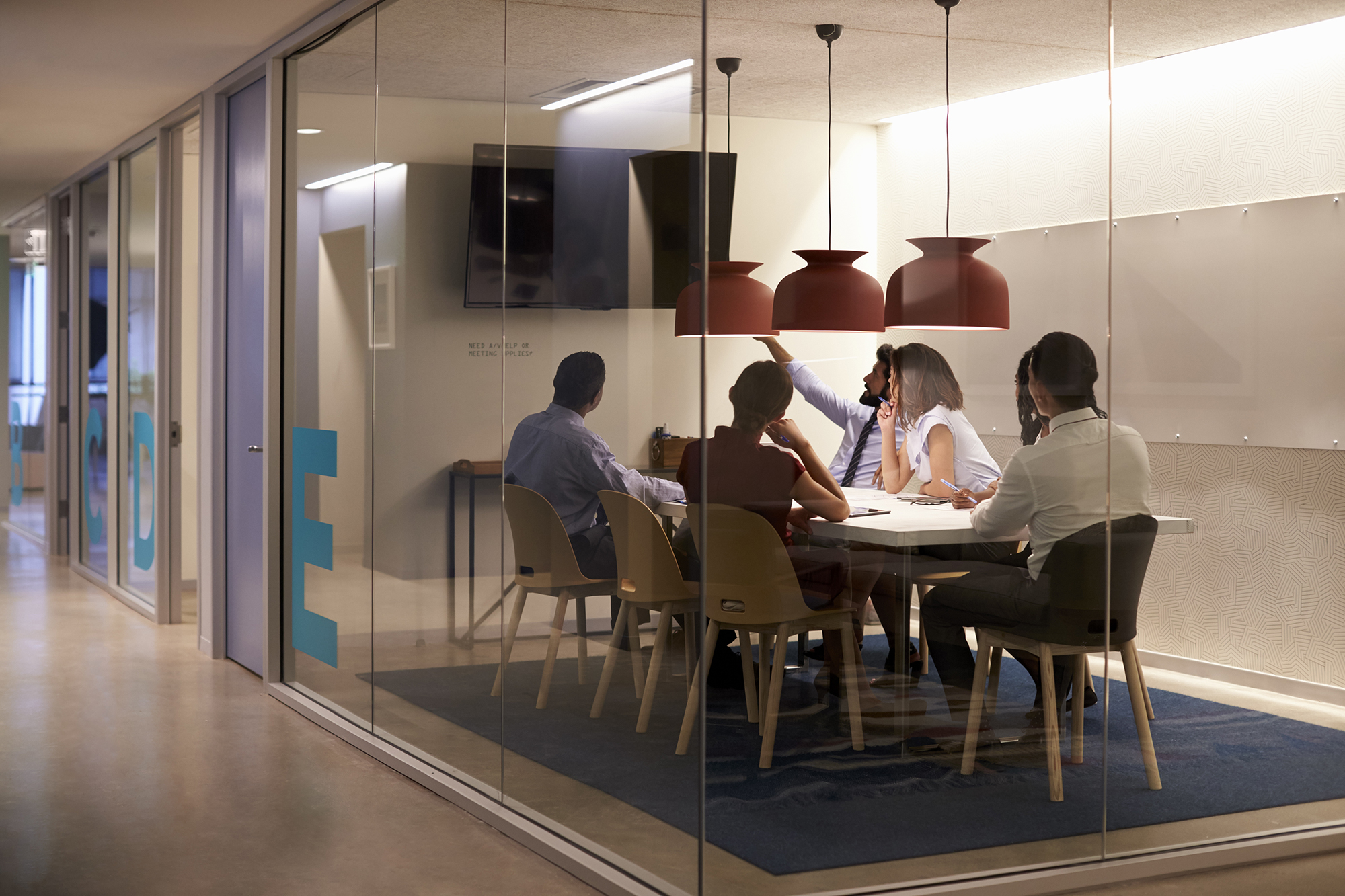
The shape of a meeting table can influence far more than the appearance of an office. It affects how easily people communicate, who can see whom, how formal a discussion feels, and whether participants naturally engage with one another. When meetings are a regular part of working life, these details can have a meaningful impact on the overall experience.
Choosing the right table should therefore begin with a simple question: How does your team actually meet? A leadership group conducting formal reviews has different needs from a creative team brainstorming ideas, while a hybrid workforce may need to prioritize camera angles, screens, power access, and clear sightlines. Understanding the strengths of different table shapes makes it easier to create a meeting space that supports the way people work rather than simply filling an available room.
Rectangular Tables for Structured and Formal Meetings
The rectangular table remains one of the most recognizable choices for traditional conference rooms. Its straight lines make efficient use of floor space and create a predictable seating arrangement. This makes it particularly suitable for rooms where presentations, formal discussions, leadership meetings, or client meetings are common. Its shape also makes it relatively straightforward to position a presentation screen at one end of the room.
Another defining characteristic is the sense of structure it creates. The seats at either end can naturally become perceived leadership positions, making this arrangement appropriate for meetings where a chairperson, executive, or presenter typically leads the discussion. For organizations that value a clear meeting hierarchy, this can be an advantage.
The main drawback is that a long rectangular table can create distance between participants. Someone seated at one end may find it harder to maintain eye contact with colleagues at the opposite end. If your meetings depend heavily on open discussion, consider whether the formal structure of a rectangle supports the type of interaction you want.
Boat-Shaped Tables for Executive Collaboration
A boat-shaped table offers a practical alternative to the traditional rectangle. Its sides gently widen toward the middle and taper toward the ends, creating a softer profile while retaining the substantial appearance expected in an executive meeting room. The wider center can also give participants a clearer view of people seated across from them.
This configuration works particularly well for leadership meetings, client discussions, and sessions that combine presentations with group conversation. It provides much of the formality associated with a conventional boardroom table, while its curved sides can make the room feel less rigid and encourage more natural interaction.
There are practical benefits as well. Participants often arrive with laptops, notebooks, documents, and other materials, so having sufficient surface area is important during longer meetings. However, boat-shaped designs can require a little more room than a straightforward rectangle. Before choosing one, consider the table’s overall dimensions alongside chair clearance and walking space.
Racetrack Tables for Balanced Interaction
Racetrack tables combine straight sides with rounded ends. The result is a design that retains much of the seating efficiency of a rectangular table while eliminating sharp corners. This can make the room feel more approachable and improve movement around the table.
The shape is particularly useful for teams that regularly switch between formal and collaborative meetings. A room might host an executive review in the morning and a project discussion later in the day. A racetrack table can accommodate both situations without making the space feel excessively formal.
The rounded ends can also make conversations more comfortable because participants are not positioned around abrupt corners. When combined with appropriate seating and technology, the shape can create a balanced environment that feels professional without becoming unnecessarily rigid.
Round Tables for Equal Participation
Round tables are particularly effective when the primary goal is conversation. Because there is no obvious head or foot of the table, the seating arrangement naturally feels more equal. Everyone faces toward the center, and participants can generally see one another without turning significantly.
This makes round tables well suited to brainstorming sessions, small team meetings, informal discussions, and collaborative decision-making. When everyone is expected to contribute, the absence of a designated head position can reinforce the idea that each participant has an equal role in the conversation.
The limitation is scale. A round table can work beautifully for a small group, but increasing its diameter to accommodate more people can make communication across the table less comfortable. It can also consume more floor space than expected. For larger groups, an oval, racetrack, or boat-shaped design may provide a better balance between collaboration and practicality.
Oval Tables for Comfortable Conversation
Oval tables provide another useful middle ground. They offer the length and capacity of a larger conference table while replacing sharp corners with curved ends. This can create a softer, more welcoming appearance without sacrificing the professional character expected in a formal meeting space.
The shape is particularly suitable for businesses that want their meeting rooms to feel polished but approachable. The curved ends can help improve sightlines, while the longer surface provides enough space for participants to work with laptops, documents, and presentation materials.
An oval design can also be a good choice when movement around the table matters. The curved ends make it easier to navigate the space compared with some large rectangular designs. However, the table still needs to be properly scaled to the room so that chairs can be pulled out comfortably and people can move around the perimeter.
Modular Tables for Flexible Meeting Rooms
Some meeting rooms need to do much more than accommodate a traditional conference. The same space might be used for leadership meetings, training sessions, workshops, interviews, or collaborative project work. In these environments, flexibility can be more valuable than a permanent table configuration.
Modular tables allow businesses to change the layout depending on the purpose of the meeting. Individual tables can be arranged into rows, groups, U-shapes, or smaller collaborative clusters. This can make one room useful for several different activities without requiring separate dedicated spaces for each function.
The trade-off is that modular furniture usually has a less permanent visual presence than a large executive table. For a formal boardroom, that may not be desirable. For a multifunctional workplace, however, the ability to rearrange the room quickly can make modular furniture a much more practical investment.
Consider the Way Your Team Uses Technology
Table shape should never be considered separately from technology. Modern meetings frequently involve laptops, displays, video conferencing, charging cables, microphones, and other equipment. A table may look perfect while still creating daily frustrations if participants cannot conveniently access power or if the layout produces poor camera angles.
Think about what happens during a typical meeting. Do most participants bring laptops? Are presentations displayed on a screen at one end of the room? Do remote colleagues regularly join through video conferencing? Does the table need built-in power or cable management?
These questions can influence the best table shape just as much as aesthetics. A design that gives everyone a clear view of the screen and one another can make hybrid meetings easier to manage. Similarly, appropriate cable management can prevent wires from becoming an inconvenience or creating unnecessary clutter.
Match the Shape to the Room
Even the right table shape can become the wrong choice if it is too large for the room. A table should leave sufficient space for chairs to be pulled out and for people to move around the perimeter. It is easy to measure an empty room and conclude that a particular table will fit, only to discover that chairs and people make the finished arrangement feel cramped.
The proportions of the room matter, too. A long, narrow room may naturally suit a rectangular or racetrack table, while a compact square meeting room may benefit from a round design. A boat-shaped table can work well in a larger executive room, provided there is enough space for its wider central profile.
The objective should not be to fill as much floor space as possible. Instead, aim for a layout that gives people room to sit comfortably, move naturally, see one another, and use the technology required for the meeting.
Let Meeting Behavior Drive the Decision
The most effective way to choose a table shape is to consider what actually happens during your meetings. If one person usually presents while others listen, a rectangular configuration may provide the structure you need. If meetings move between presentations and group discussion, a boat-shaped or racetrack design may provide a better balance.
For small teams where conversation and equal participation are priorities, round or oval tables can create a more relaxed environment. For rooms that serve several purposes, modular furniture can provide the flexibility needed to change the space according to the activity.
There is no single table shape that works for every organization. The right choice depends on team size, room dimensions, meeting style, technology requirements, and the atmosphere you want to create. When those factors are considered together, the table becomes a functional part of the meeting rather than simply another piece of office furniture.
Conclusion
A meeting table can quietly shape the way people communicate long before the first person speaks. A rectangular design can establish structure and formality, while a boat-shaped table can combine an executive appearance with improved interaction. Racetrack and oval designs offer softer alternatives for teams that want professional surroundings without an overly rigid atmosphere. Round tables can encourage equality and conversation in smaller groups, while modular options provide the flexibility required by multifunctional spaces.
The best choice is ultimately the one that reflects how your team works. Before selecting a table, think about the size of your meetings, the role of presentations, the amount of collaboration required, the technology people use, and the physical limitations of the room. A table that supports these everyday needs will do more than improve the appearance of the office—it can make meetings feel more comfortable, inclusive, organized, and productive.