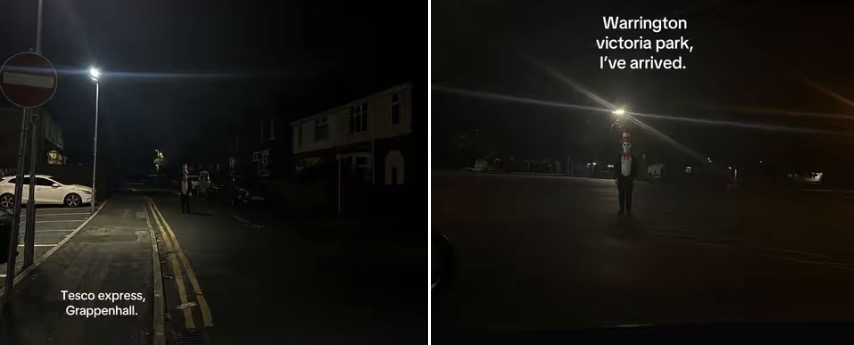
A VIRAL “Cat in the Hat” social media craze which has prompted police reassurance in other parts of the UK and Ireland appears to have reached Warrington – with Lymm seemingly next on the list.
Despite the deliberately creepy nature of the wider trend, reports from elsewhere in the UK and Ireland have shown that some of the most alarming claims surrounding it are not what they appear to be. Police in other areas have debunked supposed sightings and fake warnings, while artificial intelligence has been used in some content to place the character into images and videos of familiar locations.
In Warrington, a TikTok account has started posting videos featuring the character at recognisable local locations. (We have taken Cheshire Police advise not to advertise the account).
One video carries the words “Warrington Victoria Park I’ve arrived”, while another features Tesco Express in Grappenhall.
The account’s bio adds another local twist, simply stating: “Lymm pending.”
The Warrington posts come as the bizarre Cat in the Hat craze attracts national and international media attention, with The Independent reporting on police warnings over the viral social-media trend, while Euronews has looked at how the Cat in the Hat horror trend developed and spread. The story has also been covered by the BBC, The Telegraph and photography website PetaPixel, which examined the AI-generated imagery behind some of the supposed sightings.
The trend can be traced back to late June, when a TikTok clip took footage of Mike Myers playing the Cat in the 2003 film adaptation of Dr Seuss’s famous children’s book and paired it with an eerie soundtrack and dark caption. The now-deleted video reportedly attracted more than 4.4 million views in a week and helped inspire other users to turn the normally mischievous children’s character into an internet horror meme.
The craze then developed further, with increasingly unsettling pictures and videos purporting to show a life-sized Cat appearing in streets, driveways, outside homes and even looking through windows. The grainy, “found footage” style of many of the clips has helped make them appear convincing at first glance.
Some posts have gone much further by referring to a “killer Cat in the Hat” or suggesting the character is stalking neighbourhoods. Those claims have caused genuine concern among some younger social media users, with the BBC reporting that some teenagers had become frightened about going outside at night.
However, the wider reporting around the trend should provide some reassurance to parents and young people who may have been worried by the more extreme videos. There is no evidence in the national reports that a fictional “killer Cat in the Hat” is genuinely roaming communities in the way suggested by viral scare stories.
Gardaí in Wexford, Ireland, publicly reassured residents after similar posts circulated there, explaining that the phenomenon was essentially an AI prompt capable of placing the character into images and videos of recognisable places.
South Yorkshire Police also stepped in after a mocked-up social media statement falsely claimed officers were dealing with reports of a suspicious Cat in the Hat around Meadowhall.
The real force confirmed it had received no such reports and, while responding to the craze with some humour, made a serious point: people seeing supposed police warnings online should check that they have actually come from an official policing account.
That is particularly relevant because modern AI-generated images and video can make fictional scenes appear to have happened on a street, outside a shop or at a landmark people recognise. A familiar location does not, by itself, mean what is shown in a viral clip actually happened there.
The phenomenon has spread rapidly across social media, with reports and supposed “sightings” appearing in numerous parts of Britain and Ireland. For many users it is simply a horror-themed joke or piece of online storytelling, while others have played along with the idea that the Cat is travelling from town to town.
There is also an element of old-fashioned dressing up among some copycat videos, meaning not every Cat in the Hat clip online will necessarily have been generated by AI. What should not be assumed, however, is that ominous captions, “serial killer” claims or unofficial police notices accompanying such posts are genuine.
The Warrington account appears to be putting a distinctly local spin on the trend, using Victoria Park and Grappenhall before teasing Lymm as a possible next location.
At present it is unclear who is behind the Warrington account, whether its videos use AI, editing, a costume or a combination of techniques, and there is no evidence currently available to Warrington Worldwide linking the account to any criminal activity.
So while the videos may be designed to give viewers a fright, the wider story is also a timely reminder of how convincing fictional social-media content can now become.
Parents whose children have seen some of the more alarming versions of the trend can point to the fact that police in areas where specific claims have circulated have debunked them. As with any alarming viral post, viewers should check the original source before sharing it as fact – particularly when it claims to contain information from the police.
For Warrington residents, the local posts should therefore be viewed in the context of the wider viral online craze. Nothing currently available to Warrington Worldwide indicates that the Warrington account represents a threat.
With Victoria Park and Grappenhall already featuring and “Lymm pending” in the account’s bio, the question now is less whether Warrington has something to fear – and more which familiar local landmark might feature in the internet joke next.
After being contacted by Warrington Worldwide Cheshire Police issued the following statement: “We wouldn’t comment on individual social media accounts, many of which contain AI content generated for clickbait purposes.
“We have not received any reports of this nature, and anyone with concerns should contact us via 101.
“We would also urge local media not to advertise such accounts as this will likely encourage copycat content.”