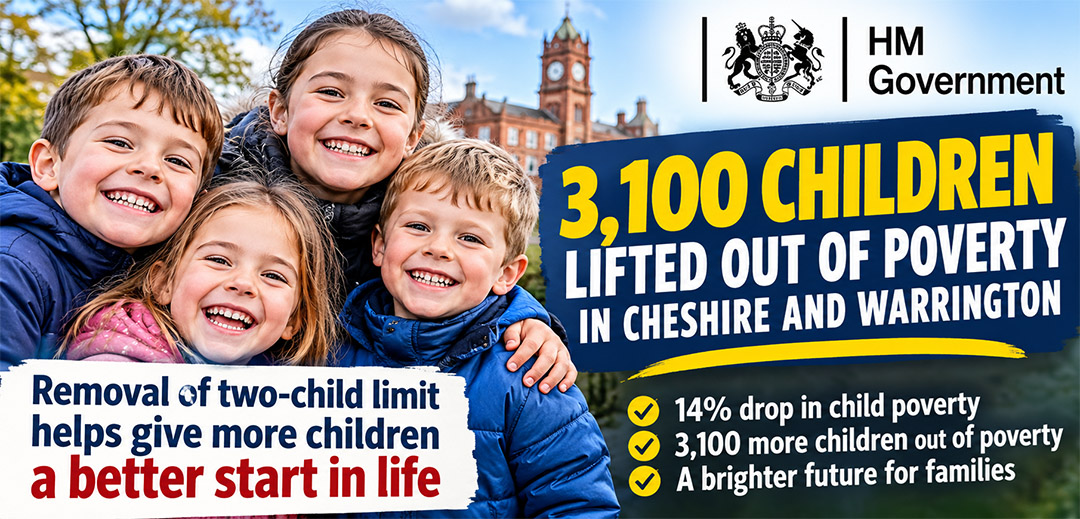
NEW government figures show child poverty among Universal Credit families in Cheshire and Warrington has fallen by 14 per cent in 12 months following the removal of the controversial two-child limit.
Some 3,100 children across the Cheshire and Warrington Combined Authority area have been lifted out of poverty following the Government’s decision to scrap the two-child limit on Universal Credit, according to new statistics published today (Tuesday, November 17).
The figures represent the first assessment of the impact of the policy change, which was announced in the November 2025 Budget and came into effect in April 2026.
Across the UK, the Government says around 300,000 children have already been lifted out of poverty as a result of the change, with that figure expected to rise to 450,000 by the end of the current Parliament.
In Cheshire and Warrington, the number of children in families receiving Universal Credit who were living in poverty fell from 30,500 in May 2025 to 26,100 in May 2026.
That represents a reduction of 4,400 children, or 14 per cent, over the 12-month period.
The Government says the policy is intended to give more children a better start in life by providing additional financial support to larger families.
The figures have been released on the same day as Alan Milburn’s final report into tackling Britain’s NEET crisis – young people not in education, employment or training.
The Government argues that reducing child poverty is an important part of addressing the problem, with children growing up in poverty more likely to face difficulties accessing education, employment and opportunities later in life.
Work and Pensions Secretary Pat McFadden said the changes were about changing the life chances of children growing up in disadvantaged circumstances.
He said: “This is about changing the story of children’s lives. Children who grow up in poverty are more likely to have mental health difficulties, to be NEET and to earn less as adults.
“We want to give every child a genuine shot at life – to do well at school, stay healthy, succeed at work – ultimately contributing to their community as adults.”
He described removing the two-child limit as a cost-effective way of reducing child poverty and an investment in children, families and the wider country.
Education Secretary Lucy Powell said no child’s future should be determined by the circumstances into which they were born.
She added that the first figures demonstrated what could be achieved, but said further measures, including free school meals, breakfast clubs and increased childcare provision, would also help ease pressure on families.
Impact across Warrington and Cheshire
The Government has published constituency-level statistics covering nine parliamentary constituencies within the Cheshire and Warrington Combined Authority area.
These include:
• Chester North and Neston
• Chester South and Eddisbury
• Congleton
• Crewe and Nantwich
• Macclesfield
• Mid Cheshire
• Tatton
• Warrington North
• Warrington South
The national figures show that, in May 2026, almost 1.57 million children were in families whose Universal Credit payments increased following removal of the two-child limit.
Of these, 301,720 fewer children were living in relative low income after housing costs.
Families receive just over £300 in additional Universal Credit support each month for every child previously affected by the two-child limit.
The Government estimates that removing the restriction will lift 450,000 children out of poverty by 2029/30 compared with retaining the policy. This could rise to 550,000 when other measures in its Child Poverty Strategy are included.
The Government defines poverty using the official measure of relative low income after housing costs.
The latest figures provide an early indication of the impact of the policy change, although the longer-term effects on child poverty and family living standards remain to be seen.
The full statistics, including constituency breakdowns, are available through the Government’s website: Statistics on the impact of removing the two-child limit from Universal Credit, May 2026.