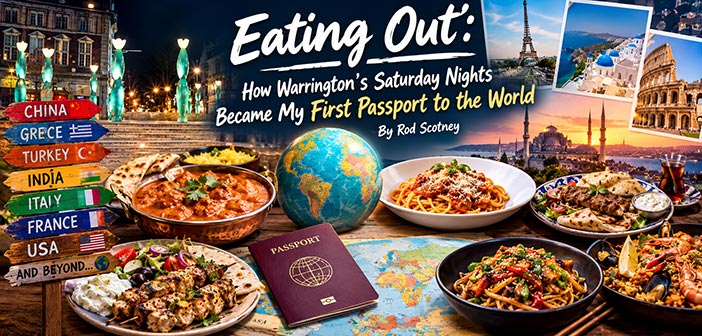
by Rod Scotney
GROWING up in Warrington, my first glimpse of foreign culture didn’t come from airports, guidebooks or geography lessons.
It arrived far more quietly — through one of the most English rites of passage: a Saturday night out with your mates, followed by a late night dash to whichever restaurant was still serving. China, Greece, Turkey, India, Italy, France, even the deep South of the USA — all of them reached me not through travel, but through menus.
Eating together is humanity’s oldest diplomatic tool. A pub lunch with your boss, a business dinner with customers, a celebratory meal after a deal — these rituals are universal. But beyond commerce, food becomes something deeper. It binds families at Christmas, knits friendships at barbecues, and turns simple birthdays into moments of belonging. The most human form of sharing doesn’t happen in conference halls or podcasts. It happens around a table holding food and drink.
Those Warrington suppers weren’t just part of growing up. They were tiny cultural windows. A plate of souvlaki, a bowl of curry, a slice of pizza — each one was a small act of exchange. You didn’t need a passport; you just needed a mate who fancied a change from chips and gravy.
Years later, in Somerset, I found myself thinking about all this. My wife and I visited an Indian restaurant: excellent service, generous menu, reasonable prices. But something was missing. The food was Indian, yet the atmosphere was unmistakably British. When you’re eating a curry beneath IKEA wall art while Pearl’s a Singer hums softly from the speakers, you’re not transported to Bombay — you’re transported straight back to your youth.
And that’s the point. Food alone doesn’t create cultural experience. Atmosphere does. Memory does. The sense of stepping briefly into someone else’s world does.
Warrington’s late night eateries — with their bold décor, unapologetic music choices and sometimes clumsy attempts to recreate distant places — gave us more than a meal. They gave us a glimpse of life beyond the town. They taught us that culture can be tasted long before it’s understood.
The Tourist Boom and the Second Passport
If restaurants were my first passport, the 1970s package holiday was Britain’s first mass market gateway to the wider world. It was chaotic, basic and often hilariously makeshift — the travel equivalent of a Morris Minor. But when the alternative was staying put, even a rough week on the Costa Del Sol felt like a revelation. For the first time, ordinary families could step beyond their own borders and sample a version of foreign life, however curated it might have been.
Looking back, my education in culture came in three stages. First, the restaurant snapshot — those Warrington nights where unfamiliar dishes hinted at a wider world. Second, the tourist resort imitation — glossy, packaged, designed for visitors. And third, the real thing: the moments when you step away from neon signs and souvenir shops and find yourself inside the authentic rhythms of another place.
Which brings me, inevitably, back to food.
Croatia
Seven years ago, while holidaying in Croatia, my wife and I noticed a handwritten sign on the hotel board:
Visit the real Croatia — visit a rural village and have supper in a barn.
It sounded wonderfully odd. We booked immediately.
Only four of us climbed into the minibus. The “village official” who greeted us turned out to be the driver himself. The village consisted of him, his wife, his elderly mother in law, his best mate — and a donkey who appeared to be the unofficial mayor. We walked across a field, patted the donkey, toured an 18th century home, then settled in an old toolshed where we drank wine, listened to stories and ate a large flat bread cooked directly on hot embers.
As the embers crackled, our host told us about his years working across Europe, including two spent in London. His passion was football; he’d visited almost every Premiership ground. He and his friend even remembered a couple of nights they’d spent in Warrington.
Then came the moment that stopped me.
As I brushed ash from my final piece of garlic bread, the two men told us — with absolute sincerity — that British pub food was the best food in Europe. Consistently good, town to town. Served in warm, friendly, atmospheric places that genuinely reflect the character of England.
They explained the economics: the cost of a good British pub meal was comparable to only basic café food elsewhere in Europe. To enjoy a dining experience of pub standard on the continent, they said, you’d need to visit a restaurant four or five times as expensive. When asked what they missed most about England, their faces lit up: shepherd’s pie, steak pie, fish and chips, and a proper full English breakfast.
“Good luck trying to buy that in Croatia,” they laughed.
Full Circle
And there it was. The 19-year-old me who once sat in a Warrington Chinese restaurant dreaming of distant cultures was now sitting on a cushion in a Croatian toolshed, eating charcoal dusted garlic bread and being told that the food I grew up with — the food I thought of as ordinary — was someone else’s exotic, atmospheric, unforgettable experience.
Eating out was my first passport. For many of us, all over the world, it still is.