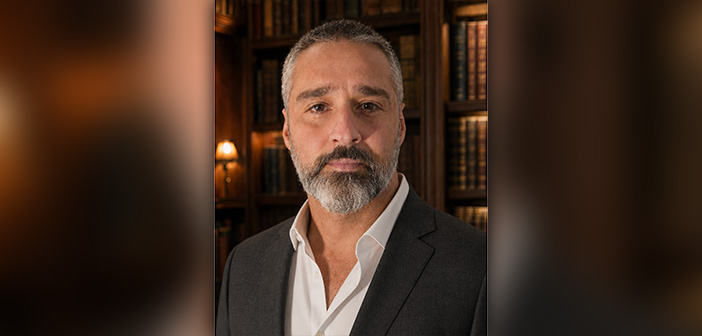
A new Warrington-based business is aiming to transform the way people understand emotions, decision-making and personal development through a unique philosophical approach.
The Hexology Institute, founded by philosopher, author and Aikido master Augusto do Carmo, has been launched with the ambition of becoming an internationally recognised centre for philosophical education and research into human behaviour, emotional wellbeing and self-governance.
The venture is taking part in the Warrington Chamber of Commerce Enterprise Accelerator Programme, which supports new and growing businesses across the borough.
Augusto said the inspiration for establishing the Institute stemmed from decades of personal study into why people respond so differently to the same situations.
“The work of the Institute begins with two fundamental questions,” he explained. “Why do we make the choices we make, and why do we differ emotionally before the same event?”
Having spent many years researching human behaviour, emotional conflict and self-knowledge, Augusto said he became fascinated by the apparent contradictions in human nature.
“We often know what we should do, yet still do the opposite. We know that a reaction may harm us, damage a relationship or create consequences we will later regret, but in the moment something appears to take control before conscious reasoning has the opportunity to intervene.”
His research eventually led to the development of Hexology, a philosophical framework based on the idea that people possess an innate ethical structure which influences how they experience emotions and respond to the world around them.
The theory suggests that individuals are naturally more sensitive to different ethical values, including justice, dignity, freedom, recognition, security and compassion. According to Augusto, these differences help explain why people can experience the same event in dramatically different ways.
“The same criticism may deeply wound one person and barely affect another. The same injustice may provoke anger in one individual, fear in another and indifference in someone else. The external event is the same, but the internal experience is profoundly different,” he said.
The Hexology Institute plans to develop books, online courses, workshops and one-to-one programmes, alongside a structured assessment process known as the Principle Mapping Protocol, designed to help people better understand the ethical principles that shape their behaviour and decision-making.
Originally moving to the UK to introduce his ideas to universities and encourage academic collaboration, Augusto hopes interdisciplinary research will further develop Hexology and contribute to new ways of understanding emotional wellbeing.
Alongside the launch of the Institute, he is conducting a public survey exploring attitudes towards philosophy and its role in everyday life, particularly in relation to emotional wellbeing and mental health.
Looking to the future, Augusto hopes the Warrington-based organisation will help restore philosophy to a more prominent place in modern society.
“I believe philosophy can play a meaningful role in emotional wellbeing, relationships, leadership, personal responsibility and the development of a more humane society,” he said.
For more information about The Hexology Institute or to take part in its public survey, visit www.hexology.net