CHESHIRE Constabulary has been praised for its use of retrospective facial recognition technology in a national report, as the technology continues to attract attention following a recent successful live trial in Warrington town centre.
A report by His Majesty’s Inspectorate of Constabulary and Fire & Rescue Services (HMICFRS), published on November 12, highlighted Cheshire Police as an example of good practice in the use of Retrospective Facial Recognition (RFR), while urging forces across England and Wales to improve their use of the technology and strengthen safeguards to maintain public confidence.
Retrospective facial recognition allows police to analyse images captured by CCTV, dashcams and social media footage in an attempt to identify suspects. Potential matches against police databases can be passed to investigating officers for further enquiries.
Cheshire Police said images analysed through the process are promptly removed from police systems once searches have been completed.
The national report highlighted Cheshire’s approach to monitoring the effectiveness of the technology, with the force having established Operation Identifying to examine deployment outcomes.
Its analysis found cases involving at least one positive facial recognition match were more likely to result in a positive outcome, including arrests and charges.
The inspectorate also praised the force for ensuring outcomes from facial recognition deployments are reported at weekly crime accountability meetings, providing oversight of how the technology is being used.
Cheshire Constabulary has one of the highest levels of retrospective facial recognition use in the country.
Between April 2025 and March 2026, officers carried out 24,018 retrospective facial recognition searches – the highest level of use relative to the number of recorded crimes of any police force in England and WaThe force operates its own in-house facial recognition team, with staff completing a five-day training course provided by the FBI, alongside regular competency testing.
The report also highlighted a case in which officers investigating a knife-point robbery in Crewe carried out an urgent facial recognition search within 10 minutes of attending the incident.
The technology identified a suspect seen catching a train to London. British Transport Police were contacted, stopped the train and arrested the suspect, recovering the stolen property. The man was subsequently jailed for eight-and-a-half years.
The force’s facial recognition team was also recognised internally, winning Staff Team of the Year at the Achieving Cheshire Excellence Awards in October after increasing submissions by 46 per cent and achieving a record 142 positive identifications in a single month.
Warrington trial put facial recognition in the spotlight
The national recognition comes at a time when facial recognition technology has been put to the test in Warrington town centre, where Cheshire Police carried out its first live facial recognition deployment on October 9.
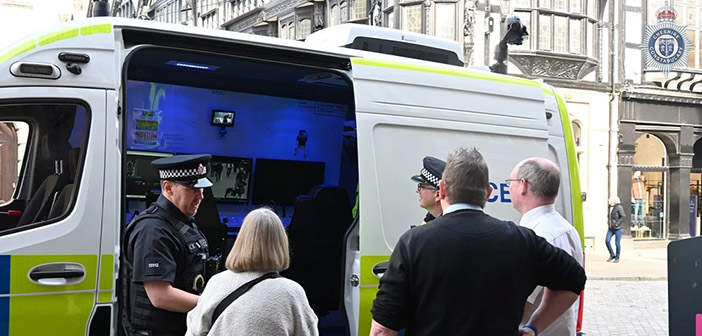
The operation, previously reported by Warrington Worldwide, saw a facial recognition van deployed in the town centre as officers engaged with members of the public, explaining how the technology worked and answering questions about privacy and safeguards.
More than 4,750 faces were scanned during the deployment, with two alerts generated by the system relating to people reported missing.
The operation also resulted in police action against a number of individuals through officers on the ground, including arrests relating to theft and a wanted man found carrying a knife.
The Warrington deployment used Live Facial Recognition (LFR), which scans faces in real time against a pre-approved watchlist. The national report praising Cheshire relates to Retrospective Facial Recognition (RFR), which is used to analyse images after an incident has taken place. The two technologies are related but operate differently.
Chief Inspector Darren Griffiths, Head of Forensics at Cheshire Constabulary, said the technology had enabled investigations to progress more quickly than traditional manual image comparison.
He said: “Retroactive Facial Recognition can positively identify suspects within seconds and with minimal room for error.”
However, he acknowledged the importance of safeguards as the technology continues to develop, adding that these were necessary to ensure it was properly governed and to maintain public confidence.
The force maintains that facial recognition is not used for mass surveillance, does not track people and does not store images of the general public.
The national inspectorate’s report nevertheless calls for forces to improve their use of retrospective facial recognition and ensure proper oversight, accountability and public confidence as its use becomes increasingly widespread.
The technology is likely to remain a growing part of modern policing, with the Warrington deployment providing a local example of how facial recognition is being introduced on the streets – and the wider national report highlighting the importance of ensuring it is used responsibly, transparently and with appropriate safeguards.