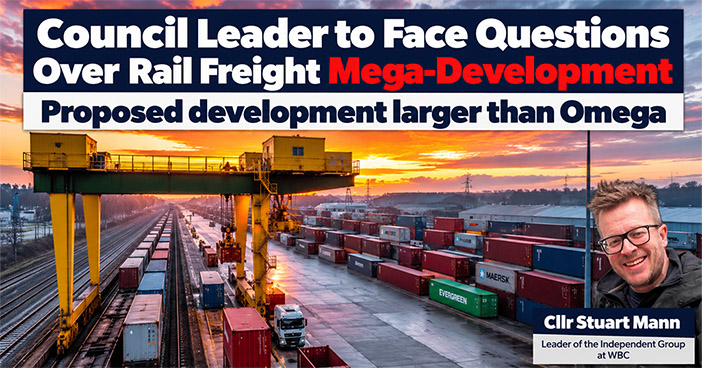
INDEPENDENT Cllr. Stuart Mann is to challenge Warrington Borough Council’s leadership over whether it will formally oppose a massive proposed rail freight logistics development near Winwick and Croft.
Cllr Mann, Independent councillor for Burtonwood and Winwick and Leader of the Independent Group at Warrington Borough Council, will raise the issue at Full Council on Monday, October 26.
He wants to know whether Warrington will follow Wigan Council, which voted unanimously in September to oppose the proposed Tritax Intermodal Logistics Park North (ILPN).
The development is proposed on predominantly agricultural land east of the M6 near Junction 22, within St Helens borough but close to the Warrington boundary.
Cllr Mann says the potential impact on communities in north Warrington could be immense, warning that many residents may not yet appreciate the scale of what is being proposed.
The main development and associated land identified for rail infrastructure, soil redistribution and environmental mitigation could cover approximately 350 hectares – equivalent to 864 acres or 37.6 million square feet.
That would make the combined area around 50 per cent larger than the original 575-acre Omega development at Burtonwood.
The scale is also equivalent to almost 11 Gulliver’s World theme parks or approximately 490 full-sized football pitches.
The comparisons include associated land and mitigation areas, rather than suggesting the entire site would be covered by buildings.
The proposals could include 17 enormous warehouses, potentially reaching heights of around 30 metres, comparable to the Home Bargains distribution centre at Omega and twice the height of those at the controversial Astley Business Park.
The warehousing floorspace alone could total approximately 8.26 million square feet, alongside a major rail freight terminal capable of handling up to 16 freight trains per day.
Cllr Mann said: “I genuinely don’t think enough people realise the sheer scale of what is being proposed on our doorstep. We are talking about a development and associated land area larger than Omega, with potentially 17 enormous warehouses and a major rail freight terminal.
“Imagine almost 11 Gulliver’s World theme parks or nearly 500 football pitches. That’s the scale we’re dealing with, and it’s being proposed less than a mile from Winwick and Croft.
“This is something that could fundamentally change the character of our area forever.”
Cllr Mann is also keen to make clear that the Tritax proposal is entirely separate from the existing Parkside developments on the former colliery site.
Parkside Phase 1 is already progressing, while Phase 2 received approval from St Helens Council’s Planning Committee on October 6, subject to conditions and a Section 106 legal agreement.
The Tritax proposal would be an additional development, principally on agricultural land east of the M6.
Its potential traffic and environmental impacts would therefore need to be considered alongside those arising from Parkside, rather than being treated as part of the same scheme.
Cllr Mann said: “I think it is important residents understand this is not the Parkside development on the old colliery site that many people are already familiar with. Parkside Phases 1 and 2 are separate developments.
“Tritax would be additional to those, bringing potentially significant further pressure on the same roads and surrounding communities.”
Traffic and environmental concerns
Although the main development would be located within St Helens, Cllr Mann argues that its consequences would extend well into Warrington.
The proposals include approximately 93.7 hectares of land identified for soil reuse and redistribution, including land extending into Warrington Borough at Croft.
The rail freight interchange could generate more than 1,300 HGV movements per day, alongside additional traffic from employees and other vehicles.
Concerns include the A49, Winwick Link Road, M6 Junction 22 and M62 Junction 9, as well as the potential for HGVs to use unsuitable local routes.
Cllr Mann believes the impact on Winwick, Croft and surrounding communities must be considered alongside the substantial traffic already expected from Parkside Phases 1 and 2.
Parkside Phase 2 alone has a proposed highway contribution of approximately £6.025 million towards improvements at four A49 corridor junctions.
He has previously argued that any additional highway improvements required because of Tritax must be funded separately and should not rely on contributions intended to address the impacts of Parkside 1 and 2.
There are also concerns about potential Green Belt loss, noise, air quality and the environmental impact of extensive construction and earthworks.
Cllr Mann said: “The fact that the main development sits within St Helens doesn’t mean the consequences stop at the borough boundary. Land within Warrington itself is identified for associated works, while our communities could face significant additional HGV traffic, noise and pollution.
“We already have substantial development pressure across north Warrington. Adding something of this magnitude without properly considering the cumulative impact would be deeply concerning.
“Warrington Borough Council has a responsibility to take a clear position and ensure our residents’ interests are protected.”
Cllr Mann also believes the proposals raise serious questions about Warrington Borough Council’s declared climate emergency and the potential environmental consequences for surrounding communities.
While acknowledging that transferring freight from road to rail can reduce carbon emissions nationally, he argues those benefits must be considered alongside emissions generated by vehicles travelling to and from the proposed interchange locally.
An illustrative calculation based on more than 1,300 HGV movements per day suggests those movements alone could generate approximately 2,135 tonnes of CO₂ annually across a five-kilometre section of the surrounding road network.
The estimate assumes 1,300 HGV movements daily, an average of five kilometres travelled per movement on the surrounding road network and an illustrative emissions factor of 0.9 kilograms of CO₂ per HGV kilometre.
It is not an official emissions forecast from Tritax and does not account for any national carbon savings from transferring freight to rail.
The calculation also excludes emissions from employee vehicles, construction traffic, rail operations and other activities associated with the development.
Cllr Mann said: “I understand that moving freight from road to rail can deliver environmental benefits nationally, and I’m not dismissing those benefits, but a development can potentially reduce carbon emissions nationally while still increasing traffic and pollution in the communities immediately surrounding it.
“Warrington has declared a climate emergency, and I believe the Council needs to explain how its response to a development of this magnitude is consistent with that commitment.
“National environmental benefits should not be used to overlook potentially significant local environmental consequences for communities such as Winwick and Croft.”
Communities coming together
Alongside raising the matter at Full Council, Cllr Mann has been working with fellow councillors, parish councils, community groups and concerned residents to consider how best to respond to the proposals.
Representatives from potentially affected communities are coming together to share information, examine the development and explore how to make effective representations through the Government’s Development Consent Order process.
Unlike a conventional planning application, the Tritax proposal is expected to be determined nationally by the relevant Secretary of State.
The emerging collaboration is considering how best to coordinate local knowledge, technical evidence and potential specialist expertise, particularly around highways, environmental impacts, Green Belt and the cumulative consequences of other developments.
Each participating council and organisation will retain responsibility for determining its own position.
Cllr Mann said: “This is far too significant an issue for individual communities to tackle in isolation. The final decision may rest with the Government, but that doesn’t mean local people should have any less of a voice.”
The central question Cllr Mann intends to put to the Leader at Full Council is whether Warrington Borough Council will follow Wigan Council’s example and formally oppose the Tritax development.
Wigan Council voted unanimously against the proposals in September, citing concerns about the potential consequences of the scheme.
Cllr Mann believes Warrington’s proximity to the site, the proposed works within its boundary and the potential impact on local roads provide strong grounds for the authority to take a clear stance.
He said: “Wigan Council has already made its position clear, and I believe residents in Warrington deserve to know where their own Council stands.
“If Warrington Borough Council is not prepared to oppose it, I want the Leader to explain why and what alternative action the Council intends to take to protect our communities.
“Our residents should not be left carrying the consequences of decisions made elsewhere.”
The Full Council meeting, starting at 6.15pm on Monday, October 26, 2026, will be live-streamed, allowing residents to hear Cllr Mann’s question and the Council Leader’s response.
It can be watched at Warrington Borough Council’s live-streaming portal https://warrington.public-i.tv/core/portal/home.
Cllr Mann hopes the debate will raise greater awareness of the scale of the proposals and encourage residents to take an interest in the forthcoming planning process.
He added: “I believe many people don’t yet realise what’s being proposed so close to their homes. This is not the Parkside development they may already know about.
“It is an additional proposal on a scale that could dwarf many of the developments we’ve previously seen in this area. Residents of Warrington deserve to understand the proposals and know whether Warrington Borough Council is prepared to stand up for them.”