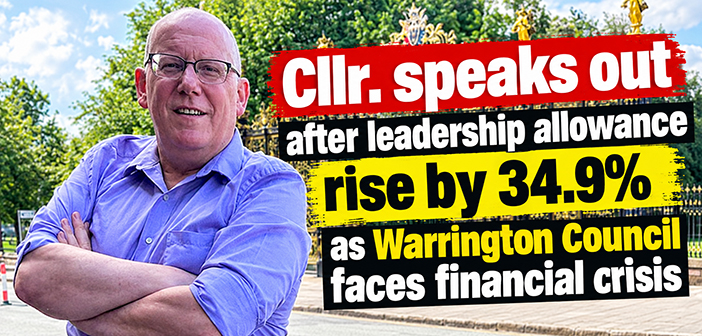
WARRINGTON’S political leadership has seen allowances rise by almost 35 per cent while the Council is asking residents to pay more Council Tax and is cutting spending and jobs.
That is the issue being highlighted by Lymm South Independent councillor Graham Gowland, who has gone through Warrington Borough Council’s own published figures on councillor allowances.
The figures show a clear difference between the increase in the basic allowance paid to councillors and the allowances paid to those holding senior political positions.
The basic councillor allowance has risen by 3.2 per cent.
But the Deputy Leader and Cabinet Members have seen their allowances rise by 34.9 per cent.
And the Leader’s allowance has risen by 34.9 per cent over two years.
The figures in simple terms.
| Position | Previous allowance | Current allowance | Increase |
| Basic councillor | £10,577.77 | £10,916 | 3.2% |
| Leader | £20,015 | £27,000 | 34.9% over two years |
| Deputy Leader | £15,012 | £20,250 | 34.9% |
| Cabinet Member | £10,008 | £13,500 | 34.9% |
The Leader’s allowance therefore increased from £20,015 to £27,000 – an increase of £6,985, or 34.9 per cent.
The increase happened in two stages, with the allowance first moving to £25,000 before rising to the current £27,000.
The Deputy Leader’s allowance increased by £5,238.
Each Cabinet Member receives £3,492 more than under the previous allowance.
With eight Cabinet Members, that represents an additional £27,936.
The figures come from Warrington Borough Council’s own published Members’ Allowance Schemes.
Cllr Gowland, who quit the opposition Lib Dem group due to frustrations within the group, says he is not questioning the workload of councillors holding senior positions. His concern is the scale of the increases at a time when the Council is under severe financial pressure.
“I am not saying people in those roles do not work hard – they do,” said Cllr Gowland.
“But I do not think you can ask residents for more Council Tax, cut services, and tell staff there is no money, while the top allowances go up 34.9 per cent in a year when the basic goes up 3.2 per cent.”
The Council’s own figures show that Warrington is facing a £178.9m budget gap over four years.
It has identified around £40m of savings for 2026/27, with further savings required.
Residents have also faced a 7.48 per cent Council Tax increase for 2026/27.
That financial backdrop has inevitably brought spending across the Council under greater scrutiny.
Cllr Gowland has also published his own payments.
In 2024/25 he received:
£10,577.76 basic allowance + £243 travel = £10,820.76
In 2025/26:
£10,916.04 basic allowance + £243 travel = £11,159.04
He receives no Special Responsibility Allowance.
“I took the rise,” he said.
“That was +£338.28 = +3.2%, which was the staff NJC pay award. I think you should know that. I will publish mine every year.”
Five serving councillors also asked Democratic Services to remain on the previous basic rate rather than take the increase, according to Gowland.
They are Judith Wheeler, Paul Warburton, Kevin Burgess, Sharon Harris and Eunice Peters.
Almost £100,000 more in total payments
Gowland has also compared the Council’s published annual payment schedules.
The total payments recorded for councillors rose from:
£817,322.23 in 2024/25
to
£915,152.54 in 2025/26.
That is an increase of £97,830.31 – almost £100,000 in one year.
The figures cover payments to all councillors, including basic allowances, Special Responsibility Allowances and eligible expenses.
Gowland has also highlighted fellow Independent councillor Stuart Mann, who represents Burtonwood and Winwick. According to the Council’s payment figures, Mann did not move onto the new basic allowance.
He did receive a £1,302.42 Group Leader allowance in 2025/26.
Gowland says Mann donates that allowance to local good causes and dementia charities.
He also says Mann proposed a motion at Monday’s Full Council calling for further increases in councillor allowances to be frozen while the Council remains in its current financial position.
The Council’s allowance scheme is not simply determined by individual councillors.
An Independent Remuneration Panel makes recommendations on members’ allowances, which the Council considers when setting its scheme.
The latest scheme also describes the new senior allowances as an interim measure, pending agreement of a revised governance structure and a further review of Special Responsibility Allowances.
The Council has therefore provided a formal framework for the payments rather than the increases being individual decisions by councillors.
But Gowland believes the timing and scale of the increases deserve public scrutiny.
Cllr Gowland says his figures come from Warrington Borough Council’s own published documents.
“I have now got all four official documents from warrington.gov.uk side-by-side, so no one can say this is spin,” he said.
All this is happening while Warrington faces a £178.9m four-year budget gap, a 7.48 per cent Council Tax increase and a major programme of savings.
For residents being asked to accept cuts and higher bills, the question of how much their elected representatives are paid is unlikely to go away.