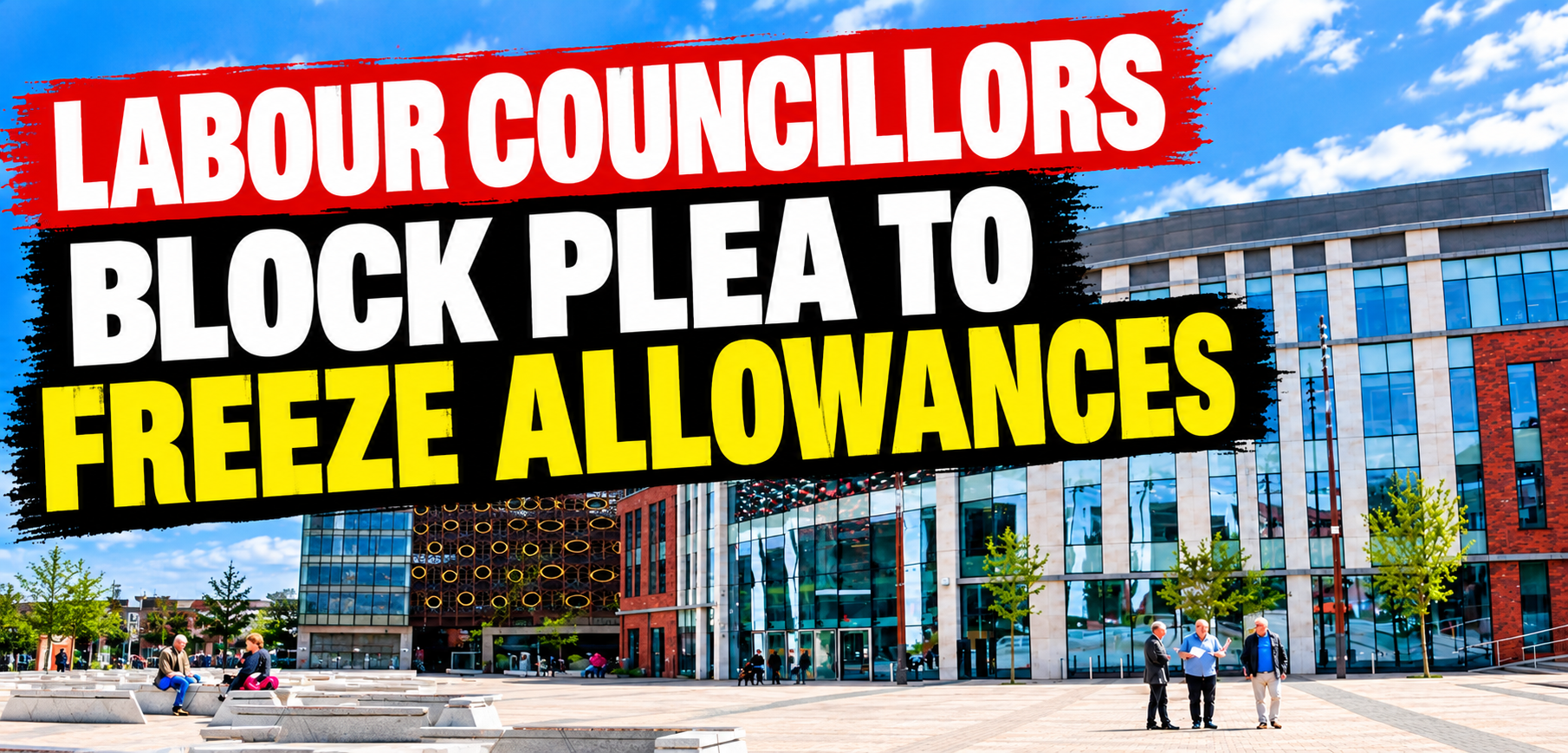
WARRINGTON councillors have clashed over their allowances in a debate which brought questions about councillor pay, workload and the council’s financial position firmly into the spotlight as Labour councillors blocked pleas to freeze allowances.
The issue was debated at Warrington Borough Council’s full council meeting last night, Monday, with councillors from across the chamber taking part in a discussion lasting around 19 minutes.
The debate involved a succession of contributions from members following a motion by Indepdent Cllr Stuart mann to freeze
At the heart of the argument was the question of how councillors should be remunerated for the work they undertake – and whether the current arrangements provide an appropriate level of compensation at a time when the authority is under considerable financial pressure.
Warrington currently operates a scheme which provides councillors with a basic allowance, together with additional Special Responsibility Allowances (SRAs) for members carrying particular responsibilities.
The council’s current published scheme states that the basic allowance was increased from £10,577.77 to £10,916, based on the 3.2 per cent National Joint Council staff award.
It also provided for annual increases linked to the NJC staff award through to the end of the current council term in May 2028.
Special responsibility allowances were also increased by 3.2 per cent, with further annual increases linked to the NJC award. (Warrington Borough Council)
The arrangement was described by the council as an interim measure, pending changes to the council’s governance structure, after which the Independent Remuneration Panel would review the special responsibility allowances.
That independent panel has a key role in the process.
Warrington Borough Council says it must seek and take into account recommendations from an Independent Remuneration Panel before making changes to its councillor allowance scheme. (Warrington Borough Council)
The issue has previously proved controversial.
In December 2025, Warrington Worldwide reported that Labour councillors voted in favour of the three-year increase, while a number of Independent and Liberal Democrat councillors and the Conservative representative opposed it.
At that time the basic allowance was increased from £10,577.77 to £10,916, while the scheme also included increases to special responsibility allowances.
The move came against the backdrop of Warrington Borough Council’s serious financial difficulties and its attempts to secure additional government support.
Workload versus public perception
Monday night’s debate revisited the wider question of what councillors should be paid for the work they do.
Councillors are not council employees and their allowances are intended to recognise the responsibilities and time commitment involved in serving as elected members.
However, the issue is particularly sensitive in Warrington because the council is simultaneously facing major financial challenges, with difficult decisions being made over services, jobs and spending.
The council has 58 elected members representing 22 wards.
The allowances debate therefore raises a fundamental question for the authority: how should the cost of democratic representation be balanced against the financial pressures facing council taxpayers and council services?
The council’s published scheme also makes clear that councillors can receive additional payments where they undertake special responsibilities, meaning the amount received by individual members can vary considerably depending on their roles.
Independent review
The system is designed to separate decisions on councillor remuneration from councillors simply setting their own pay.
The Independent Remuneration Panel is required to consider the appropriate level of allowances and make recommendations to the council.
The panel had previously requested comparative work looking at whether Warrington’s allowances were broadly in line with those paid by similar authorities.
That comparison is particularly relevant given the continuing debate about the appropriate level of allowances and the council’s financial circumstances.
Monday night’s discussion demonstrated that the issue remains politically sensitive.
While councillors have argued that allowances should properly recognise the time, responsibility and pressures involved in being an elected representative, the counter-question remains whether increases can be justified to residents while the authority is making difficult savings elsewhere.
The debate ultimately put the spotlight on an issue which extends beyond the actual figures.
It is about how Warrington values the work of its elected representatives – and what taxpayers believe is an appropriate level of public money to spend on democratic representation at a time of unprecedented financial pressure.
A majority of councillors voted against it.
After the meeting Cllr Mann said: “The point seems to have been completely missed. I was not saying councillors shouldn’t receive an allowance. I was saying what we receive today is sufficient for now.
“We’re asking residents for greater civic pride and increasingly relying upon volunteers, community groups and parish councils as the Borough Council can no longer afford to do everything it once did.
“If we’re asking for that goodwill and sacrifice from everyone else, elected members have to be prepared to demonstrate some of it ourselves.”
Warrington faces a £178.9 million financial gap over its medium-term financial plan, with a further £51.2 million package of savings having been considered as part of the Council’s attempts to address it.
Cllr Mann said arguments that freezing allowances would make little difference to a problem of that scale ignored the reality that the Council itself is now searching for comparatively small savings across services.
During his Full Council speech, he highlighted £30,000 from ending out-of-hours attendance at traffic-signal faults, where council papers warn of an increased risk of road traffic collisions, and £100,000 from Children’s Services legal support.
He has also pointed to the withdrawal of funding for annual servicing of the church clocks at St Oswald’s in Winwick and St Michael’s in Burtonwood, involving sums measured in hundreds rather than thousands of pounds.
“We’re looking for savings from things residents actually see and rely upon – from highways and road safety to the maintenance and appearance of our communities.
“So I struggle with the argument that a saving doesn’t matter because it is small compared with £178.9 million.
“We cannot say every penny counts when we’re cutting services and then say the sums are insignificant when we’re talking about our own allowances.”
Concerns go far beyond visible services
Cllr Mann said the debate also needed to be seen against the much wider concerns residents have about what Warrington’s financial position and the scale of the savings programme could ultimately mean for services they depend upon.
“For some residents this isn’t about whether the grass gets cut as often or whether a service takes a little longer.
“Families are understandably worried about social care, support for vulnerable people and whether changes could ultimately leave them coping with less support or greater pressures themselves.
“People are looking at the scale of the savings being discussed and wondering what it could mean for them, their parents, their children or somebody they care for.”
Cllr Mann said he was not suggesting that freezing councillor allowances could fund Warrington’s social-care system or remove the need for difficult decisions.
Instead, he argued it was about the example elected representatives set while asking residents to accept those decisions.
“Of course freezing our allowances doesn’t solve the social-care budget or a £178.9 million financial problem.
“But when residents are worried about what these savings could mean for some of the most important services in their lives, I find it difficult to understand why simply saying we will take no more ourselves for now was considered too much to ask.”
“Nobody was asking councillors to work for nothing”
Arguments were also made that allowances are important in enabling people from different financial circumstances to serve as councillors.
Cllr Mann said that was an important principle but did not address what his motion actually proposed.
“Nobody proposed abolishing allowances. Nobody proposed councillors working for nothing.
“The question was much simpler: in the exceptional circumstances Warrington finds itself in, is what we receive today enough for now?
“I believe it is.”
The existing allowance scheme provides for Basic and Special Responsibility Allowances to increase annually in line with the NJC staff award until May 2028. The defeated motion sought to have the Independent Remuneration Panel consider suspending those increases while Warrington remains in its current financial position.
Cllr Mann said the outcome risked creating a damaging perception of a double standard at precisely the time when the Council needs residents and communities to help it through its financial difficulties.
“This is what concerns me most. We’re asking residents to volunteer. We’re asking community organisations to step up. We’re asking parish councils to consider taking on more. And council employees face the prospect of losing their jobs.
“People are being asked to help with things that historically they might reasonably have expected their council to provide – whether that’s supporting community facilities, libraries, looking after their local environment or simply giving their own time to help keep their neighbourhoods clean and tidy.
“But it’s difficult to ask residents to volunteer their time for nothing to help fill gaps left because the Council can no longer afford to do everything it once did, while suggesting that freezing what councillors themselves receive is unreasonable.”
Cllr Mann said the issue went to the credibility of the Council’s wider calls for residents to help Warrington through its financial difficulties.
“You cannot call for civic pride from the people of Warrington and then give the impression that the same call for restraint doesn’t extend to the Town Hall.
“If we’re asking communities to take on more of the strain, people will understandably ask: if councillors aren’t prepared to do it, why should we?
“Civic pride has to start at the Town Hall too.”
The full debate can be watched on Warrington Borough Council’s webcast, beginning at 1:32:28. (Warrington Webcasting)