
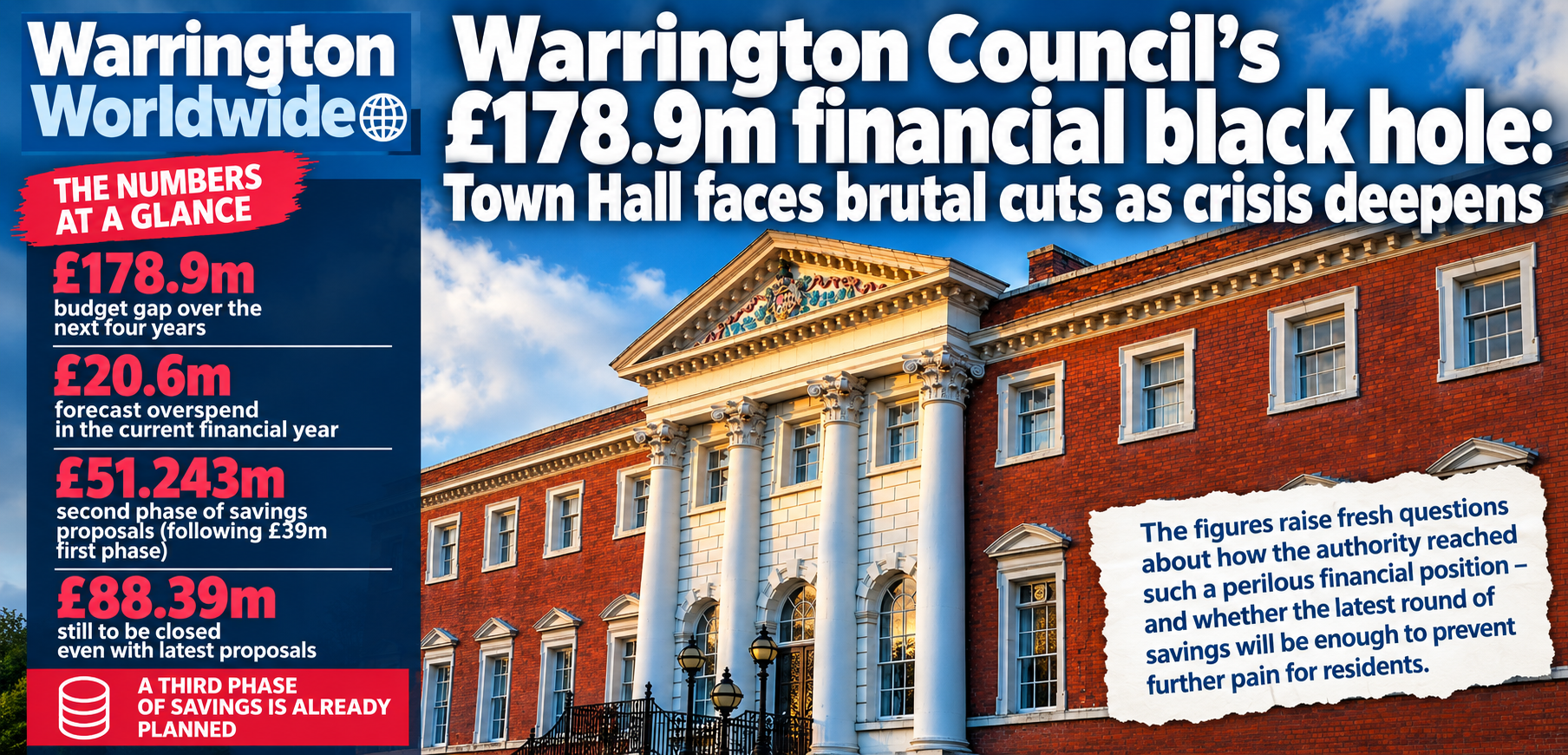
WARRINGTON Borough Council is facing a financial crisis of unprecedented proportions, with its own scrutiny papers laying bare the scale of the challenge confronting the authority – including a staggering £178.9m budget gap over the next four years.
And despite a massive programme of cuts and savings, the council is still forecasting a £20.6m overspend in the current financial year.
The figures raise fresh questions about how the authority reached such a perilous financial position – and whether the latest round of savings will be enough to prevent further pain for residents.
The latest scrutiny report reveals that the council’s second phase of savings proposals amounts to £51.243m, following the first £39m phase approved earlier this year.
But even if the latest proposals are delivered in full, the council says there will still be an £88.39m gap to close. And a third phase of savings is already planned.
The figures are contained in papers considered by the council’s Scrutiny Committee last night, as the authority battles to restore financial stability following years of mounting debt, controversial commercial investments, unachieved savings and government intervention.
Following last night’s meeting Independent group leader Cllr. Stuart Mann said: “The people of Warrington did not create this financial crisis, but they are being asked to pay the price through higher Council Tax and reduced services.
“When residents see weeds along their kerbs, blocked drains, uncut grass and overgrown bushes, or struggle to get help with Council Tax, social care, a school application or simply getting through to the Council, they should remember that these are the real-life consequences of political decisions being made at the Town Hall.
“Savings now have to be made because of the position the Council finds itself in, but there has to be a line between fixing its finances and hollowing out the services residents rely on.
“I will fight to make sure we do not cross it.”
The council’s latest forecast shows an adverse variance of £20.603m for 2026/27.
Of this, £8.661m relates to departmental overspending – while a further £11.942m is attributed to savings which have not been achieved.
That is perhaps one of the most worrying aspects of the latest figures. The council isn’t simply struggling to find new savings. It is struggling to deliver savings it has already promised.
The authority has previously acknowledged that its financial problems have been compounded by weaknesses in historic budgeting, the financial impact of its commercial portfolio and the continuing backlog of unaudited accounts.
The council currently has six years of accounts awaiting final external sign-off, stretching back to 2019/20. (Warrington Worldwide)
The scale of the financial emergency has already forced the authority to seek Exceptional Financial Support from central government.
Government support for Warrington included approval in principle for £87.029m for 2025/26 and £92.047m for 2026/27 – extraordinary intervention which allows the council to borrow to support its revenue position. (GOV.UK)
In other words, taxpayers are now being asked to help pick up the bill for a financial position which has become too large for the council to resolve through normal budgeting alone.
£51m of cuts – and residents will feel the pain
The second phase of savings contains some of the most politically sensitive proposals yet.
They include:
• 206 to 237 full-time equivalent posts potentially disappearing
• reductions in highway inspections and maintenance
• changes to street sweeping and weed treatment
• increased parking charges
• changes to the way libraries and community buildings operate
• reductions in environmental services
• changes to cultural services
• reduced capacity to support events, volunteers and community groups
• changes to fly-tipping services
• reviews of public rights of way
• changes affecting parks and green spaces.
The council itself acknowledges that some of the proposals could result in worsening road conditions, increased third-party claims and increased risks of injury or damage.
So much for a recent reassuring political message that residents’ everyday services will not be affected. The council’s own papers tell a very different story.
Parking charges set to rise
One proposal would increase council-owned car parking charges by 10 per cent in April 2027, another 10 per cent in 2028 and a further 10 per cent in 2029.
That means that, if all three increases go ahead, motorists could ultimately be paying roughly one-third more than they do today.
And the council itself recognises the potential danger – warning that higher charges could push motorists towards privately operated car parks and affect town and district centre economies.
Another proposal involves a fundamental review of council-run community buildings and library services.
The council says alternative operating models will be explored and admits the process may reduce the number of community buildings directly managed by the authority.
That could potentially open the door to community or alternative providers taking over facilities which have traditionally been regarded as core public services.
For residents, the question is obvious:
How much of Warrington’s public service infrastructure will still be council-run when this financial recovery programme is complete?
The £1.4bn elephant in the room
The latest crisis cannot be considered without looking at Warrington’s enormous borrowing position. Council borrowing has previously reached around £1.9bn, before subsequently being reduced to around £1.4bn.
That level of borrowing has been at the heart of growing concerns over the council’s financial resilience and its ambitious commercial investment strategy.
A Local Government Association peer challenge had already warned that Warrington’s use of reserves was unsustainable, with usable revenue reserves falling from £123m in 2021/22 to around £70m.
The council subsequently came under formal government scrutiny, with a Best Value Inspection and Ministerial Envoys brought in as the authority battled to get its finances and governance back on track.
Perhaps the most damning statistic contained within the latest papers is this: Even after £39m of savings already approved and another £51.243m now proposed, Warrington still has an £88.39m gap to address.
And that is before considering the possibility that some of the proposed savings fail to materialise.
The council has already forecast nearly £12m of savings which it expected to make but currently isn’t achieving. That should set alarm bells ringing.
Because balancing the books on paper is one thing. Actually delivering the savings without creating even greater costs somewhere else is another.
The council is also proposing to put up to £5m more into its Transformation Fund, financed from service reserves, to pay for the cost of implementing change – including potential redundancy costs.
The authority argues that spending money now will enable it to deliver substantially greater recurring savings in future. But that strategy comes with its own risks.
Every pound taken from reserves is a pound which cannot subsequently be used to protect services from an unexpected financial shock.
And the council’s own figures show just how little room for manoeuvre is now available.
The question residents deserve answered
For years Warrington was sold a vision of a council acting entrepreneurially – borrowing heavily and investing commercially to generate income and support regeneration. That strategy has now collided head-on with the reality of local government finances.
The authority is operating under an Improvement and Recovery Plan.
It has required extraordinary government financial support.
It has millions of pounds of historic borrowing.
It has a backlog of unaudited accounts.
It has missed savings targets.
It is forecasting another multimillion-pound overspend.
And it is now asking residents to accept tens of millions of pounds of cuts and service changes.
The uncomfortable question is no longer whether Warrington Borough Council has a financial problem. It clearly does.
The question is how much more residents will ultimately have to pay – through higher charges, reduced services, fewer council employees and potentially higher council tax – before the books finally balance.
And perhaps most importantly of all: Who is ultimately accountable for how Warrington got into this position in the first place?
That is a question which deserves far more than another round of budget meetings.
It deserves answers.



2 Comments
There are several people who should be worried about jail time, perhaps especially one person who openly sneered in interviews with this magazine at people who raised concerns. Why he is even allowed at Wolves games or anywhere else in the town is beyond me.
Broomhead and Green – they were the paid professionals who ultimately were there to oversee budgets, audits, and that the council was able to deliver services and stay within its means. They are now gone without much of a dent in their pensions that we paid for, if any.
Then there’s Mather, who can only be continuing in post to help navigate the unwinding of the great big ball of spaghetti the two already mentioned left behind whan they scarpered, and is all over the shop STILL as a speaker on the magical mystery tour that senior council finance officers talk themselves up on.
Next come Bowden and Mitchell who thought they’d struck political gold, but in reality it was a perpetual motion machine. Bowden the physicist should have known what that meant. A long way behind – *possibly* a gap that was exploited – are the members of the EB / Cabinet. They took reports at their word and mostly nodded but they did get ratty at anyone who questioned what was going on – one with his infamous ‘Eye of a needle’ speech that was as misplaced as a toupee on an alpaca.
But the main culprits were Broomhead and Green. Without their ‘professional’ backing Bowden and Mitchell would not have got anywhere in growing the debt. They should be held properly accountable, not just let out to grass while they enjoy their pensions that we funded.