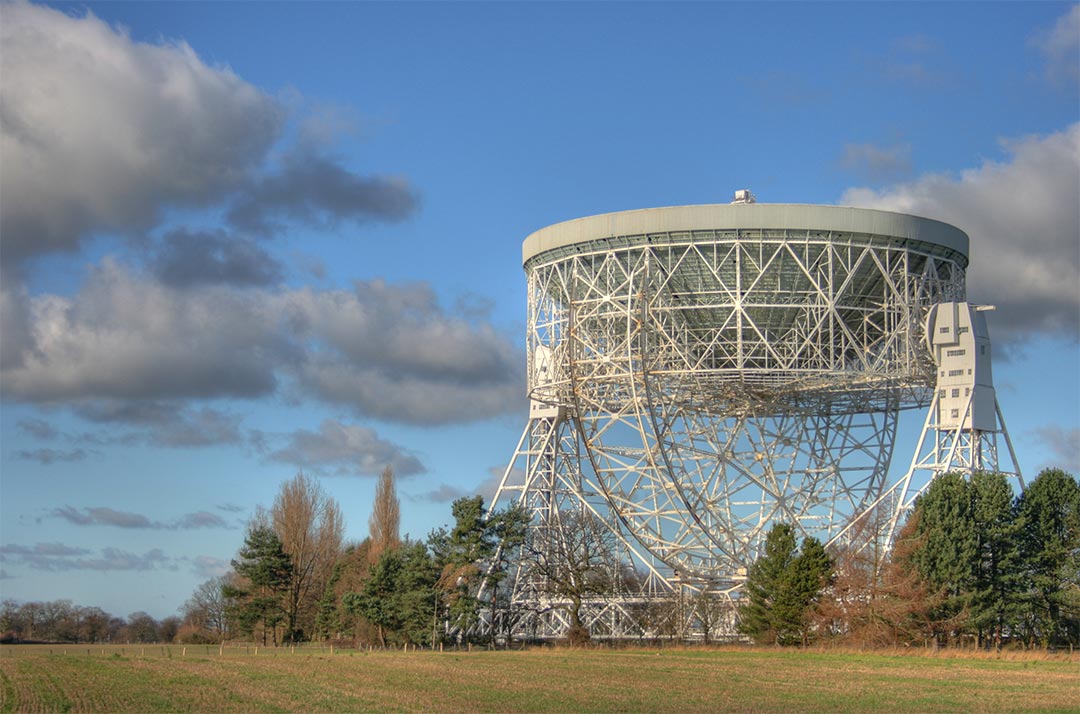
BUSINESS and political leaders have urged the Business Secretary to reconsider the decision to end £2.8m of funding for Jodrell Bank Observatory, warning it would undermine research activity, skilled employment and future investment in the region.
Steve Purdham, Chair of the Cheshire and Warrington Business Advisory Board — representing 41,000 businesses — has written to Business Secretary Jonathan Reynolds asking for the funding to be maintained for a further five years while alternative long-term options are explored. He notes that Jodrell Bank is not simply a heritage site but an active part of the regional economy.
A second letter from Cheshire’s political leaders, led by Cllr Louise Gittins, Chair of the Cheshire and Warrington Combined Authority, makes the same request. They highlight that while the financial amount is modest nationally, the strategic implications of withdrawing support are significant.
Cllr Gittins said the funding is essential to ensuring the Observatory’s continued operation and accessibility, and called for a temporary extension to allow time to identify sustainable future arrangements.
Steve Purdham added that losing the Observatory would weaken the region’s research capability, reduce employment opportunities and deter investment.
The funding forms part of the e Merlin National Radio Astronomy Facility operated by the University of Manchester. UKRI’s decision means scientific observations at Jodrell Bank are expected to end in April 2028, affecting around 3,000 researchers, 28 Observatory staff and wider investment linked to the site.
Located near Knutsford, Jodrell Bank is owned and managed by the University of Manchester and has helped identify supermassive black holes, new galaxies and tracked spacecrafts. Jodrell Bank receives 150,000 visitors per year, 21,000 of whom are school pupils on an educational visit.
Meanwhile, Tatton MP Esther McVey said the £2.8 million cut would have widespread consequences, not only for the future of the observatory, its staff and the local economy but also the UK’s wider global standing in terms of science.
Ms McVey said: “Jodrell Bank has been at the forefront of radio astronomy research worldwide for nearly 70 years, supporting many hundreds of scientists to further their work in that time. It also is a very visible sign of the UK’s commitment to world-leading research.
“In terms of government spending, £2.8 million is tiny but the impact on our global credibility in terms of scientific research (should it be taken away) will be immense.
“I vehemently oppose these cuts and will work with whoever I need to, to try and ensure funding is reinstated.”
The Jodrell Bank site was first established in 1945 and pioneered radio astronomy and the study of galaxies. Since then, it has been played a vital role in the study of distant galaxies and training future astronomers.
Ms McVey has also written to Business Secretary Jonathan Reynolds demanding answers.
She said: “We need to know what assessments were made before this decision was taken, in terms of UK-based research, our global standing within the scientific community and the region’s economy.”
The UK Research and Innovation (UKRI) said it had no option but to cut the observatory’s budget because research costs for physics and lab costs had escalated.
Unless an alternative source of funding is secured, all scientific work at the observatory and its telescope network are expected to end on April 1, 2028