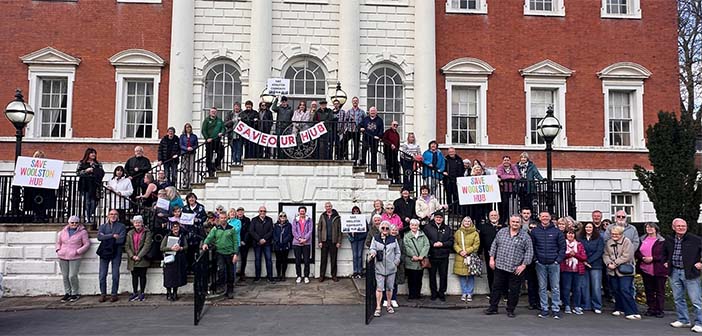
WHILE a powerful show of community support unfolded outside Warrington Town Hall earlier this week, as residents gathered in force to protest against the continued closure of Woolston Neighbourhood Hub, campaigners say they fear for the future as funding questions mount.
Councillors were greeted with chants of “Save our Hub” ringing loud and clear around the Town Hall grounds, the passion of the Hub supporters clearly undiminished by the considerable length of time since its closure.
Inside the chamber, Dan Warren, representing the “Save Woolston Neighbourhood Hub” campaign group, put forward a direct and important question to Councillor Jean Flaherty – why Section 106 funding, generated by property developers in the area, and identified for sports provision in Woolston could not be used to help bring the Hub back into safe operation?
Councillor Flaherty responded that they were unaware of any external funding to cover all the required costs for bringing Woolston back into a safe condition to open. The funding for Woolston is for structural repairs and safety.
Members of the Save Woolston Hub committee commented: “The answers to this question laid bare the appalling level of disrespect that has been applied to this wonderful building and essential infrastructure. The Council’s glass-half-empty approach to a building that enhances and lengthens Warrington residents’ lives is highly inappropriate. Nine months on from the closure of the swimming pool and seven months on from the closure of the building, this marvelous asset still hasn’t even had a detailed estimate of the cost of repair – as if it’s a disused park shed. If the Council don’t know how much the building costs to repair, then they clearly won’t know if they can acquire the funds to reopen it!
“There’s no law that states that Councils who are receiving EFS can’t spend any money on a building as essential as this. In addition, S106 money can be used for developments which include a clearly much-needed secondary support safety system for the roof ducting and also used for system separation of the water systems. This would be so that, should legionella occur (which it has, and could again in the future), at least all the dry side could re-open within a short amount of time. It could also be used for a group change facility (replacing far side unused toilet/ shower rooms) so that the pool could be open a lot more often before and after schools access it, increasing both footfall and revenue. This could re-pay the cost of additional repairs, as could other initiatives such as re-introducing Saturday morning swimming lessons. Councillor Flaherty stated that S106 money (and grants in general) can only be used for new activities and access to improvements.
“The 3 examples cited sit perfectly in that category. Councillor Flaherty’s comment that priority goes to areas with a strategic gap/ under supply also fits again as there are no other Livewire pools in East Warrington, and Warrington has an under supply of pools, alongside more than it’s fair share of rivers and canals (particularly in Woolston.)”
In 2022 KKP produced a report for Warrington Borough Council which stated that, for Woolston “ Facilities are well used, and it merits refurbishment/replacement especially given its proximity to new housing development in the area and the additional demand this will create”, yet these findings were ignored, nothing was done, and now the building is closed altogether.”
Campaigners added: “It is no use blaming the cost of Health and Social care for not funding the Leisure Centre when closing a building like this increases Health and Social Care so significantly.
“The fundamental problem is that the Council are currently lacking the political will to get Woolston up and running again.
“In the meantime, we have residents reporting mobility problems, mental health issues, and financial strain due to a huge hike in travel costs (over £500 a year for someone accessing the leisure centres three times a week, which means that their Council tax is effectively increasing by more than 30% in many cases.)
“The summer holidays are approaching and the local children will have no pool, gym or library to go to. There probably wasn’t one person amongst us in the Council chamber who hadn’t learned to swim in a public pool. Yet we are denying today’s youngsters the same opportunities, and witnessing a destruction of this culture. As a town, we can do so very much better than this.”