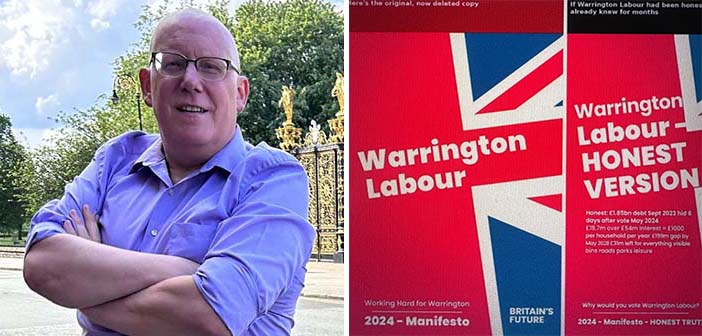
WARRINGTON Labour has been accused of failing to give residents the full picture of the council’s financial position when it asked for their votes in May 2024.
Lymm South Independent councillor Graham Gowland has criticised the party’s election manifesto, claiming it promised improvements to roads, leisure facilities and public services without explaining how they would be funded or acknowledging serious financial warnings already received by the council’s leadership.
His comments come as Warrington residents face an 18.2 per cent rise in the Band D council tax bill over three years, while the borough council grapples with a projected £179m budget gap, significant savings requirements and Government intervention over its finances.
Cllr Gowland described the manifesto as showing a “complete lack of honesty” with residents. His remarks are political criticism rather than a formal finding of dishonesty, and the financial pressures facing the council have also been affected by inflation, rising demand for services and national funding decisions.
However, the timing of financial warnings received before the election raises questions about what voters were told about the affordability of Labour’s promises.
Labour’s 22-page manifesto, published ahead of the May 2, 2024, local elections, set out six priorities and a wide-ranging list of commitments.
Its opening page promised “efficient, well-run and accessible public services”, alongside improvements to parks and green spaces, transformed leisure services, community spaces and libraries, upgraded roads and better public transport.
The manifesto also pledged to secure “external funding to redevelop leisure centres like Broomfields” and establish “new protected greenspace parks across the town, putting in place a permanent ban on any future development”.
Other commitments included a new Intermediate Care Facility, a ‘Deal for Carers’, a mental health plan, facilities for homeless families, improved special educational needs and disabilities (SEND) services, regenerated high streets and a redeveloped town centre.
The document did not provide individual costings for these new commitments or set out a comprehensive funding plan. It referred to securing external funding and highlighted money already obtained for previous projects.
Its introduction blamed “Conservative cuts and economic mismanagement” for pressure on public services but did not discuss the council’s approximately £1.8bn borrowing.
Instead, Labour presented its investments as a strength, describing Birchwood Park as a “strategic asset which generates income to support council services we all rely on” and promising to “build on the success of Time Square”.
Financial warnings before voters went to the polls
Two independent reviews had raised significant concerns about Warrington’s financial position before residents voted in May 2024.
The Chartered Institute of Public Finance and Accountancy (CIPFA) examined the council’s borrowing and investments, describing its debt-funded investment portfolio as “very large and uniquely complex”.
The council has said it received the draft report in September 2023, around seven months before Labour’s manifesto was launched.
A separate Local Government Association (LGA) review provided feedback to the council leader, Cabinet and chief executive on March 8, 2024, eight weeks before polling day and around seven weeks before the manifesto was published on April 26.
The LGA described Warrington’s borrowing of approximately £1.8bn as “amongst the most significant in local government nationally”.
Neither report was publicly available when residents voted. The Government published the CIPFA review six days after polling day, while the LGA report followed 84 days later. The council has previously said it pressed for earlier publication of the CIPFA findings.
However, Cllr Gowland argues that the manifesto could have acknowledged the financial risks already known to the council’s leadership, even if the independent reports had not been published.
The Government subsequently warned of “clear financial risks” which, if they materialised, were likely to have a “significant impact on local residents”.
Inspectors were sent in, and in July 2025 the Government formally intervened, directing the council to address its finances, reduce borrowing and improve how it was run.
The council has since confirmed that its borrowing peaked at £1.896bn on March 31, 2024, four weeks before the manifesto was launched.
In January 2026, when applying for emergency Government financial support, the authority acknowledged specific local problems linked to its commercial programme and unaudited accounts.
Cabinet member for finance Cllr Denis Matthews said: “We also need to acknowledge that we have specific local issues that are driving some of our financial challenges, linked to risks around our commercial programme and our unaudited accounts.”
The contrast is stark: while Labour’s manifesto highlighted the council’s investments as assets supporting public services, independent reviewers had already raised concerns about the scale and complexity of the debt underpinning them.
How are the manifesto promises progressing?
The council has not published a comprehensive scorecard showing residents how its 2024 manifesto commitments are progressing.
There has been progress in some areas, including a new carers’ hub, an adult mental health strategy and faster decisions on SEND assessments.
But the position across several of Labour’s major pledges has changed considerably.
Efficient, well-run services
The Government intervened in July 2025 over the council’s finances and governance.
Warrington now faces a projected £179m budget gap to 2029/30, has required exceptional Government financial support and has identified around £90m in savings.
Upgrading roads
The council’s latest £51.2m savings package warns of fewer maintenance schemes, reduced street sweeping and weed treatment, and “worsening road conditions”.
The proposed savings raise questions about how the manifesto’s pledge to improve roads will be delivered alongside the authority’s need to reduce spending.
Transforming leisure services
Before Labour’s manifesto was published, councillors had already been told that an £8.6m Government funding bid to redevelop Broomfields Leisure Centre had failed.
Broomfields’ swimming pool has been closed since July after ducting fell from the roof. A similar incident occurred at Woolston Neighbourhood Hub a year earlier.
Woolston has been closed since September 2025, with legionella also found at the facility. The council says it is unlikely to be able to afford the estimated £3m needed for repairs.
Leisure facilities, libraries and community buildings are now among the services under review as the authority seeks to balance its budget.
Supporting residents with the cost-of-living crisis
Labour made tackling the cost-of-living crisis its first priority in the manifesto.
Since then, the Band D council tax bill has increased by 18.2 per cent over three years. Free Sunday parking at Time Square has been scrapped, while further 10 per cent increases in car parking charges have been proposed.
Meanwhile, the council-owned car park in Latchford remains free of charge.
Building on the success of Time Square
A council scrutiny report published in August 2026 found that Time Square’s financial performance had “fallen far short of even the cautious assumptions” in its business case.
The report indicated that the shortfall was leaving the council to cover around £5m a year. It also identified factors including the Covid-19 pandemic, Brexit and energy prices.
New protected green space parks
No published list or register has been identified setting out the new protected green space parks promised in the manifesto, or the permanent development bans associated with them.
Not all the difficulties facing the council were within its control. Inflation, increasing demand for services and national funding decisions have all contributed to financial pressures. The leisure centre closures were triggered by maintenance problems, although the authority has subsequently said it is unlikely to be able to afford the repairs at Woolston.
Some projects highlighted by Labour, including £22.1m of Town Deal projects and the electric bus fleet, were also largely funded through Government grants secured before the election.
What does it mean for households?
For a typical Band D household in an unparished area, the annual council tax bill has risen from £2,032.71 in 2023/24 to £2,403.04, an increase of £370.33.
That represents an 18.2 per cent rise over three years.
Of the current bill, £2,007.51 goes to Warrington Borough Council, with the remainder covering Cheshire Police and Cheshire Fire. Households in most parished areas pay additional charges.
The council’s £51.2m savings package, approved in September 2026, also warns of the possibility of fewer staff answering residents’ calls and higher car parking charges.
Cllr Matthews has acknowledged the scale of the challenge, saying: “Realising the overall £90 million of identified savings will continue to require very difficult decisions about the services we are able to provide in future.”
Meanwhile, the scheduled allowance for the council leader rose by around 28.5 per cent between 2023/24 and 2025/26, from approximately £29,500 to £37,916.
Over the same period, the Band D council tax bill rose by 10.2 per cent.
Councils must take account of the recommendations of an independent remuneration panel when setting councillors’ allowances, although the final decision rests with elected councillors.
Cllr Gowland said: “In my view, this manifesto showed a complete lack of honesty with Warrington residents.
“Labour’s leadership had been warned about the council’s exceptional debt and financial risk. Yet they went to voters promising the world – better roads, transformed leisure centres, protected green spaces and help with the cost of living – without costing a single one of those promises or saying how they would be paid for.
“They even held up the council’s investments as a success story while independent reviewers were warning about the debt behind them. Now residents are paying 18.2 per cent more in council tax and being asked to accept cuts to roads, leisure and local services.
“Honesty is not only about whether an individual sentence is technically true. It is also about whether voters are given the facts they need to judge what is being promised. On costs, affordability and the known financial risks, this manifesto did not do that.
“Labour should now explain why those warnings were missing, how its promises were supposed to be paid for, and publish a proper scorecard showing residents what has – and has not – been delivered.”
The 2024 manifesto could not be found on Warrington Labour’s website when searched on October 14, 2026. The original pages of the document were reviewed for this article.
The Labour group was offered the opportunity to respond to Cllr Gowland’s claims – but none has been forthcoming, although it is understood the website previously hosting the manifesto is being redeveloped.