REPRESENTATIVES from local communities surrounding the proposed Intermodal Logistics Park North met earlier this week as the huge rail freight and logistics development moves towards its next stage.
The meeting, organised by the Lane Head South Residents’ Group, brought together representatives from Lane Head South Residents’ Group, Lowton West Residents, Lowton East Neighbourhood Development Forum, Croft Parish Council, Winwick Parish Council, Culcheth & Glazebury Parish Council, Culcheth & Glazebury Residents Association, Wigan Council and St Helens Council, together with Jo Platt MP.
The meeting provided an opportunity to look at where the Intermodal Logistics Park North (ILPN) proposals currently stand, what has changed since the last consultation and how neighbouring communities can prepare for the next stages.
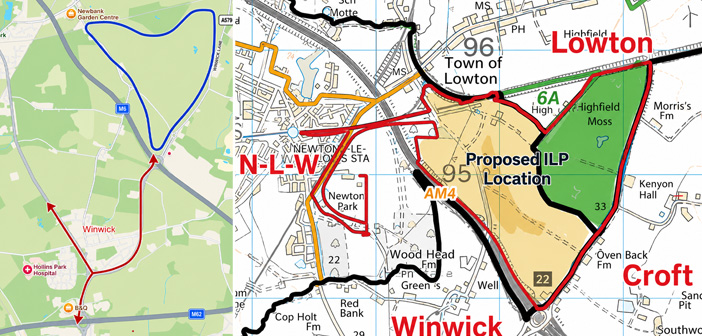
ILPN is a proposed Strategic Rail Freight Interchange and major logistics development on land east of Newton-le-Willows, close to the boundaries of St Helens, Warrington and Wigan.
The plans provide for approximately 767,000 square metres, or around 8.2 million square feet, of warehousing and associated floorspace, together with a new rail freight terminal.
At full operation, the terminal could accommodate up to 16 freight trains a day, equivalent to 32 train movements.
This IS NOT simply a railway development. Tritax’s published assessment models 395 two-way HGV movements during the busiest daytime hour, with 245 during the modelled busiest night-time hour.
These are hourly figures, not a daily total.
The plans also include 228 dedicated HGV parking spaces, comprising 143 associated with the rail terminal and 85 serving the logistics park, together with facilities for drivers.
Cllr Stuart Mann, (Burtonwood & Winwick) who attended Monday’s meeting alongside Cllr Norman Partington representing Croft Parish Council, (Wards that would directly border the proposed site) said: “When people hear ‘rail freight interchange’, it is easy to think this is mainly about trains. Rail is clearly a major part of it, but this would also be an enormous warehousing and road freight operation. The figures give residents some idea of the scale and explain why the highways work is so important.”
The traffic issue goes well beyond M6 Junction 22. The principal site access is proposed through Parkside Link Road East towards M6 Junction 22, but the transport implications extend considerably further.
The wider transport work includes M62 Junction 9 and the A49/Newton Road corridor through Winwick, as well as connections towards the M6 and the wider link-road network.
This means the updated transport assessment will need to explain not only what happens at Junction 22, but how ILPN traffic is distributed across the wider highway network.
Cllr Mann contiunued: “This isn’t simply a Junction 22 issue. The transport route extends to M62 Junction 9 and Newton Road through Winwick. Residents need to be able to see how much additional traffic is expected on those routes and what happens when the other development taking place around us is added into the equation.”
It was these very concerns about traffic that led to me and WBC to push for £6m of ringfenced funding for junction improvement works in Winwick as part of the Parkside Phase 2 scheme. I would expect further support or funding for roads if any future Rail Freight Scheme is approved, including ANPR managed routes.
Despite the amount of information already published, ILPN hasn’t been approved and the final application hasn’t yet been submitted.
An initial consultation took place between January and March 2025, followed by statutory consultation between 28 October and 23 December 2025.
Further consultation is planned before the application is submitted, with highways, noise and air quality expected to be key subjects.
ILPN is being promoted as a Nationally Significant Infrastructure Project. Instead of being decided as an ordinary local planning application, Tritax intends to seek a Development Consent Order (DCO).
The application will be examined through the Planning Inspectorate, with the final decision ultimately taken nationally by the relevant Secretary of State.
Residents, councils, parish councils and community organisations will have opportunities to participate in that process.
Wigan Council changes its position on key Green Belt land
There has also been a significant development since the previous ILPN consultation.
Wigan Council has announced that it intends to remove four Green Belt employment sites from its emerging Local Plan, including West of Winwick Lane, Lowton and relevant to the wider ILPN proposals.
Wigan says it now considers there is sufficient employment land elsewhere to meet its expected requirements without allocating this Green Belt site.
The change doesn’t stop Tritax pursuing ILPN, because the DCO will be considered through the separate national infrastructure process.
What isn’t yet clear is whether Wigan’s new Local Plan position will have any material impact when ILPN is eventually examined.
Cllr Mann added: “Wigan’s decision doesn’t stop ILPN, but it does change the planning picture.
“Wigan is now proposing that this Green Belt land isn’t required to meet its employment needs, while Tritax continues to promote nationally significant development involving the wider area. Whether that has any material impact on the eventual national decision remains to be seen.”
ILPN isn’t happening in isolation
Another important issue discussed was the cumulative impact of development across the wider area.
Major housing construction is already taking place at Peel Hall in North Warrington, while a developer is promoting approximately 220 homes north of Golborne Road in Winwick.
In Croft, an outline planning application has been submitted for up to 200 homes at Turret Hall Farm, north of Lord Street, while further housing is being promoted around Culcheth, including land west of Hob Hey Lane. These proposals are at different stages and haven’t all received planning permission.
Across the boundary in St Helens, Bold Forest Garden Village is planned to provide approximately 3,000 homes, together with supporting infrastructure and facilities.
Development is already taking place at Parkside, while Haydock Point, close to the A580 and M6, has also returned to the wider development picture with proposals for significant employment and logistics development.
All of this matters when future traffic levels are assessed.
Cllr Mann said: “Residents don’t experience one planning application at a time. They experience the combined traffic from developments using the same roads and junctions. When Tritax publishes its updated transport work, we need to understand exactly which developments have been included, what the combined traffic looks like and whether the infrastructure can accommodate it.”
Construction traffic will matter too
The traffic generated once ILPN is operational is only part of the picture.
A development of this size would require a substantial construction programme, potentially overlapping with other housing and infrastructure projects across the area.
Residents will therefore need clear information about construction HGV numbers, approved routes, working hours and how restrictions intended to protect surrounding villages would be monitored and enforced.
That will be particularly important for communities around Winwick, Croft, Lowton, Golborne, Culcheth, Glazebury, Burtonwood and Hermitage Green.
What happens next?
Last Monday’s meeting wasn’t about asking every parish council or residents’ organisation to adopt the same position on ILPN.
It was about sharing information, understanding the process and making sure communities on all sides of the proposed development are prepared for what comes next.
Winwick Parish Council has agreed to host a further joint meeting at Winwick Community Centre in September.
That meeting will provide an opportunity to look more closely at the DCO process, future deadlines and how councils and community organisations can work together where they share common concerns.
For residents, the immediate position is clear: ILPN hasn’t been approved and its formal DCO application hasn’t yet been submitted.
The next major stage will be further consultation and updated information, particularly around highways, noise and air quality in the spring of 2027.
That should provide a clearer picture of the number and routes of HGVs and other vehicles, the effects on M6 Junction 22 and the wider network including M62 Junction 9 and Newton Road.