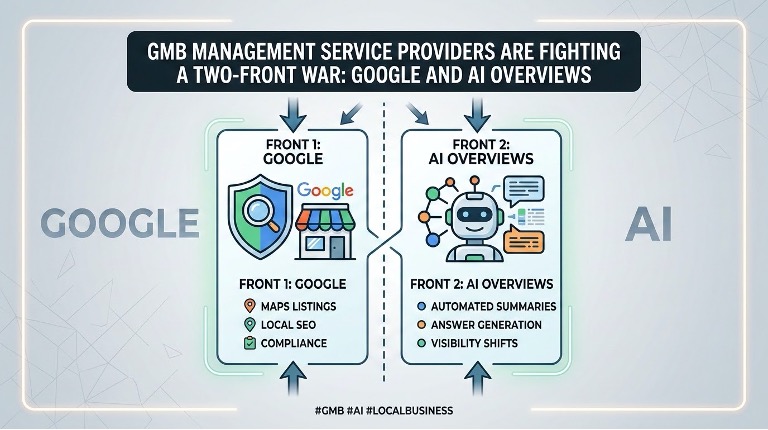
GMB management service providers are caught in a two-front war: battling Google’s relentless algorithm shifts on one side and the rise of AI Overviews threatening to erase local visibility on the other.
Local pack volatility, zero-click dominance, and risks of snippet extraction are accelerating. The result is a client retention crisis that traditional optimisation tactics are not built to solve.
Here is what is happening, why it matters, and how to fight back.
The Two-Front War Facing GMB Management Services
Google’s March 2024 Core Update brought significant ranking volatility to local search. At the same time, AI Overviews now appear across a growing share of local queries, pulling data directly from Google Business Profiles and returning answers without requiring a click.
Local pack click-through rates have dropped as a direct result. The algorithm changes prioritise E-E-A-T signals, proximity, and entity-based relevance. AI Overviews compress visibility further by surfacing summaries that satisfy user intent before anyone visits a business listing.
These are not separate problems. They compound each other.
How Google’s Algorithm Shifts Changed the Rules
The 2024 Core Updates rewrote the playbook for local businesses’ rankings. Experience, expertise, authoritativeness, and trustworthiness now need to be demonstrated through the profile itself, not just inferred from citations and keyword presence.
Semantic search has taken priority over exact-match keywords, building on the foundation laid by earlier updates like BERT. Proximity signals have been refined, and Core Web Vitals became a genuine ranking consideration, requiring fast load times and mobile-ready pages.
For GMB management providers, this means:
- Optimizing for semantic search with natural language in posts and Q&A sections
- Improving Core Web Vitals by compressing images and enforcing HTTPS
- Strengthening proximity signals through geo-targeted keywords and local schema
- Building prominence through citation consistency across directories like Yelp and Bing Places
Recovery from core updates takes time. Google Search Console audits and competitive analysis are no longer optional. They are standard operating procedures.
AI Overviews: What They Are and Why They Change Everything
AI Overviews are AI-generated answer boxes that appear in Google search results, launched in May 2024. They pull data from top-ranking Google Business Profiles and synthesize summaries up to roughly 200 words, reducing the need for users to click through to a website or listing.
The reason they matter for local search is straightforward: these summaries target informational queries like “best plumber near me” and return answers directly on the results page. Users get what they need without visiting your client’s site.
GMB data, including reviews, business descriptions, and posts, feeds directly into these summaries. Providers who do not optimize for extraction risk lose visibility that they cannot fully recover through traditional ranking tactics.
Practical adjustments include:
- Enhancing photo optimization and post frequency for rich snippet eligibility
- Managing Q&A sections to control what answers are surfaced
- Focusing on review generation for positive sentiment in overviews
- Adding LocalBusiness schema markup to improve structured data extraction
Traditional GMB Tactics Are Not Enough Anymore
Before AI disruptions, core tactics drove predictable results. NAP consistency across directories, regular GBP posts, photo optimisation, and review response cadence built a stable foundation for local pack rankings.
Those tactics still matter. They are just no longer sufficient on their own.
The optimization checklist that worked in 2022 is now the floor, not the ceiling:
- Maintain NAP sync across Yelp, Bing Places, and major local directories
- Upload 15 or more photos with geo-targeted file titles
- Schedule weekly GBP posts to highlight services or promotions
- Respond to 95% of reviews within 24 hours
- Complete the Q&A section proactively to address common queries
- Set one primary category and up to nine secondary categories
Pair this with rank tracking tools and regular audits. The foundation still needs to be solid. The issue is what gets built on top of it.
Declining Organic Visibility: The Data Behind the Shift
The drop in click-through rate is not subtle. Before AI Overviews, a position one local result captured around 27% of clicks. After, the number fell to roughly 9%. Position two dropped from 15% to 6%. Position three from 10% to 4%.
Zero-click searches are rising because AI provides direct answers before the user has any reason to scroll. Map Pack results are compressing, showing fewer listings before requiring a scroll. Impression-only interactions are growing as a share of total local search activity.
Local Falcon heatmaps have been widely used to document this volatility. Businesses that held stable positions for years are now seeing week-to-week swings. High-urgency service categories like HVAC and plumbing are most disrupted because their queries are exactly the kinds of questions AI Overviews are optimized to answer.
Google’s Core Updates and Local Pack Volatility
The March 2024 Core Update hit GMB management service providers hard, according to RankRanger data. Rankings fluctuated more sharply in dense urban markets. Providers in competitive verticals saw the most disruption.
Local pack positions changed frequently on a week-to-week basis after the update. BrightLocal’s multi-market grid analysis documented daily rank swings averaging several positions. Tools like Local Falcon offer seven-day rank grids specifically for tracking this kind of movement.
A basic tracking setup in Google Sheets works: input daily positions in a column, use =AVERAGE(A1:A7) for weekly averages, and =MAX(A1:A7)-MIN(A1:A7) for the volatility range. It is simple, and surfacing patterns early is what matters.
Google now weights hyperlocal relevance substantially higher than it did before. Neighborhood-specific landing pages are no longer a nice-to-have; they’re a must-have. Proximity factors account for a significant share of ranking weight, and service-specific categories, combined with schema markup, are how providers clearly signal relevance.
GMB Snippet Extraction Risks
Google automatically extracts the first two reviews and the business description to populate AI Overviews. If that content is outdated, thin, or negative, users see it without context or recourse.
Four common problems and their fixes:
- Outdated hours: Update weekly through the Google Business Profile dashboard
- Negative review priority: Respond promptly and flag policy violations to surface better content
- Missing schema: Implement LocalBusiness markup for structured data control
- Thin descriptions: Write 300 or more characters optimized with geo-targeted keywords and service specifics
The JSON-LD schema format is worth implementing correctly. A Local Business block in your site header that includes name, address, geo coordinates, phone, hours, and a detailed description gives Google structured signals to work with, rather than having to guess.
Service Provider Challenges: Retention and ROI
Agencies face a 43% client churn risk tied directly to declining GMB visibility, according to an AgencyAnalytics survey. That number reflects what happens when clients see organic traffic decline and do not understand why traditional rankings no longer translate into leads.
The mismatch between client expectations and current search behavior is the core problem. Clients want quick wins. Local SEO in an AI-dominated environment produces slower, less linear results.
A Clutch.co survey found that 62% of SEO clients now demand monthly lead reports following the AI rollout. The response from providers should shift from reporting rankings to reporting revenue signals.
Practical adjustments include:
- Switching from rank reporting to lead tracking with tools like CallRail and Google Analytics
- Building Looker Studio dashboards to visualize GMB insights and conversion behavior
- Shifting to value-based pricing models that reflect ROI rather than position
- Offering white-label programs for agencies that need to scale
ROI Measurement in a Zero-Click World
Traditional ranking KPIs have become unreliable. WordStream’s 2024 data shows cost-per-lead rose 41% as organic traffic declined. Ranking number one no longer means what it used to.
The new measurement framework looks different:
| Old Metrics | New Metrics |
| Rank #1 = success | CPL under $47, 3.2% conversion rate |
| Impressions only | Leads x LTV minus costs |
| Local pack position | Dwell time, behavioral signals |
A simplified ROI formula: (Leads x $127 LTV) minus $1,950 per month equals $4,305 ROI. Agencies that frame results this way retain clients longer because the reporting reflects business outcomes, not search engine positions.
Adaptation Strategies That Are Working
Agencies combining AI-resistant content with technical Google Business Profile optimization are seeing lead growth despite the disruption. The key is pairing GBP work with owned assets like local landing pages and review funnels that drive calls and visits regardless of what Google surfaces above the fold.
Companies like NetReputation have focused on this kind of multi-layered approach to local visibility, recognizing that any single-channel strategy becomes fragile when algorithm or product changes shift how results are displayed.
The structure that holds up under pressure combines:
- Post scheduling and schema markup for local SEO signals
- Direct response channels, like call tracking, for conversion measurement
- Competitive analysis and keyword research as ongoing inputs, not one-time exercises
AI-Resistant Content Creation
AI-resistant content is content that yields long read times and includes original data, reducing the likelihood that AI systems will extract and replace it with a summary.
A seven-step framework for service pages and posts:
- Long-tail geo-keywords in descriptions of 500 or more characters
- Original research drawn from local market data
- Video testimonials embedded from YouTube for social proof
- Interactive calculators for service estimates
- FAQ schema to target voice search queries
- First-party data from customer surveys
- Human writing signals, including specific examples and firsthand observations
Test content for a three-minute-plus read time. Update quarterly based on performance data. This approach builds relevance signals that AI extraction struggles to replace, because the value lies in depth, not just the facts.
Hybrid Optimization Approaches for GMB Management Services
A hybrid approach combining GBP automation with owned direct-response channels outperforms pure GMB tactics in terms of ROI. The five core tactics:
- GBP API auto-posting through affordable scheduling tools
- Review funnels to generate consistent responses
- Local landing pages customized per service area or location
- Call tracking integrated with analytics
- Tiered pricing models that scale with client size
| Approach | Focus | Key Benefits | Best For |
| Pure GMB | Business listings, posts, reviews | Quick Maps visibility | Single-location businesses |
| Hybrid | GMB + landing pages, calls | Direct leads, tracking | SEO agencies expanding |
| Multi-Channel | GMB + directories, social, email | Full-funnel conversions | Franchises, enterprises |
A 30-day implementation timeline works well: Week 1 for audits, Week 2 for setup, Weeks 3 and 4 for testing and refinement. Monitor through Google Search Console and adjust for proximity and prominence signals as data accumulates.
The two-front war is not going away. The providers who treat AI adaptation as a core competency rather than a temporary adjustment are the ones building client relationships that survive it.