THE scale of Warrington Borough Council’s financial challenge has increased, with a new four-year finance strategy projecting a £200m budget gap as the authority continues efforts to reduce its huge debt mountain and recover from the consequences of its commercial investment programme.
The council’s draft Medium Term Financial Strategy (MTFS) for 2027-2031 sets out how it intends to tackle the financial pressures, deliver millions of pounds in savings and reduce its reliance on borrowing and government support.
The latest projected budget gap represents an increase from the £179m forecast in the previous 2026-2030 financial plan.
However, the council insists its plans are now more developed, with a greater proportion of the savings identified and a clearer strategy for reducing debt and disposing of commercial assets.
The draft strategy will be considered by the council’s Scrutiny Committee and Cabinet in the coming weeks before a final version is presented to Full Council on March 1, 2027.
Debt mountain and the legacy of commercial investments
Warrington’s financial difficulties have their roots partly in an ambitious commercial investment strategy pursued over a number of years, which saw the authority borrow heavily to acquire businesses and property assets in the hope of generating income to support council services.
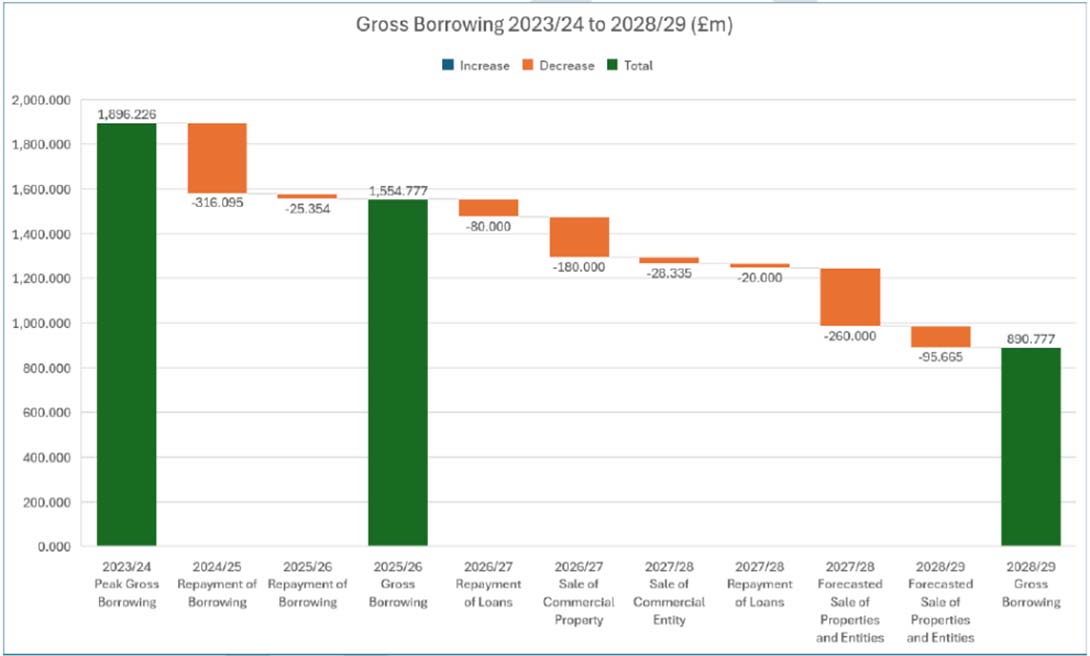
The council’s borrowing peaked at approximately £1.896bn in March 2024, placing it among the most heavily indebted local authorities in the country.
The strategy has come under considerable scrutiny following the collapse or poor performance of some investments.
These include the council’s involvement in energy company Together Energy, which collapsed into administration, and its investment in Redwood Bank, which became the subject of controversy amid concerns over the returns and the council’s decision to dispose of its stake.
The performance of the council’s commercial property portfolio has also raised questions about whether the income originally anticipated has been achieved.
A scrutiny review of the Time Square development in August 2026 found that its financial performance had fallen well short of even cautious assumptions, leaving the council having to cover an estimated £5m a year.
The council has also faced criticism over the scale of its borrowing and the risks associated with using public money to fund commercial ventures.
The Chartered Institute of Public Finance and Accountancy (CIPFA) previously described Warrington’s debt-funded investment portfolio as “very large and uniquely complex”, while the Local Government Association described its borrowing as among the most significant in local government nationally.
The council has since been subject to increased government scrutiny and intervention, with financial recovery and improved governance among the key priorities.
£90m savings programme already identified
Under its previous 2026-2030 financial strategy, the council identified approximately £90m in savings across what it described as Phase 1 and Phase 2.
However, it acknowledges that not all these savings will be delivered within the original timescales.
Around £18m has therefore been rephased across the financial plan.
The authority is now developing a further programme, known as Phase 3, which places greater emphasis on reducing debt and disposing of assets associated with its commercial investment portfolio.
Cabinet member for finance Cllr Denis Matthews said a proposed £60m savings package under Phase 3a was considered realistic, with support from the Government-appointed Ministerial Envoys.
He said: “Our Ministerial Envoys have provided great support to our ‘Phase 3’ work and there is a proposed £60m savings package that we believe is realistic, and which is built around reducing our debt and disposing of our commercial assets in a measured way – which we are calling ‘Phase 3a’.”
The council forecasts that its commercial debt could fall from its peak of £1.89bn in 2023/24 to £890.8m by 2028/29, subject to market conditions.
This would represent a reduction of approximately £1bn.
Further savings are also expected through Phase 3b, involving a review of land, buildings and other assets outside the commercial portfolio.
A target of around £29m has been identified through this process.
Phase 4 identifies a further £39.9m in savings that will need to be found.
Together, the Phase 3b and Phase 4 targets mean the council still needs to identify or deliver a further £68.9m in savings beyond the commercial debt reduction programme.
Rising costs and increasing budget pressures
Cllr Matthews said the increase in the projected budget gap did not simply reflect a deterioration in the council’s finances, but also a more realistic assessment of future spending pressures.
The council estimates that around £60m of additional pressures will need to be managed, particularly in children’s and adult social care, where demand and costs have continued to rise.
He said the authority was not assuming any additional service savings in 2027/28 beyond those already identified in Phases 1 and 2, allowing it to concentrate on delivering existing commitments.
Cllr Matthews said: “We know that not all of the identified £90 million savings will be delivered on time in line with our original forecasting, so part of this savings amount (circa £18million) has been rephased across our finance plan.
“Equally, costs and demand pressures on our services have continued to rise, particularly across children’s and adult services.”
He added that the £200m forecast reflected a more prudent approach to identifying future financial pressures rather than leaving them unaccounted for.
“This is not something that we have historically always done well,” he said.
Further government support required
Despite the proposed savings and debt reduction, Warrington is expected to require further Exceptional Financial Support (EFS) from the Government.
EFS allows councils facing severe financial difficulties to use capital receipts or borrowing to help meet day-to-day costs, but it is not a grant and ultimately has to be repaid.
The draft strategy assumes the council will need to request:
– £75.4m in 2027/28.
– £54.9m in 2028/29.
– A further £44.7m contingency for 2029/30.
The council says that if it delivers its savings on time, including the remaining £68.9m, and successfully manages forecast spending pressures, it may not need to use the £44.7m contingency provision.
However, the continued reliance on exceptional government support underlines the scale of the task facing the authority.
Council insists recovery plans are credible
Cllr Matthews said he remained optimistic that the authority could achieve long-term financial sustainability through a combination of debt reduction, asset disposals, changes to services and delivery of the agreed savings programmes.
He said: “I am optimistic that we have credible plans in place that will pave the way for us to ultimately achieve financial sustainability.
“Through a combination of reducing our debt, disposing of commercial assets, redefining services and delivering our agreed savings programmes, we know we can deliver the majority of savings we need to make, and we have time to identify further savings to close the gap.”
He added that the immediate priority was to accelerate delivery of savings already agreed.
The coming months will be crucial in demonstrating whether the council can turn its recovery plans into tangible results.
While the projected reduction in commercial debt is significant, the authority still faces substantial financial pressures, further savings requirements and the challenge of restoring confidence following years of controversial commercial investment and financial difficulties.