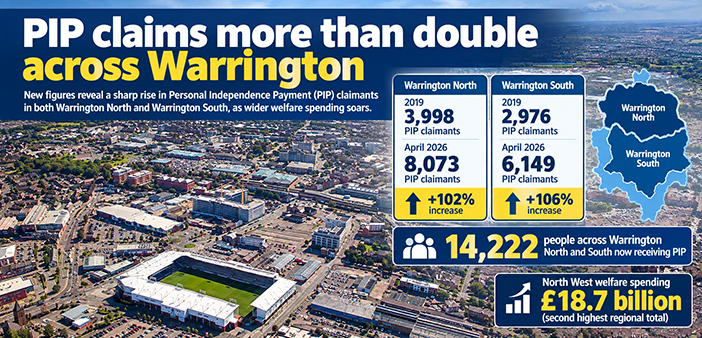
MORE than 14,000 people across Warrington’s two parliamentary constituencies are now receiving Personal Independence Payment, with the number of claimants more than doubling since 2019.
The latest figures show 14,222 people across Warrington North and Warrington South were receiving PIP in April 2026.
In Warrington North, the number has risen from 3,998 in 2019 to 8,073. In Warrington South, the figure has increased from 2,976 to 6,149 over the same period.
Taken together, the figures show the number of PIP recipients across the two constituencies has risen from 6,974 in 2019 to 14,222 in April 2026 – an increase of more than 100 per cent.
The figures provide a striking local snapshot of a much wider increase in welfare spending highlighted by new research from the TaxPayers’ Alliance.
The organisation has launched a Welfare Map covering every constituency and local authority in England and Wales.
It shows that spending on six major benefits, including Universal Credit and PIP, reached £133.1 billion in the 12 months to March 2026.
That represents an increase of £26.1 billion, or 24.4 per cent, in just over two years.
The North West accounted for £18.7 billion of the total – second only to London’s £24.2 billion regional welfare bill.
The research also highlights the particular concentration of PIP spending in the North West, with four of the five constituencies recording the highest PIP spending in England and Wales located in the region.
Warrington’s dramatic increase
The rise in PIP recipients has been particularly pronounced in both Warrington constituencies.
In Warrington North, the number of claimants increased steadily from 3,998 in 2019 to 4,616 in 2020, 5,008 in 2021, 5,471 in 2022 and 6,148 in 2023.
It then rose to 6,935 in 2024, 7,623 in 2025 and 8,073 in April 2026.
Warrington South has followed a similar pattern, rising from 2,976 PIP recipients in 2019 to 3,448 in 2020, 3,719 in 2021, 4,096 in 2022 and 4,481 in 2023.
The figure reached 5,131 in 2024, 5,764 in 2025 and 6,149 in April 2026.
The combined increase means there are now more than twice as many PIP recipients across the two constituencies as there were seven years ago.
What is behind the increase?
The figures are likely to add to the increasingly heated political debate over welfare reform.
However, a rise in PIP recipients should not automatically be interpreted as evidence of fraud or people receiving benefits they are not entitled to.
PIP provides financial support to people with long-term health conditions or disabilities, and changes in the number of recipients can reflect a range of factors, including changes in health, population, awareness of the benefit and assessment decisions.
The latest figures nevertheless demonstrate the growing scale of PIP within Warrington and come as the Government faces pressure to control the rising cost of the welfare system.
The TaxPayers’ Alliance is calling for tougher controls on welfare spending, including tighter benefits caps, assessments and eligibility and greater use of means testing.
The campaign group says its Welfare Map shows how dramatically welfare spending varies between constituencies.
Overall, 54 constituencies recorded annual welfare bills of more than £365 million, equivalent to more than £1 million every day.
For Warrington, the figures provide a powerful local dimension to the national welfare debate.
While the TPA research focuses on total spending across six benefits rather than simply PIP, its figures show the North West is one of the areas where welfare expenditure is particularly significant.
And with 14,222 people across Warrington North and Warrington South now receiving PIP, compared with fewer than 7,000 in 2019, the scale of the change locally is difficult to ignore.
The figures are likely to fuel further debate among Warrington’s MPs and political parties over how the welfare system should support people with disabilities and long-term health conditions while controlling the rapidly increasing cost to taxpayers.
Warrington Worldwide approached the town’s MPs, Charlotte Nichols for Warrington North and Sarah Hall for Warrington South for comment, but none had been received at time of going to press.