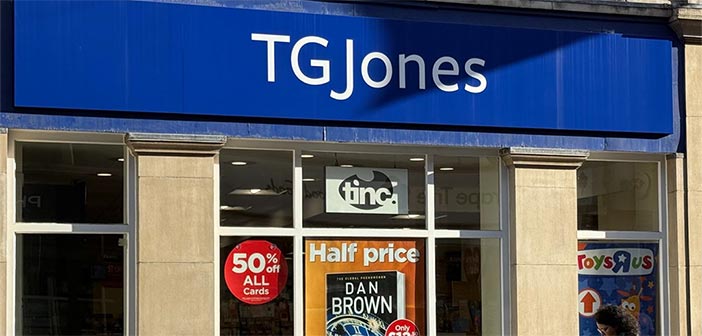
THE slow death of the traditional newsagent is being played out on Warrington’s streets – and the latest crisis at former high street giant WHSmith is another warning sign.
For generations, the British newsagent was part of the fabric of everyday life. You popped in for the morning paper, a magazine, a packet of sweets, a birthday card, a lottery ticket – and quite often a bit of local gossip thrown in for free.
But increasingly, the traditional newsagent is becoming a memory.
And here in Warrington, the disappearance of familiar names and the changing face of the high street provides a stark local illustration of a national crisis.
The latest warning comes from the extraordinary demise of WHSmith as a familiar high street name.
The 233-year-old WHSmith name has disappeared from hundreds of Britain’s high streets following the sale of its high street operation to private equity-backed Modella Capital.
The business has been rebranded TGJones – and it is already facing a major restructuring, with potentially around a third of its stores at risk of closure.
In Warrington, the familiar WHSmith in the Golden Square has become TGJones, although the store continues to provide newspapers, books, stationery and a Post Office service.
But the name above the door is only part of the story.
The bigger question is whether the traditional newsagent business model has a viable future at all.
The decline is nothing new in Warrington. Some of the town’s traditional newsagents have disappeared quietly over the years, often without making the headlines.
Who remembers Horrabins on Sankey Street, which closed well before the massive modern redevelopments of the town centre, vanishing alongside other nostalgia-heavy Sankey Street staples of that specific generation.
Further afield, Lymm provides another example of how the traditional family newsagent has struggled to survive.
In 2007, Peter and Joan Dobson retired after running their Eagle Brow newsagents for 39 years.
The business was believed to have been a newsagent for generations, with Mr Dobson’s father and grandfather having previously operated as newsagents in Stockton Heath.
They were also the last newsagents in Lymm to deliver newspapers – a service they finally discontinued shortly before their retirement.
At the time, the couple highlighted the increasing difficulty of finding paper boys and girls to operate traditional newspaper rounds – and that’s nearly two decades ago and things have certainly not got any easier in the industry.
It is difficult to imagine a clearer snapshot of how much the retail landscape has changed.
The disappearance of McColl’s has also been felt locally.
McColl’s was once a major part of the neighbourhood newsagent and convenience-store landscape, including stores in Warrington.
The company collapsed into administration in 2022 and was bought by Morrisons.
The rescue involved the closure of 132 stores, while the remaining McColl’s outlets were progressively converted to Morrisons Daily.
One of the Warrington stores listed for closure was the McColl’s at Market Gate.
The McColl’s name has now effectively vanished from Britain’s high streets. Again, the physical shops did not necessarily disappear overnight. They simply changed identity. And that is becoming an increasingly familiar story.
WHSmith becomes TGJones
Now Warrington has witnessed another extraordinary chapter in the story. WHSmith’s high street operation was sold in 2025 for around £76m, covering approximately 480 stores.
The new owner, Modella Capital, renamed the business TGJones.
The WHSmith brand itself has been retained by the original company for its more profitable travel operation, including airports and railway stations.
The former high street business, however, has been left fighting for survival.
Recent reports indicate that TGJones is planning substantial store closures as part of a court-approved restructuring programme.
That should concern anyone who cares about the future of traditional town-centre retail.
Because if a retailer with hundreds of stores and one of the most recognisable names in British retail history is struggling, what chance does the independent newsagent on the corner have?
There is, however, an important Warrington twist. The town centre is not simply dying. In fact, some of the latest figures suggest that parts of the town centre are performing surprisingly well.
Warrington BID reported a 3 per cent year-on-year increase in town-centre footfall in 2025, alongside increased visitor spending and a significant rise in tourism.
Major events have also demonstrated that Warrington can still attract huge numbers of people.
The BID recorded more than 67,000 visits during the 2025 Food and Drink Festival weekend, while other major events attracted tens of thousands of visitors.
So this isn’t simply a story about people abandoning Warrington. It is about what they do when they get here.
People will still come into town for entertainment, food, drink, events and experiences. But increasingly they are not coming into town specifically to buy a newspaper, magazine or greetings card.
And that distinction could prove crucial for the future of the traditional newsagent.
A high street under pressure
Warrington Borough Council’s own evidence base demonstrates that the town centre has experienced significant retail vacancy over the years. Its latest Annual Monitoring Report points back to the 2019 retail study, which recorded 84 vacant town-centre units – 17.8 per cent of the total. That was an improvement on 2014, when 121 units – 23.5 per cent – were vacant.
But the council noted that the level remained significantly above the then national average of 11.2 per cent.
The situation has undoubtedly evolved since then, with new developments, new businesses and major investment changing the face of the centre. But the underlying challenge remains.
Traditional retail has to compete not only with other shops but with supermarkets, out-of-town retail parks, discount stores and, above all, the internet.
For independent newsagents, the economics are particularly brutal.
According to the research highlighted by Parcelhero, newspaper and magazine cover prices have increased by more than 138 per cent over the past decade.
Yet independent retailers continue to face wholesale distribution and carriage charges – reportedly around £75 to £80 a week – while margins on publications can be as little as 15 per cent.
In other words, the very products that originally brought customers through the door are increasingly becoming loss-making or low-margin traffic generators.
The traditional newsagent has therefore had to reinvent itself.
Parcel collection.
Lottery.
Tobacco.
Confectionery.
Groceries.
Coffee.
Parcel services.
Mobile phone top-ups.
And dozens of other services have been added in an attempt to keep the tills ringing.
But there is a fundamental problem. If customers stop buying newspapers and magazines, the reason for visiting the traditional newsagent in the first place disappears – And then there is the internet. Perhaps the biggest threat is sitting in all of our pockets.
Why wait until tomorrow morning for the newspaper when the latest story is available on your phone within seconds?
Why buy a magazine when its content is available online?
Why walk into town to buy a book when it can be delivered to your front door?
And why wait for a card shop to open when an online retailer can deliver almost anything to you tomorrow?
The transformation of the news industry has been particularly dramatic.
Indeed, when Warrington Borough Council’s then chief executive Steven Broomhead reflected on the changes facing the town’s media landscape in 2019, he made the telling observation that “hardly anybody buys newspapers now” – adding that newsagents could no longer even deliver newspapers to the Town Hall.
It was a throwaway comment at the time. It now looks remarkably prophetic.
The question is whether we should simply accept this as progress. Because a newsagent was never just a shop. For many older residents, it was part of their daily routine.
For children, it was where pocket money disappeared in exchange for comics and sweets. For communities, the local newsagent often doubled as a Post Office, parcel collection point, lottery outlet and informal information centre. And for decades, the newspaper delivery round provided employment for generations of young people.
Those functions are disappearing or being replaced by larger retailers and digital services.
The danger is that we only realise what we have lost once it has gone.
Warrington’s retail future
The irony is that Warrington is investing heavily in creating a new kind of town centre. Time Square, Warrington Market, Golden Square and a growing food, leisure and events offer are helping bring people back into the centre.
The town’s BID says the evidence is encouraging. But the high street of the future is likely to look very different from the high street many Warrington residents remember.
The traditional newsagent may be one of its biggest casualties.
And the question is not simply whether there will be somewhere left to buy a newspaper.
It is whether, in an increasingly digital world, we still value the independent businesses and familiar faces that once made our neighbourhoods feel like communities.
Because once the shutters come down for the final time, you don’t simply lose a shop.
You lose a little piece of the place. And perhaps that really is why no news is bad news!
Here at Warrington-Worldwide we have been part of the changing landscape, as the first independent daily online newspaper in the country when we launched in 1999 alongside a print magazine, which we still produce today.
Many of our clients say they get a better reponse in print than online – so maybe there is still some hope for the industry?
Here at Warrington Worldwide we aim to deliver the best of both worlds!