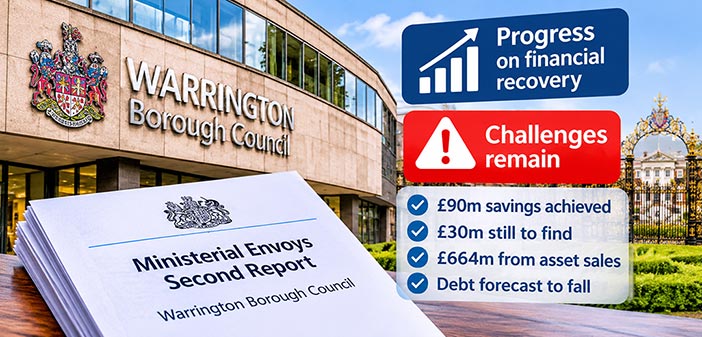
WARRINGTON Borough Council has been told it is making encouraging progress towards financial recovery, but government-appointed Ministerial Envoys have warned that the real test will be delivering more than £150m in savings and reducing its substantial debt burden.
A second report by the four Ministerial Envoys, published by the Government on Wednesday (November 25), acknowledges improvements in the council’s financial planning, leadership and governance.
However, it also raises concerns about the pace of transformation, the council’s ability to deliver savings and continuing problems with its new finance and HR computer system.
The report, dated October 23, follows nine months of work involving the envoys, councillors and senior officers to develop a route towards financial sustainability.
It concludes that the council now has a clearer financial recovery plan, but stresses that delivering the proposals will be critical to avoiding further financial difficulties.
The council has identified around £90m in Phase 1 and Phase 2 savings against an original recurring budget gap of approximately £180m.
A further £60m in savings is expected to come from reducing the cost of its commercial investments and debt through a programme of asset disposals and loan repayments.
The envoys say this strategy aims to generate around £564m in capital receipts from asset disposals, alongside £100m in third-party loan repayments, producing a total of approximately £664m.
The council’s gross borrowing, which stood at around £1.5bn in 2025/26, is forecast to fall to £890m by 2028/29, subject to the strategy being delivered.
However, the report makes clear that a further £30m in core savings from council services still needs to be identified, with delivery required by March 2029.
It also warns that the proposed savings are heavily dependent on the council successfully exiting its commercial investments over the next two years.
The envoys acknowledge that some disposals are already well advanced, with capital receipts approaching £300m forecast during the current financial year, assuming there are no further external financial shocks.
But they also highlight the financial consequences of unwinding the council’s commercial strategy.
The current commercial strategy is costing the authority £16.4m a year, while exiting it would result in an estimated capital loss of around £166m.
Repaying that loss would cost approximately £14.3m annually over 20 years, reducing the potential annual revenue savings from disposals to around £2.1m.
The report says the remaining £30m budget gap could potentially be reduced by half if the council did not have the continuing cost of servicing this overhanging debt.
Concerns over pace of savings and IT problems
Despite welcoming the progress made, the envoys express concerns about the council’s ability to deliver the necessary savings quickly enough.
They say there has been a lack of progress and experience in delivering a transformation programme on this scale, although additional resources and expertise are now being recruited.
The report also highlights a £21m adverse variance in the council’s Quarter 1 revenue monitoring position.
This included £9m in projected departmental overspending and £12m relating to savings that had not been delivered.
The council’s ability to monitor its finances has also been severely hampered by problems with the SAP finance and HR system, which went live in April.
The envoys say the seriousness of the problems was not recognised and escalated quickly enough and that intervention was required before the scale of the difficulties was acknowledged.
Attempts to resolve the issues by the end of October were unsuccessful, meaning the council again had to rely on manual workarounds and alternative reporting arrangements for its second-quarter monitoring.
Specialist external expertise is now being brought in to investigate and stabilise the system.
The report also highlights the continuing backlog in the council’s audited accounts, which had not been completed for six years.
Auditors are nearing completion of the 2019/20 accounts, with only minor matters outstanding, but the envoys say clearing the remaining backlog could take a further 12 to 18 months.
Governance and leadership improvements
On a more positive note, the envoys say the appointment of a new Chief Executive, Sarah Smith, in March has brought “much needed stability” to the senior leadership team.
They also recognise improvements in relationships between councillors and officers, with more engagement involving opposition groups and wider briefings on the proposed savings.
An independent governance review has made recommendations covering the need for a new constitution, accountability and decision-making, Cabinet delegations, joint executive arrangements and the role of scrutiny.
The envoys say implementing these recommendations must now be a priority.
Progress with the council’s wider transformation programme has been slower than originally anticipated, partly because of a lack of capacity and the focus on identifying further savings.
A 15-strong transformation team is expected to be fully in place by December.
The report also highlights the substantial savings expected from Adult Social Care, with £34m of the £51m Phase 2 savings agreed in September relating to the department.
The envoys say they are confident these savings can be delivered, but acknowledge the scale of the challenge.
They also recognise positive performance in Children’s Services, where recent inspections have highlighted effective partnership working and services comparing favourably with regional and national benchmarks.
The appointment of the envoys followed a critical Government-commissioned Best Value Inspection of Warrington Borough Council, published in May 2025.
The inspection followed earlier concerns about the council’s commercial investment programme, borrowing and financial management, including findings from a CIPFA capital assurance review.
The Best Value Inspection identified significant failings across five of seven areas examined, including continuous improvement, leadership, governance, culture and use of resources.
It raised serious concerns about the council’s commercial investment decisions, financial management and decision-making arrangements.
In July 2025, the then Government Minister for Local Government, Jim McMahon, confirmed a statutory intervention under the Local Government Act 1999.
Four Ministerial Envoys – Harry Catherall, Sir Stephen Houghton, Carolyn Williamson and Phil Brookes – were appointed to provide support and challenge, reporting directly to the Government.
The council retained responsibility for its day-to-day operations and primary decision-making, but was required to follow a series of Ministerial Directions and produce an Improvement and Recovery Plan.
The intervention is intended to run until July 2030.
Government says delivery is now the real test
In a written statement to Parliament, Minister for Local Government, Devolution and Regional Growth Jim McMahon acknowledged the work undertaken by councillors and officers to address the authority’s significant challenges and develop a clear financial recovery plan.
However, he reinforced the message from the envoys that delivery is now the priority.
He said the council must move at pace to deliver savings and transformation, progress the disposal of major commercial assets and implement its refreshed Improvement and Recovery Plan while continuing to provide essential services to residents.
The Government will continue to review the intervention arrangements and expects clear evidence of progress in the next report.
Council welcomes progress
Council Leader Cllr Hans Mundry said: “I am pleased with the progress the council is making as we work to achieve financial sustainability.
“The Ministerial Envoys’ report reflects the hard work we are putting in and our strengthened approach regarding our finances, governance and leadership.
“We continue to welcome the expertise of our envoys and with their support, we are definitely heading in the right direction. We are committed to maintaining this positive progress.”
Cabinet member for finance Cllr Denis Matthews added: “I welcome our Ministerial Envoys’ report. It notes that we are making good progress to improve how we operate, as we work to ensure we can provide the best possible services within our budget.
“The report also shows that we are developing credible plans to reduce our level of debt and address our commercial portfolio in a measured way.
“The key priority for the council now, as is reflected in the report, is to deliver the savings we need to make. While there will be challenges ahead, we are undoubtedly on the right track.”