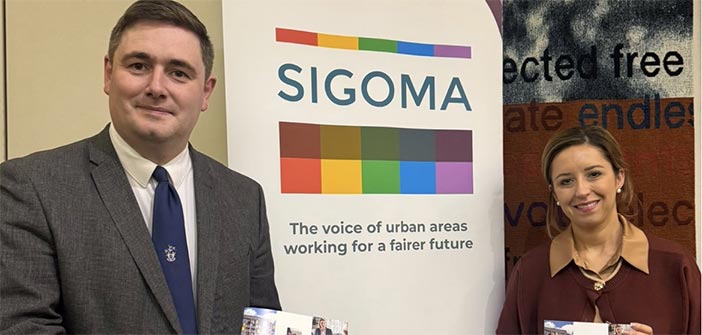
WARRINGTON Borough Council has joined 18 other local authorities across the North West in calling for a major overhaul of the way local government is funded, warning that councils serving communities with some of the greatest needs are being left struggling to meet growing demands with limited social care resources.
Warrington is among 19 North West councils represented by SIGOMA, which has launched a new manifesto calling on the Government to introduce a fairer and more sustainable funding system for local authorities.
The group represents 50 metropolitan and unitary councils across England, serving around 16 million people.
Its membership includes Blackburn with Darwen, Blackpool, Bolton, Bury, Halton, Knowsley, Liverpool, Manchester, Oldham, Rochdale, Salford, Sefton, St Helens, Stockport, Tameside, Trafford, Warrington, Wigan and Wirral.
The call for reform comes at a particularly challenging time for Warrington Borough Council, which is already grappling with substantial financial deficits, major savings requirements and concerns over the future delivery of essential services.
The SIGOMA manifesto highlights the growing financial burden of adult and children’s social care, alongside increasing demand for support for children with special educational needs and disabilities (SEND).
It argues that councils serving areas with higher levels of deprivation are facing greater demand for essential services while having weaker Council Tax and Business Rates bases from which to fund them.
Social care spending accounts for 87 per cent of locally funded expenditure
New analysis by SIGOMA shows average adult social care spending across its member authorities increased by 49 per cent between 2021/22 and 2025/26, rising from approximately £98.5m to £146.9m.
Children’s social care spending increased even faster, rising by 53 per cent from £70.6m to £108m over the same period.
The figures show that net spending on adult and children’s social care across SIGOMA authorities was equivalent to 87 per cent of their Net Revenue Expenditure in 2025/26, compared with 43 per cent across England.
Net Revenue Expenditure measures spending funded through councils’ own resources, principally Council Tax and Business Rates.
SIGOMA says the figures demonstrate the scale of social care commitments relative to the resources its member councils can raise locally, leaving them increasingly dependent on Government grants.
While these are collective figures for the 50 SIGOMA authorities rather than Warrington-specific spending figures, they highlight the wider financial pressures facing the borough as it attempts to balance its own budget.
SEND demand creating further financial pressure
The manifesto also warns of a growing crisis in funding for children with special educational needs and disabilities.
Without further Government intervention, SIGOMA forecasts that accumulated deficits among its member councils through the Dedicated Schools Grant will exceed £1.6bn by March 2028.
The proportion of pupils with an Education, Health and Care Plan (EHCP) across its authorities increased from 4.1 per cent in 2021/22 to 6.5 per cent in 2025/26.
SIGOMA is calling for historic deficits to be resolved in full, alongside a more sustainable funding system that reflects current levels of need and deprivation.
It also wants greater investment in early intervention, mainstream inclusion and local specialist provision to help tackle the underlying causes of rising costs.
Warrington’s ability to raise money locally highlighted
One of the key arguments in the manifesto is that councils serving more deprived communities often have less ability to generate income through local taxation.
In 2025/26, Council Tax requirements were equivalent to 54 per cent of Net Revenue Expenditure across SIGOMA authorities, compared with 69 per cent nationally.
Average gross Business Rates collected per resident were also lower, at £350 compared with £472 across England.
SIGOMA says this creates a double financial challenge, with greater deprivation driving demand for services while weaker local tax bases restrict the ability to pay for them.
Its manifesto calls for a funding formula which more accurately reflects deprivation, demand and the ability of individual councils to raise revenue.
Call for reform of Council Tax system dating back to 1991
The group is also calling for the first national Council Tax property revaluation since the system was introduced, arguing that the current system no longer accurately reflects relative property values across the country.
Since 1995, average house prices have risen by 388 per cent in SIGOMA areas, compared with 476 per cent across England and 626 per cent in London.
It wants regular property revaluations in future and changes to Council