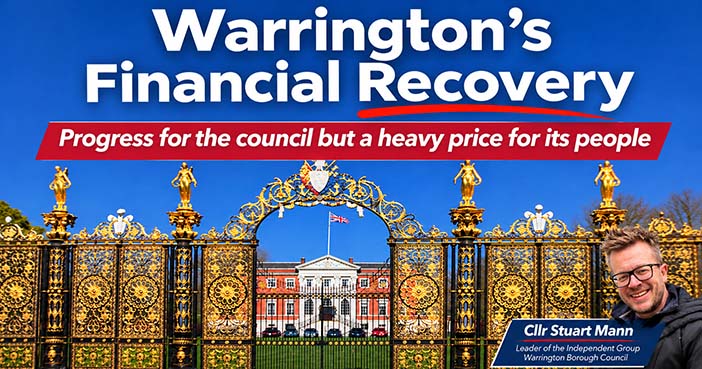
WARRINGTON’S Independent Group Leader, Cllr Stuart Mann, has welcomed signs of progress in the borough council’s financial recovery but warned that improving forecasts must not be allowed to overshadow the political failures that made government intervention necessary or the consequences residents will face for years to come.
Ahead of Warrington Borough Council’s Scrutiny Committee meeting on Monday 30th November at Time Square, newly published financial papers provide a clearer picture of the council’s financial position, its recovery plans and the considerable challenges that remain.
While the figures suggest the council is moving towards a more financially sustainable future, Cllr Mann believes recognition for that progress must be firmly directed towards the officers delivering the recovery programme under the direction and oversight of Government-appointed Ministerial Envoys.
Credit where credit is due
There is no doubt council officers are working under extraordinary pressure to deliver substantial savings, reduce borrowing, restructure the organisation and maintain essential public services, against a backdrop of uncertainty over their own jobs and the future structure of the council.
That work comes at considerable expense to the people of Warrington but is beginning to establish a more credible route towards financial stability.
The Scrutiny papers recognise the work undertaken by officers and Envoys in reviewing the council’s financial provisions and developing its commercial investment disposal strategy.
Cllr Mann believes their achievements deserve considerable recognition, particularly given the scale of the task they have inherited and the pressure under which they are working.
He said: “The officers working to put this council’s finances right deserve enormous credit. Many are facing uncertainty over their own futures while being tasked with addressing the consequences of years of poor political stewardship. Everyone in our town should want the officers and Ministerial Envoys to succeed, but no-one should be allowed to claim political credit for the hard work of those repairing the damage made on their watch.”
Beyond financial figures, there is a greater cost to the town that receives far too little attention.
Government intervention, extraordinary financial briefings, expensive external expertise, recovery boards, organisational restructuring and repeated rounds of savings now consume a considerable amount of the council’s time and resources.
Regardless of whether those briefings deliver encouraging or concerning news, Cllr Mann argues that they should never have been necessary in the first place.
Across the council’s committees, so much time is being devoted to managing financial pressures, reducing expenditure and addressing historic governance failures.
Under different circumstances, that time, money and expertise could have been directed towards improving every part of the town. Instead of considering how services could be improved, councillors are increasingly having to consider how they can be reduced, delivered differently or stopped altogether.
Cllr Mann said: “Just imagine what Warrington could be achieving if its councillors and officers were able to concentrate on improving the town rather than constantly dealing with the consequences of poor financial decisions. The cost of financial failures must also be measured in what Warrington could have achieved but hasn’t.”
National pressures are not an excuse for local failures
There is no doubt that a longstanding and inadequate local government funding formula, spiralling adult social care costs and increasing demand for special educational needs and disabilities (SEND) provision have all contributed to the financial challenges facing councils across the country.
Even the current Labour Government’s review of local government funding is not expected to deliver any material improvement in Warrington’s funding position, but these pressures are not and never have been unique to Warrington. Many other councils have faced similar challenges without accumulating comparable financial exposure or requiring intervention on the scale now being experienced in Warrington.
There is a fundamental distinction between the financial pressures imposed upon the council by national circumstances and the additional financial risks it created for itself through local political decisions. The national funding formula did not require Warrington to pursue its massive commercial investment strategy, nor did rising social care costs dictate the scale of its commercial borrowing.
Those were decisions made locally.
“The administration in Warrington cannot simply point the finger at Whitehall when so many of the decisions that contributed to this financial crisis were made right here in our own Town Hall,” said Cllr Mann.
Progress, but far from certainty
The council’s latest published financial information demonstrates the extraordinary scale of the challenges that remain:
• Approximately £1.5 billion in borrowing.
• More than £90 million in previously approved savings.
• A further £60 million targeted through changes to financial provisions, borrowing arrangements and commercial investment disposals.
• Nearly £69 million in additional recurring savings still to be identified.
• Approximately £179 million in Exceptional Financial Support already approved, with potentially another £175 million required.
• A proposed further council tax increase of 4.98% for 2027/28.
• The council is targeting approximately £664 million in receipts from commercial investment disposals and loan repayments to reduce borrowing, with the disposal strategy intended to be fully delivered by March 2029.
Achieving that would represent huge progress, but it remains dependent on investments being sold at anticipated values and loans being repaid within expected timescales.
Meanwhile, an underlying projected overspend of nearly £20 million for the current financial year is expected to be offset through changes to financial provisions but that does not necessarily mean the underlying spending pressures have been resolved.
Most significantly, the scrutiny papers acknowledge that if the council cannot balance its budget and the necessary further Exceptional Financial Support is not granted, the Section 151 Officer may need to issue a Section 114 Notice, triggering severe restrictions on new council expenditure and an even greater impact upon residents.
For Cllr Mann, that warning demonstrates the considerable difference between establishing a credible route towards financial sustainability and achieving it.
Much of the improved outlook remains dependent on assets that have not yet been sold, savings that have not yet been identified and government support that has not yet been approved.
The direction of travel is positive, but Warrington remains far from financially secure.
The reality of Labour’s commercial investment strategy
For years, Warrington’s Labour administration promoted the income generated by its commercial investments and the contribution that income made towards protecting local services.
The latest published financial information paints a considerably less favourable picture.
The commercial properties and investments in commercial entities identified within the council’s disposal strategy were originally acquired for approximately £812 million but had an estimated value of around £564 million in March 2026.
That represents a potential reduction in value of approximately £248 million.
Once borrowing costs and revised financial provisions are considered, the council now identifies an annual revenue loss of approximately £16.4 million from these investments and even more concerning, selling those investments will not bring an end to their financial consequences.
The council anticipates being left with approximately £166 million in residual financial exposure, costing around £14.3 million annually over the longer term.
Generating income is not the same as generating a sustainable financial return. Borrowing costs, asset values, long-term liabilities and exposure to changing economic conditions must all be properly understood and managed.
The latest figures do not establish that every investment was unsuccessful or that the portfolio made a loss in every previous year, they do, however, raise questions about whether the financial benefits previously and frequently promoted by Labour adequately reflected the full costs and risks involved.
“Warrington could still be paying millions of pounds every year for commercial investments it no longer owns. Money that should be improving our town will instead be spent dealing with the financial legacy of those decisions, ” said Cllr Mann.
Government support is not free money
Another significant financial legacy is the council’s reliance on Exceptional Financial Support.
This is not simply additional government funding. It allows the council to use borrowing or capital receipts to finance expenditure that would ordinarily be funded from its annual income and the council’s published papers identify a potential total requirement of approximately £354 million across five financial years.
Based on a 20-year repayment provision and assumed interest of 5%, gives a lifetime financing cost of approximately £708 million if the full amount is borrowed on those assumptions. Even if the council avoids the final year’s requirement, the equivalent calculation produces a potential lifetime cost of approximately £619 million.
These are illustrative calculations rather than confirmed liabilities costs will depend on the amount borrowed, the financing arrangements and prevailing interest rates.
Exceptional Financial Support means future generations could still be paying for expenditure incurred many years before and financial recovery must not simply create another financial problem for the future.
What should have been a marathon has become a sprint
Cllr Mann believes Warrington’s financial risks should have been confronted much earlier, allowing difficult changes to be introduced progressively rather than through an accelerated recovery programme.
Of the nearly £69 million in additional recurring savings still required, more than £47 million is concentrated in 2029/30 alone.
The scale and concentration of those savings create significant risks for council employees, residents and the continued delivery of local services.
Had difficult decisions been confronted earlier, rather than the administration ‘sticking its fingers in its ears’ there might have been more opportunity to consult residents properly, protect vulnerable people, manage organisational change and give communities time to adapt.
Instead, the council now finds itself attempting to deliver years of financial and organisational change within a relatively short period.
“What should have been a marathon of carefully managed change has become a sprint to restore financial stability. Difficult decisions don’t disappear because Cllrs choose to delay them. They simply become harder, more expensive and more painful when they eventually must be made.”
Residents paying more and receiving less
For the majority of people in Warrington, the town’s financial recovery will not be measured through spreadsheets, accounting adjustments or borrowing figures, it will be measured through council tax bills, the availability of local services and the additional costs households may have to meet themselves.
Changes affecting adult social care, school transport, libraries, subsidised bus services and school crossing patrols have already featured in the council’s wider published savings programme. The scrutiny papers explicitly acknowledge that the savings required will mean some services are provided differently, while others may need to stop altogether.
Cllr Mann is also worried about the potential for responsibilities, currently undertaken by the borough council, to be passed to parish councils, community organisations, charities and volunteers.
While the extent of any such transfers remains to be determined, residents could find themselves paying additional parish precepts or other charges to maintain services previously provided through their existing council tax.
He said: “Already two Parish councils have given grants totally £15,000 to support Westbrook Library following the decision by WBC that it could not afford to keep running it. These grants may well become annual requests, but that’s just one community asset in a Parish with at least four, what happens if all the other centres need similar funding? Where will that come from and who will pay?”
One Cllr Mann’s main concerns is a need for a comprehensive assessment of the combined impact of the financial recovery programme on residents. Higher council tax, additional transport costs, reduced access to services and greater caring responsibilities could collectively place considerable pressure on the same household and there is also a risk that reducing preventative services today could create greater demand for more expensive services in the future.
Even if officers successfully deliver everything currently forecast, residents face the prospect of paying more and receiving less for years to come.
“A saving for Warrington Borough Council is not necessarily a saving for the people of Warrington. Sometimes it simply means somebody else has been left to pick up the bill. Even if the recovery programme is an overwhelming financial success, residents could still spend years paying more and receiving less.”
Political accountability cannot be forgotten
The independent Best Value Inspection identified serious weaknesses in leadership, governance, organisational culture and the use of resources at Warrington Borough Council. Government intervention followed.
While responsibility for individual financial decisions extends beyond elected politicians the Labour administration must remain politically accountable for its stewardship of the council during the years leading up to intervention.
The requirement for expensive external expertise, Ministerial Envoys and an extraordinary financial recovery programme must remain a matter of considerable political concern, regardless of how encouraging the latest forecasts may be.
Cllr Mann likened any attempt by any group to claim political credit for the recovery to the actions of someone starting a fire and then seeking recognition for the work of the emergency services.
“For Labour to claim political credit for the recovery would be rather like setting the Town Hall on fire, calling the fire brigade and then expecting a medal for saving the ashes. Those fighting the fire deserve enormous credit, but let’s not forget why they had to be called in the first place.”
Making sure it never happens again
Alongside financial recovery, the council is undertaking work to improve its governance arrangements through its Improvement and Recovery Plan the effectiveness of those reforms will ultimately be tested when the Ministerial Envoys depart, and the council is once again operating without extraordinary government oversight.
Cllr Mann and others on Scrutiny committee have raised concerns about the limited time available for effective financial scrutiny, with only one clear day between Monday’s Scrutiny Committee meeting and Cabinet’s consideration of the financial proposals on Wednesday 2 December.
Given the historic governance failures identified through the Best Value Inspection, meaningful scrutiny, independent challenge and transparency should be among the council’s highest priorities.
Residents deserve assurances that the governance improvements being introduced will remain effective long after the Envoys have departed and that the circumstances which led to government intervention cannot simply be allowed to develop again.
Getting the council’s finances under control is one challenge. Keeping them under control is another.
Cllr Mann is clear that challenging the council’s financial position and holding its political leadership to account should never be confused with talking the town down.
“Warrington is so much more than its council’s financial failures. It is its people, my friends, its families, its businesses, its communities and the thousands of residents and volunteers who work tirelessly to make the town a better place.
“Everyone in Warrington deserves a council that can concentrate on improving their lives rather than spending years repairing its own finances.”
Ahead of Monday’s meeting, Cllr Mann says he will continue to challenge the financial assumptions, seek assurances over the risks to the recovery programme and most importantly press for a greater understanding of the consequences for residents.
While he welcomes the improving financial direction and made pains to stress how much of a positive step forward these improvements are, he believes the political and financial legacy must never be forgotten.
Services will change, opportunities will be lost and future council budgets will remain constrained by historic financial commitments.
“The people of Warrington did not create this financial crisis, yet they are the ones being asked to pay more, accept less and live with its consequences. The greatest tragedy to me is not simply how much money Warrington has lost, but how much more the town might have achieved had those financial failures never occurred.
“We should celebrate the work of those repairing the damage, but must never allow that progress to rewrite the history of how the damage was caused or who was responsible,” he concluded.