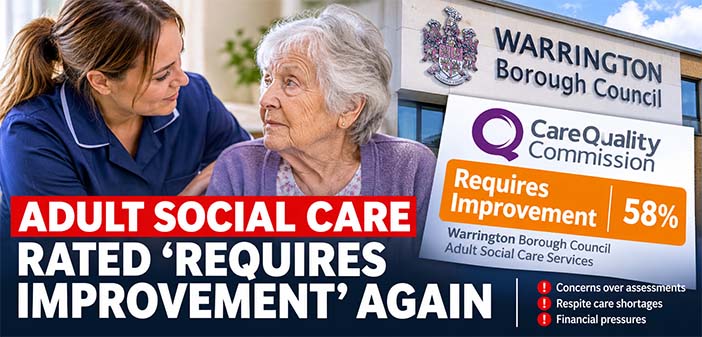
WARRINGTON Borough Council’s adult social care services have once again been rated ‘Requires Improvement’ by the Care Quality Commission (CQC), with inspectors highlighting continuing concerns, although there have been improvements over previous safeguarding issues.
The latest assessment, which follows a previous inspection in 2024, published in 2025, has found that despite progress in several areas, too many improvements have yet to become fully embedded, with some of the problems identified at the previous inspection still unresolved.
The findings come at a particularly challenging time for Warrington Borough Council, which is battling a huge financial deficit and planning to find £32m in savings from its adult social care budget, alongside wider proposals involving staff redundancies.
The financial pressures raise further questions about how the authority will maintain and improve services while attempting to deliver such substantial savings.
The CQC assessment, carried out between June and September 2026, including a site visit in August, gives Warrington an overall rating of Requires Improvement, with 58%.
The rating is unchanged from the previous assessment.
Inspectors spoke to people receiving care, unpaid carers, voluntary organisations, council staff, senior leaders and care providers, as well as examining individual records and performance information.
Concerns remain over assessments and care reviews
One of the main areas of concern is the experience of people going through care assessments and reviews.
While some people told inspectors they had received timely, person-centred assessments and felt listened to, others reported feeling ignored, with concerns that assessments were inaccurate or did not properly represent their wishes.
Some people said their views had been misrepresented in assessments and they had not even received a copy to check what had been recorded.
Others felt they would have benefited from independent advocacy or having family members present to help communicate their needs.
Inspectors found that the council had made progress in developing a more strengths-based approach, but it was not yet consistently embedded.
In particular, people’s desired outcomes were not always followed up during subsequent reviews.
In September 2026, 72 people were waiting for a Care Act assessment, with a median waiting time of 27 days.
However, a much larger backlog existed for annual reviews, with 823 people waiting.
Although waiting times had reduced between June and September, inspectors said longer waits for reviews remained an issue.
The CQC also found that not all support plans demonstrated how people’s eligible care needs were being met or whether there were unmet needs.
Safeguarding improvements – but further work needed
Safeguarding was another area where inspectors identified continuing shortfalls, although they acknowledged improvements since the previous inspection.
The 2024 assessment had identified significant weaknesses in safeguarding practices.
Since then, the council has introduced a new safeguarding hub, bringing referrals together under a centralised system, with qualified social workers responsible for triaging concerns.
Inspectors found this had improved the handling of safeguarding referrals, with more consistent processes and clearer responsibilities.
However, the hub was relatively new and was not fully staffed when the assessment took place.
Inspectors also found that some safeguarding procedures were not yet being used effectively and that the principles of ‘Making Safeguarding Personal’ were not consistently applied.
There was still insufficient feedback from people who had experienced safeguarding processes to demonstrate how their experiences were influencing improvements.
The report also highlighted concerns over safeguarding arrangements for young people moving from children’s services into adult services.
Inspectors said more work was needed to establish clear pathways where safeguarding risks were involved.
Unpaid carers struggling to get respite
The experiences of unpaid carers also featured prominently in the report.
While some carers praised the support they had received, others said they were unaware of the assessments and assistance available to them.
Inspectors found that 88 people were waiting for a carer’s assessment in September 2026, while a further 180 unpaid carers had not received an annual review.
The council attributed the waiting lists partly to vacancies within its carers’ assessment team.
However, perhaps one of the most concerning findings related to the lack of respite care.
Carers frequently told inspectors they struggled to access sufficient breaks from their caring responsibilities.
Some described how their caring roles had resulted in the loss of employment and financial security.
National data showed just 8.82% of Warrington’s carers were accessing support or services allowing them to take a break from caring at short notice or in an emergency.
This compared with an England average of 11.88%.
Inspectors also found that most unpaid carers did not have contingency plans in place should they suddenly become unable to continue caring.
The lack of personalised contingency arrangements was an issue already identified in the previous assessment.
Concerns over care home availability and provider finances
The CQC also highlighted pressures within the local care market, including the financial sustainability of providers.
Inspectors found that many residential and nursing care providers were charging above the council’s funding levels, creating pressure on the availability of placements.
Although the council had taken steps to secure care home capacity, including block-bed arrangements and paying above its usual fee levels where necessary, inspectors warned of vulnerabilities in the market.
If an existing provider were to close, the council could face limited alternative provision at its current funding rates.
Providers had raised concerns about rising operating costs and fees failing to keep pace, warning that this could threaten their long-term viability.
Workforce pressures also remained significant
The CQC reported that the adult social care workforce turnover rate had risen from 28% at the time of the previous assessment to 30.5% in 2025/26.
There were also gaps in provision for people with learning disabilities and autistic people requiring more complex support, particularly personal care at home.
Hospital discharge delays and contingency planning
Inspectors found that improvements had been made to hospital discharge arrangements, with more emphasis on helping people return to their usual homes rather than automatically entering residential care.
However, some people were still remaining in hospital after being medically fit for discharge because of disputes between the council and NHS over funding decisions or because they did not have suitable accommodation to return to.
The council had also strengthened its contingency arrangements for potential care provider failures.
However, inspectors found that individual contingency plans for people receiving care were still not consistently in place.
This meant some people and their carers did not have clear arrangements setting out what would happen if their normal care arrangements broke down.
Some areas of progress recognised
The report does acknowledge a number of improvements and examples of good practice.
The council received a ‘Good’ assessment for supporting people, including unpaid carers, to live healthier lives.
Its prevention work, reablement services and mental health outreach provision were highlighted positively.
A jointly funded mental health outreach service had supported 77.1% of people using it between April and June 2026 to remain independent without requiring further support from services.
Inspectors also praised partnership working between the council, NHS, voluntary organisations and community groups.
The Living Well programme, including its Talking Points community information and advice service, was highlighted as an example of effective joined-up working.
The council also received a ‘Good’ assessment for partnerships and communities.
Its governance, management and sustainability arrangements were rated Good, with inspectors recognising stronger oversight and accountability since the previous inspection.
Mary Cridge, CQC’s director of adult social care and integrated care, said: “When we returned to Warrington Borough Council, we found leaders had shown a real commitment to making improvements since our last assessment and were dedicated to making further changes. The challenge that is with them now is to embed these changes through sustainable systems and processes. For example, we saw improvement in areas like safeguarding but at the time of our assessment it was too early to tell if it would drive long lasting positive change.
“Leaders at the authority must make sure that people have access to the services they need. We heard staff sometimes struggled to find specialist care for autistic people and there were gaps in home care personal support for people with a learning disability.
“People’s experiences were mixed. Some felt listened to, that their wishes had been respected, and they’d received timely person-centred assessments and reviews. Others felt ignored and told us that their assessments were inaccurate.
“However, Warrington worked well with partners. For example, it had developed Talking Points, a signposting and advice service, where people could find out about services most appropriate to their needs. This was part of a living well programme, designed to help people lead healthier lives, preventing them from needing more formal support. This had been shortlisted for a national award.
“There were many positive areas in our report that leaders now need to build on, and we look forward to seeing their progress.”
The financial challenge facing adult social care
However, the overall findings come against the backdrop of an increasingly difficult financial position for Warrington Borough Council.
The authority is continuing to grapple with a huge budget deficit and has been pursuing substantial savings and transformation measures across its services.
Plans to find £32m in savings from adult social care, alongside proposed staff redundancies, will place the future delivery of services under further scrutiny.
The CQC report acknowledges that council leaders are aware of the financial challenges and that savings will need to be made.
It records that the intention is to achieve these through delivering services differently and maximising people’s independence.
However, the inspection does not assess the council’s £32m savings proposals or establish what impact the proposed reductions or redundancies will have on care provision.
With inspectors already identifying waiting lists, gaps in provision, difficulties accessing respite and concerns about the sustainability of care providers, the challenge will be ensuring that financial savings do not undermine the improvements still needed.
What happens next?
The latest assessment shows that Warrington has made progress since the previous inspection, particularly in safeguarding systems, governance, partnership working and prevention.
However, the fact that the overall rating remains unchanged at Requires Improvement demonstrates that the council still has considerable work to do.
Some of the weaknesses identified in 2024 remain evident, while several of the improvements introduced since then are too recent for inspectors to establish whether they will deliver sustained benefits.
The CQC’s findings provide a further challenge for council leaders as they attempt to balance the need to improve adult social care with the authority’s increasingly difficult financial circumstances.
In response to the findings Cabinet member for adult social care, Cllr Tony Higgins, said: “We know that good adult social care can transform lives, and help people to remain independent, safe and connected to their communities. Each year, we provide support to around 4,000 people through our adult social care services, and we are determined to ensure the best outcomes for each of our residents.
“I am certainly encouraged by the progress identified by the CQC, but we are equally clear that our improvement journey is not complete. Making widespread improvements to a service as vast and wide-ranging as adult social care will take time, and we know the areas we continue to further develop and improve. We will continue to build on the positive foundations that have been established and maintain our focus on improving outcomes for our residents.
“The council will continue to deliver its improvement programme, working closely with residents, carers, health partners, providers and the voluntary sector to ensure these recent improvements are fully embedded and sustained.”
Council Leader, Cllr Hans Mundry, said: “The CQC’s latest assessment recognises the good progress we are making in adult social care. Significantly, I am pleased that we have been able to exit our intervention related to safeguarding. This in particular demonstrates that while we have more to do, we are definitely heading in the right direction. I want to thank our staff, partners and people with lived experience who have helped drive these improvements.”