By Rod Scotney
There was a time in Warrington when the day didn’t begin with an alarm clock, a phone screen, or the hum of central heating. It began with a sound so ordinary, so woven into the fabric of daily life, that no one imagined it could ever vanish.
The clang of glass bottles on the doorstep.
A soft “morning!” exchanged through half‑opened curtains.
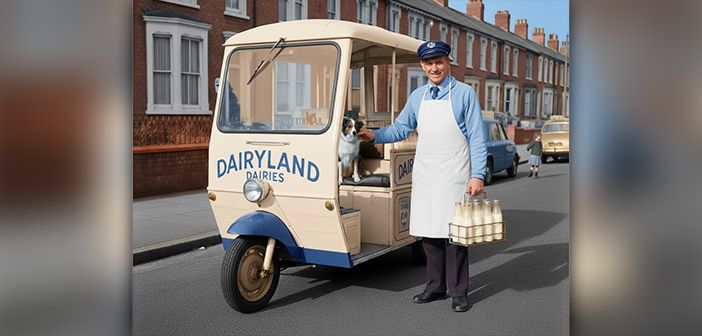
And then the unmistakable whirr of the milk float, easing its way down the street like a gentle mechanical lullaby.
For decades, the milkman wasn’t just a delivery service. He was part of the neighbourhood’s rhythm — a familiar figure who knew which households needed an extra pint, who preferred gold-top, and who’d be grateful for a quiet knock because the baby was finally asleep. In Warrington’s terraced streets and new estates alike, the milkman was as reliable as sunrise.
The Slow Fade of a Local Institution
The decline didn’t happen overnight. It crept in, almost unnoticed at first.
Supermarkets arrived with their bright aisles, long opening hours, and the irresistible promise of everything under one roof. Milk — once a daily essential delivered fresh before breakfast — became just another item tossed into a trolley between the bread and the biscuits.
Prices dropped. Convenience soared. And the milkman, who had served Warrington faithfully through snow, strikes, and school runs, suddenly found himself competing with a system designed to make him obsolete.
By the late 1990s and early 2000s, the familiar floats were fewer. Routes were merged. Some milkmen took early retirement; others held on as long as they could, hoping the tide might turn. But the supermarket juggernaut rolled on, and Warrington — like so many towns — quietly lost one of its most human services.
The Taste That Time Took Away
Ask anyone who grew up in Warrington before the supermarkets took over, and they’ll tell you the same thing: milk never tasted quite the same again.
Maybe it was the glass bottles, cold and beaded with condensation on a summer morning.
Maybe it was the freshness — milk that had travelled only a few miles, not across counties.
Or maybe it was the ritual: the simple pleasure of opening the door to find breakfast waiting, delivered by someone who knew your name.
Supermarket milk was cheaper, yes. But it was also anonymous. Homogenised. Standardised. Stripped of the small, local quirks that made it feel like part of the community.
More Than Milk
Losing the milkman wasn’t just about losing doorstep deliveries. It was about losing a thread in the social fabric.
The milkman noticed when curtains stayed closed too long.
He checked on elderly customers.
He passed on news, shared a joke, and kept an informal eye on the neighbourhood long before “community policing” became a phrase.
When Warrington lost the milkman, it lost a quiet guardian — someone who connected streets, households, and generations without ever making a fuss.
A Memory That Still Rings
Today, the clang of bottles has been replaced by the rumble of delivery vans and the click of online orders. Milk floats, once a dawn chorus, are museum pieces or nostalgic curiosities on social media.
But for those who remember, the memory is vivid:
the soft glow of the float’s headlamp,
the gentle clatter on the doorstep,
the knowledge that someone had already been up, working, caring for the community before most people had even stirred.
Warrington didn’t just lose a service.
It lost a sound, a taste, a ritual — a small but meaningful part of what made the town feel like home.
About the Author
Now living in Somerset with his wife, Heather, Warrington-born Rod Scotney shapes his writing from childhood memories and a lifetime’s devotion to music, art, history, and engineering.