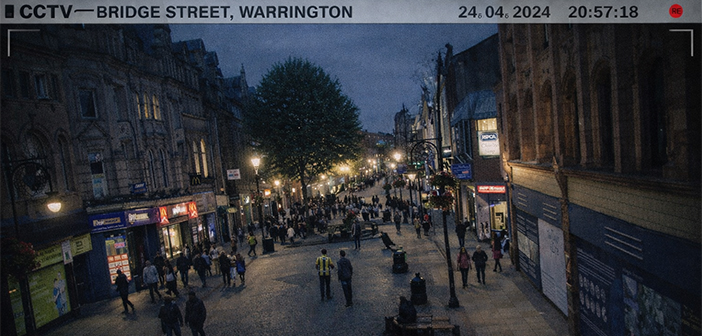
THE Chief Constable of Cheshire, Mark Roberts, has condemned proposed CCTV cutbacks in Warrington Borough Council’s budget, describing them as “a backward and unwelcome step in keeping Warrington residents safe.”
His concerns come as questions are being raised about the potential public safety implications of proposed changes to Warrington’s town centre CCTV service as part of the Warrington Borough Council’s 26/27 proposed budget, particularly when viewed alongside previously reported plans to dim or switch off street lighting overnight.
The concerns follow a correspondence received by Warrington Worldwide, which challenges how the proposed CCTV savings have been characterised and calls for greater clarity from the council before any final decision is taken.
The issue relates to a draft budget proposal that would see the closure of the town centre CCTV control room, reducing staffed monitoring hours from the current level to zero, generating a proposed saving of £113,000.
While the proposal is currently part of a wider package of draft savings and has not yet been approved, questions are now being asked about what the change would mean in practice for community safety, crime prevention, and policing support.
According to the correspondence, the council-operated CCTV service is not a duplication of Cheshire Police provision.
Instead, it is described as a locally managed system that supports policing activity, with monitoring, camera control and footage retrieval undertaken by council CCTV operators.
The submission suggests that Cheshire Constabulary does not operate or fund a public-space CCTV monitoring service in Warrington and instead relies on the council’s system for evidential support.
The message also highlights the council’s statutory responsibilities under Section 17 of the Crime and Disorder Act 1998, which requires local authorities to consider crime, disorder and public safety in the exercise of their functions and to take reasonably practicable steps to prevent them. While the legislation does not mandate the use of CCTV, questions have been raised about how the council intends to demonstrate that these duties have been considered if live monitoring is removed.
Concerns have also been expressed about the cumulative impact on public safety if CCTV monitoring is withdrawn at the same time as street lighting is dimmed or switched off overnight, as previously reported as part of separate budget proposals. The submission argues that the combined effect could reduce both visibility and surveillance in public spaces during late-night hours, particularly in the town centre and night-time economy areas.
It is suggested that while public reporting of incidents via 999 is essential, it is inherently reactive, occurring after incidents have taken place.
By contrast, live CCTV monitoring is described as a proactive tool that can help identify emerging risks, track incidents in real time and support earlier deployment of emergency services. In that context, the submission argues that lighting, CCTV and policing should be viewed as complementary elements of public safety rather than interchangeable cost lines.
Operational questions have also been raised around access to recorded footage. It is claimed that Cheshire Constabulary does not have independent download access to council CCTV recordings and must request footage through CCTV operators.
If correct, the removal of the control room could place additional demands on frontline police officers when evidential material is required.
The submission further questions whether reliance on fixed-position cameras alone would provide an adequate alternative, noting that without live operators able to pan, tilt and zoom cameras in response to developing situations, coverage would be more limited and less responsive to changing patterns of activity between daytime and night-time economies.
Given the scale of the proposed change and the relatively modest saving of £113,000 a year, calls are now being made for the council to provide greater transparency around the current role, usage and effectiveness of the CCTV service before any decision is taken.
Questions being raised include:
• How many incidents CCTV operators were involved in during 2025 and what types of incidents these were
• How frequently CCTV footage is requested by police and for what purposes
• Whether police have independent access to recorded footage or rely on council operators
• What public safety mitigations would remain in place if live monitoring ends
• How the combined impact of reduced CCTV monitoring and street-lighting changes has been assessed
• How the council has considered its Section 17 community safety duties in relation to these proposals
As the draft budget progresses through scrutiny, residents and businesses may reasonably expect these questions to be answered openly, allowing a clearer understanding of whether a £113,000 saving represents an acceptable trade-off against potential risks to public safety.
The council report states: “Early discussions are to take place with Cheshire Police in order to identify funding options to allow the system to remain operational in real time.
“It is the responsibility of Cheshire Police to ensure the safety of residents, and any issues should be reported through the appropriate channels, including 999.”
The council says that the move would save £113,000 a year, with real-time monitoring planned to cease from September 2026 at the earliest.
“Cameras will be left in a ‘passive position’, which will allow Cheshire Police to retrieve this themselves in support of their investigations,” council documents state.
“During 2025, real-time intervention led to circa-600 arrests and 3,500 police attendances without arrest.”
After hearing about the proposals Cheshire Police Chief Constable Mark Roberts issued a statement saying: “It is disappointing to find out about this proposal at the eleventh hour without any consultation.
“It is also extremely disappointing to read in the report that the council states that the safety of residents is solely the responsibility of the force.
“Having a fully operational CCTV function within the town centre is essential to keeping people safe, and providing the public with reassurance.
“Working collaboratively with the council, crime and disorder in Warrington continues to fall because of our proactive approach.
“CCTV is vital to reduce crime in the nighttime economy, to address shoplifting, and to protect women and girls.
“To do this effectively and to prevent crime, it needs to be live monitored.
“Community safety is not just an issue for the police; it is a collaborative approach, strengthened by the crime and safety partnerships that work on the principle that no single agency can address all drivers of crime and antisocial behaviour.
“Local authorities have legal responsibilities under the Crime and Disorder Act to prepare and implement partnership plans, and they play a crucial role in ensuring that their communities are protected and empowered.
“This proposed move would be a backward and unwelcome step in keeping Warrington residents safe.”