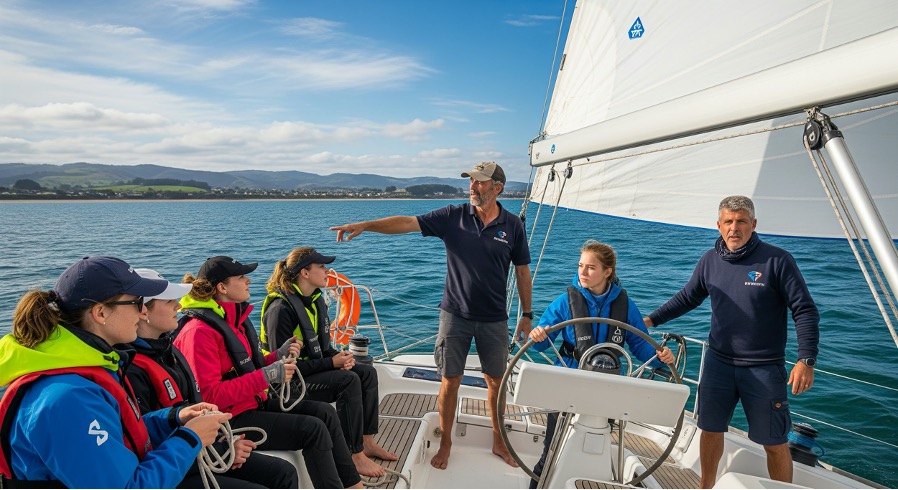
A significant percentage of new sailors begin their education by completing an RYA Start Yachting course, and they quickly discover that well-organised training can transform what would otherwise be an unpredictable pastime into a secure, self-assured one.
The time spent on the water is far more rewarding when it is done in an informed manner rather than via guesswork. Every class will help to develop awareness, stability, and judgement, all of which can reduce risk and increase pleasure. Understanding how these programmes protect trainees helps explain why formal training is such an essential component of ensuring a sailor’s competency.
Building Competence Through Repetition
Skills develop gradually. Repetitive practice will teach students how a vessel reacts to wind, tide, and crew movement. Coordination motions, such as cutting down sails or preparing to tack, start out being slow and time consuming. With time, these movements become fast and automatic. Practice also minimises the likelihood of errors in challenging situations. Drills are also conducted regularly to assist sailors in evaluating each duty objectively. This constant learning curve reduces risk while also establishing confidence.
Developing Awareness of Conditions
The wind, the sky, and the sea all communicate, and training is the process of teaching sailors how to decipher these signals. The ability to detect the slightest change in airflow or cloud formation can help predict future occurrences. Sailors are alert to more than just the weather; they are also mindful of vessel behaviour, current strength, and traffic. Every observation contributes to safer decision-making. In the absence of this information, the water becomes unpredictable. Sailors answer with clarity rather than uncertainty.
Strengthening Communication on the Board
Effective communication is a vital safety tool. Training offers clear instructions and standard language among crew members. All board members should be aware of the requirements for making a manoeuvre. Work is more dangerous when the terminology is vague or undefined. Courses teach sailors how to transmit information quickly, calmly, and consistently. These techniques reduce misunderstandings, encourage collaboration, and create a safer environment for everyone.
Understanding Essential Safety Equipment
A sailor is well-trained and understands the operation and application of each safety item. The courses teach learners to properly inspect equipment, wear life jackets, and use emergency equipment. These skills are considerably easier to practise in controlled environments, making them much easier to execute when a problem comes unexpectedly. Knowledge will reduce panic and allow sailors to respond fast. Only via proper use of equipment can it become relevant, and training provides that critical insight.
Improving Balance and Boat Handling
Balance influences all aspects of sailing. Courses provide students with the opportunity to observe how the yacht changes under varying loads and wind angles. Knowing how to adjust body weight, move around the deck, and handle lines properly will help you avoid injury. The proper technique will reduce strain, allowing sailors to navigate without endangering themselves or others. With improved boat handling, the boat appears less like a barrier and more like a willing partner on the water.
Preparing for Emergency Scenarios
Unexpected situations occur at any time. Controlled simulations are presented in courses to help sailors learn how to respond to typical problems. Such instances may include a sudden loss of wind, a clogged line, or a person in the water. Simulating reactions in the absence of threat helps learners internalise the appropriate behaviours. Sailors are also aware of the steps to take if they encounter significant difficulties in the future. Such planning will save time, prevent panic, and reduce risk.
Managing Navigation With Greater Precision
Navigation entails more than simply heading towards a destination. There are classes for chart reading, buoy recognition, and coastal awareness. These gadgets help sailors navigate congested waterways without taking unnecessary risks. Knowledge of fundamental navigation reduces the likelihood of grounding, crashes, or navigational errors. Navigation training, when combined with hands-on boat-handling training, can be regarded as one of the most effective approaches to water safety.
Reducing Risk Through Better Decision Making
Navigation entails more than simply heading towards a destination. There are classes for chart reading, buoy recognition, and coastal awareness. These skills help sailors navigate congested waterways without taking unnecessary risks. Knowledge of fundamental navigation reduces the likelihood of grounding, crashes, or navigational errors. Navigation training, when combined with hands-on boat-handling training, can be regarded as one of the most effective approaches to water safety.
Why Training Creates Safer Sailors
Training transforms uncertainty into confidence through structured skill building. Each component, from communication to navigation, adds an added layer of protection. An initial student who takes a course gains more than just technical skills. They grow in awareness, judgment, and the ability to observe the water with composed information. Such characteristics result in safer sailors and travels, and each journey can be undertaken with greater security and pleasure.