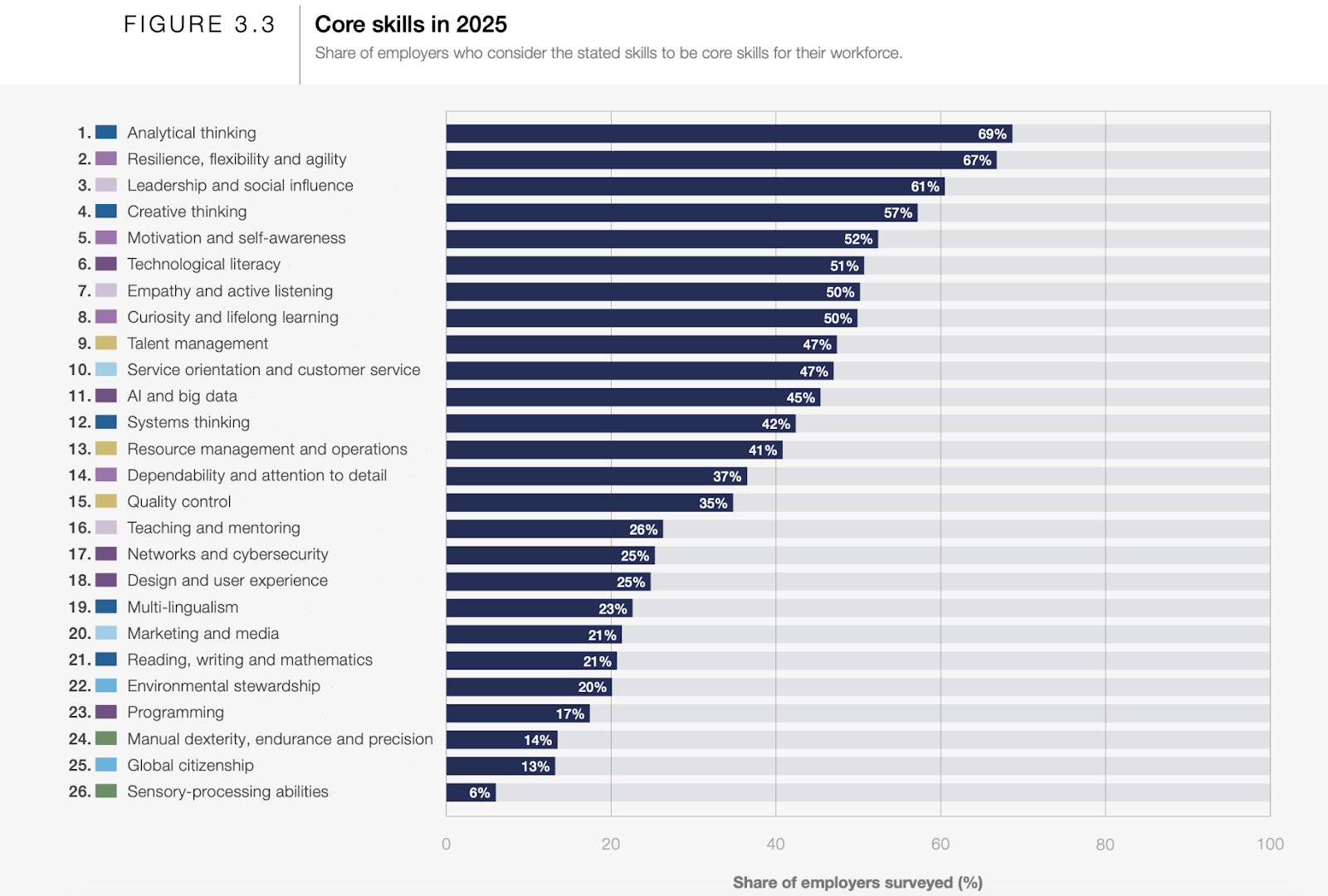
Leadership soft skills are now the core operating layer for technical and AI‑driven teams, and this focus is intensifying today. Social influence and resilience, along with flexibility, agility, and analytical thinking, are the top skills team leaders consider essential.
While hard skills define what a team can build, interpersonal competencies influence how quickly and for how long a team can sustain its output.
In high-pressure environments, you probably often see leaders focus on leadership microlearning or subscribe to events and hackathons to improve soft skills. This is crucial, as the ability to coordinate human effort is now even more valuable than individual technical expertise, according to the report we mentioned above.
Quick overview of the top leadership soft skills for a tech-driven world in 2026
Leadership soft skills in the tech niche are the interpersonal and cognitive abilities that determine how effectively leaders guide and support teams. These skills directly influence flexibility and the speed of adoption in continuous learning, as well as in collaboration and communication with employees. In that aspect, we highlighted the most critical leadership soft skills in 2026:
- Emotional intelligence – regulating emotions to maintain trust and prevent burnout and decision fatigue in high-pressure AI environments.
- Psychological safety – enabling the team to challenge ideas and experiment with AI and tools without fear of blame.
- Communication – translating data insights into clear direction for hybrid and remote teams, using agile approach and tools like Slack, Zoom, Notion, Figma, shared docs, and collaboration platforms.
- Cognitive clarity – reducing bias and keeping teams focused on high-priority work.
- Coaching and feedback – social influence that gives actionable guidance tied to measurable outcomes: team velocity, skill development, and innovation.
1. High Emotional Intelligence (EQ) and Empathy in Data-Heavy Environments
Emotional intelligence consistently appears in top Google SERP results, nonfiction bestsellers, and major publications and reports on leadership. For example, Daniel Goleman’s work on ‘Emotional Intelligence’ outlines how empathy shapes leadership effectiveness, especially in high-pressure environments. Its relevance has intensified with the adoption of AI; here, we often see how teams may worry about constant upskilling pressure.
On Reddit forums such as r/management and r/askprogramming, recurring feedback from employees in AI-integrated workplaces highlights similar themes on how leadership pushed tools without explaining the bigger picture or how teams were confused about AI implementation.
These comments reflect emotional mismanagement. Leaders who recognise emotional signals, like stress and burnout or decision fatigue with defensiveness, can respond proactively before morale drops or performance declines.
According to In cyber security times, in modern cybersecurity environments, professionals operate in highly data-intensive settings where millions of logs, alerts, and threat indicators compete for attention daily. While technical expertise is essential, high Emotional Intelligence (EQ) and empathy are equally critical for effective security operations.
How EQ-driven leaders sustain performance in continuous upskilling cultures
Emotional intelligence (often called EQ) is the ability to manage and respond effectively to emotions — both your own as a leader and those of others, including your employees. Transformation initiatives are significantly more likely to succeed when leaders demonstrate strong change in communication and empathy behaviours. EQ includes five core abilities:
- Self-awareness – knowing what you’re feeling and why
- Self-regulation – controlling impulsive reactions
- Motivation – staying driven without external pressure
- Empathy – understanding others’ emotions
- Social skills – managing relationships and conflict
Without it, miscommunication rises and trust declines, facing low performers:
- Low EQ: reactive decisions, ego-driven defensiveness, and blame shifting.
- High EQ: measured communication, transparency, and psychological stability.
2. Psychological safety as a performance metric
One of the most significant findings in organisational behaviour came from Google’s Project Aristotle. This study sought to understand why some teams succeeded while others with similar talent levels failed. The researchers found that psychological safety was the most important factor.
Psychological safety exists when team members feel they can take risks or admit mistakes without facing professional penalties. In a software development context, this safety level impacts:
- Review quality: For example, developers are more likely to offer honest critiques.
- Incident reporting: Engineers can flag system vulnerabilities before they cause outages.
- Innovation and AI: Junior staff feel comfortable proposing unconventional solutions and using new AI solutions.
Leaders who practice active listening and emotional regulation create this environment. These behaviours are not just social preferences; they are requirements for maintaining a reliable deployment pipeline.
3. Communication across hybrid and remote teams
Top-ranking competitor content repeatedly identifies communication as the most important soft skill. Digital leadership communication now translates complex data into direction, and team leads clarify decisions through digital platforms such as Slack, Zoom, shared documents, and virtual collaboration spaces, including metaverse-style environments. It also includes:
- Aligning remote and hybrid teams across time zones
- Preventing misinterpretation in async communication
- Reducing information overload
- Clarifying AI-generated insights and much more
Employees often feel frustrated because of context gaps. These are situations where leaders think everyone is aligned, but the alignment isn’t actually there. Some people may not understand the background or reasoning when it has not been clearly explained.
Or the situation, where a short message in Slack may be seen as an order, even if it was only an idea. Without tone or a clear explanation, people may treat written messages as policy or otherwise use cliché language that could be misunderstood or sound generic without alignment. This simply creates confusion.
4. Developing cognitive and strategic clarity
Effective leadership in tech requires a shift in how you process information and, importantly, how you solve problems. Prominent leaders move from being individual contributors to becoming talent multipliers.
After reviewing leading nonfiction works in the leadership space, particularly those focused on systems thinking, and a consistent theme of cognitive and strategic clarity, here are the foundational soft skills from the bestselling authors:
- ‘The 5 Elements of Effective Thinking’ by Edward B. Burger and Michael Starbird shows that deep understanding starts with mastering simple concepts and directly supports strategic clarity in tech environments. When you focus on the Earth element (attaining a firm foundation), you ensure your team doesn’t build complex features on top of misunderstood requirements.
- ‘Good Strategy Bad Strategy’ by Rumelt: A good strategy begins with a clear diagnosis of what is actually wrong. It is not based on ambition alone or inspiring words. It is an accurate diagnosis and a cognitive interpersonal capability: when a leader clearly defines the real problem, the team gains focus.
- ‘Thinking, Fast and Slow’ by Kahneman: The work explains human judgment or how people make decisions, and how their thinking is often biased. It shows that leaders often use quick, intuitive thinking when a more careful analysis is actually needed. This book strengthens awareness of overconfidence and risk assessment.
- ‘Multipliers’ book explores how leaders amplify the intelligence of their teams rather than dominate decision-making. Cognitive clarity means creating environments where experts think deeply and independently, rather than executing unclear directives.
- ‘Scrum: The Art of Doing Twice the Work in Half the Time’ by Jeff Sutherland: Scrum framework is a way to organize teams so they can deliver work with fewer delays. A leader’s role here is to remove anything that stops the team from finishing a task. By mastering the soft skill of facilitation, they can help the team maintain a steady velocity without burnout.
5. Coaching and feedback as the final pillar of leadership soft skills
Leaders who coach regularly see 12-18% higher team productivity and 28% lower turnover. Tech environments often prioritize analytical thinking and use metrics to estimate results: velocity, uptime, deployment frequency, and ROI. Yes, performance in result-driven teams and cultures is usually measured with numbers — even when the topic is soft skills like coaching or feedback.
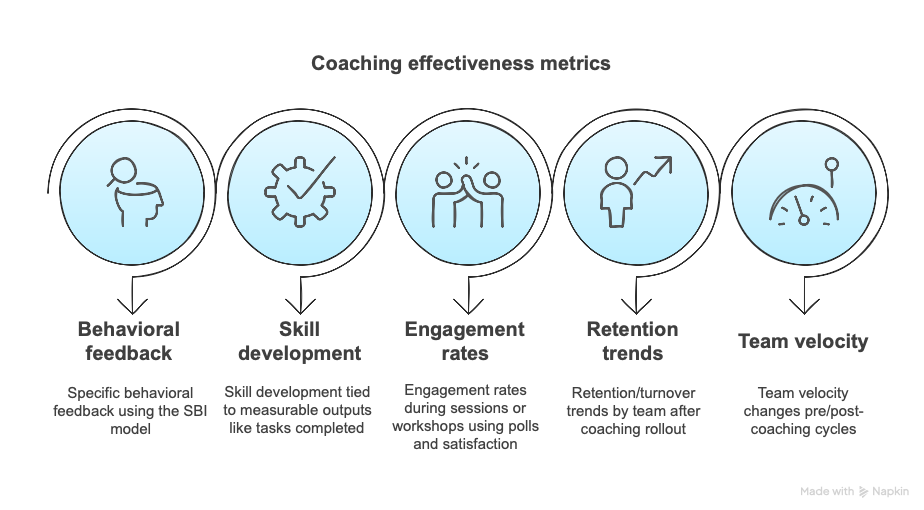
Organisations and leaders who build coaching into daily work see improvements in how tasks are done and, overall, stronger innovation. Effective coaching results through the dashboard-style metrics could be built on:
- Specific behavioural feedback (Specific behavioural feedback or SBI model: sprint reviews, demo, progresses with situation, behavior, impact notes)
- Skill development tied to measurable outputs (e.g., tasks completed post-training)
- Engagement rates during sessions or workshops (workshop polls, satisfaction)
- Retention/turnover trends by team after coaching rollout
- Team velocity changes pre/post-coaching cycles
To wrap this up, for leaders, it is also crucial to give feedback in line with proven soft skills practices. Effective feedback requires consistency, as well as time and space to reflect. To address this, many leaders use structured microlearning. This approach breaks skill development into focused sessions that fit into busy schedules. It allows leaders to gradually build soft skills.
Trust is another real currency of high-performing teams and leadership soft skills. The organisations that move forward the fastest are not doing it because of formal policies. They move forward because their teams use agile approaches and feel psychologically safe. Leaders are transparent and trust their employees with respect and care.